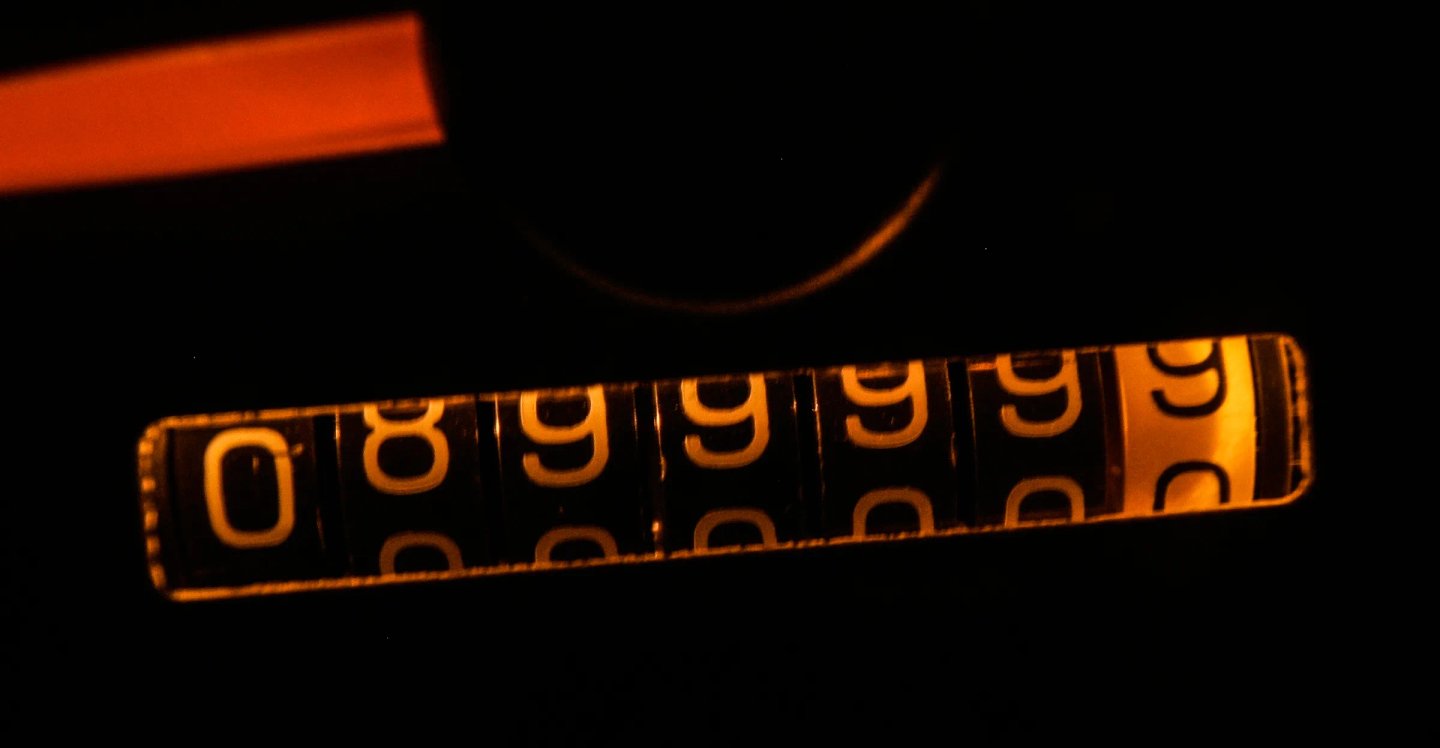
A hundred miles costs about $10 at American wholesale car auctions. That is the price gap between a car on 79,800 miles and one on 79,900. The next hundred miles, from 79,900 to 80,000, costs $210.
Those numbers come from Nicola Lacetera, Devin Pope and Justin Sydnor, who had the records of more than 22 million sales at such auctions between 2002 and 2008. The average car was four years old, had done 57,000 miles and fetched $10,301. At every 10,000 miles, from 10,000 up to 100,000, the price has a step in it of $150 to $200. Between those marks it slopes down gradually.

Rows of cars in a yard, seen from above. The American data covers more than 22 million cars sold to dealers.
Wear cannot explain that. A car does not wear faster in the hundred miles around a round number. The researchers also looked at warranties and odometer fraud, and neither accounted for it. The neatest check came from Canada, where odometers read in kilometres. In 289,055 Canadian auction sales the step sat at every 10,000 kilometres, averaging CAN$184. At the points where those cars passed 10,000 miles there was nothing. So buyers respond to the digit that changes and not to the distance.
Psychologists call it left-digit bias: we read the first digit fully and the rest only partly. The economics are simple. About 30% of what a car loses per 10,000 miles falls at the moment the digit turns. Cars that depreciate quickly therefore have bigger steps. In the American data those included BMWs, Mercedes, Corvettes and Jaguars, against small steps on Honda Accords.
Who is making the mistake
Only licensed dealers buy at these auctions, and you might expect them to see through this. They do. The experienced ones were more likely to buy the dearer cars just below the mark. They are paying for the mistake of someone who is not in the room: the private buyer who will later walk around their forecourt and read 80,100 miles differently from 79,900.
That buyer is not stupid either. The researchers work out that the error costs a buyer about $75 up front, on the purchase of a car. Nobody spends a week thinking about that. Added up, the mispricing in their data came to $2.4 billion, most of it money moving from one party to another.
The sum in euros
Florian Englmaier, Arno Schmöller and Till Stowasser found the same in more than 63,000 listings on the German site mobile.de from the summer of 2009: Golf, Astra, 3 Series, A4 and A-Class, averaging €13,209. Those are asking prices and not sale prices, but the shape is the same. Between the marks the price falls by €63 per 1,000 km. At the mark it falls by €367, whether the seller is a dealer or a private owner.
You can do sums with that. Say a seller is on 99,400 km and wants one more 600 km trip before the car goes online. That trip then costs not €38 but over €400. A valuation that looks only at mileage in round thousands misses it.
For a buyer the sum runs the other way, with one catch. Buying just above a mark saves the step, but they still pass the next one later. Take two buyers who each drive about 30,000 km. The first buys on 99,900 and sells on 130,100, passing four marks. The second buys on 100,100 and sells on 129,900, passing two. On the German averages that is €734 for the same car and the same use. The rule is cheap: buy just above a round number and sell just below one.
Some sellers already do. In the American data, dealer supply was clearly higher just before each mark from 60,000 miles upwards. A car offered at 99,800 km may be a coincidence. It may also belong to someone who did not need this article.
Where it may not hold
None of these figures is about enthusiast cars. They are Golfs and Accords a few years old. We did not find a comparable study of €60,000 cars, so what follows is reasoning.
There are good reasons to expect a smaller step. The buyer of a Porsche 964 is not comparing forty cars but three. They read the folder of invoices, and at 3,000 km a year that says more than the odometer. On older cars the first digit may be missing as well. Many cars into the 1980s had five-digit odometers that go back to zero after 99,999.
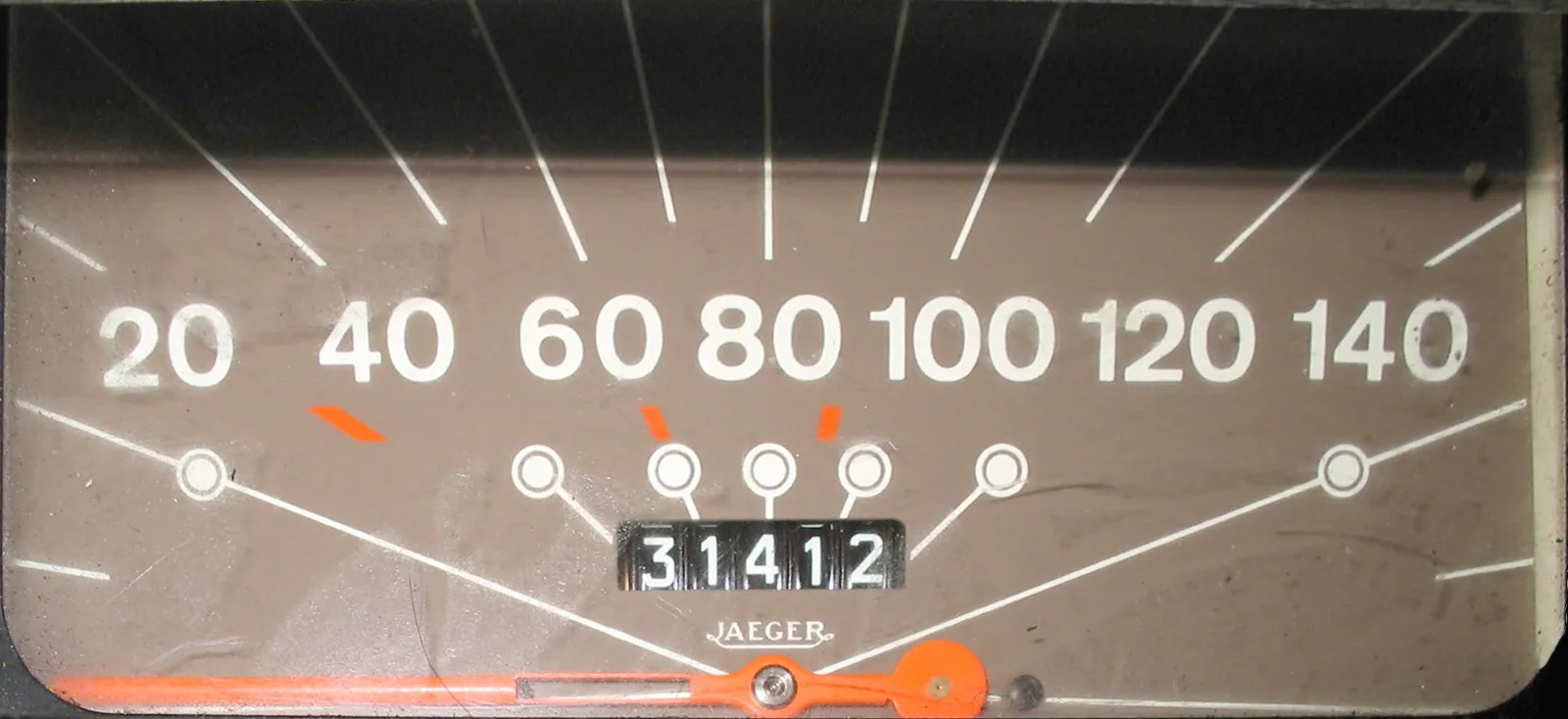
The odometer of a 1986 Citroën Acadiane, with five digits. Whether this car has done 31,412 km or 131,412 km is not on the dial.
There is also a reason the step might survive, however good the buyer. Englmaier and his colleagues point to search costs: people compare within the group a site shows them. On classified sites that group is round. The mileage filter on AutoScout24 runs to 100,000 in steps of 10,000 and then carries on with 125,000, 150,000 and 175,000. A car with 100,300 km falls outside a search for 'up to 100,000' and lands among cars with nearly 125,000. That is no error of judgement by the buyer. They simply never see the car.
In Lacetera's data the step at 100,000 miles was no bigger than the others, incidentally. The magic number was not there. Whether that filter changes things for kilometres on classified sites has not been measured.
Sometimes you can see the step without driving at all. A British car on 62,100 miles appears on a Dutch site at 99,940 km, and a hundred miles later at 100,101. In England the last mark for that same car was at 60,000 miles and the next is at 70,000.
Images: Odometer Flip (15806065471) by Tony Webster from Portland, Oregon, United States (CC BY 2.0); Photo by giantasparagus on Pexels; Speedometer Odometer by Georg Wiora Dr. Schorsch (CC BY-SA 3.0). Images resized.

