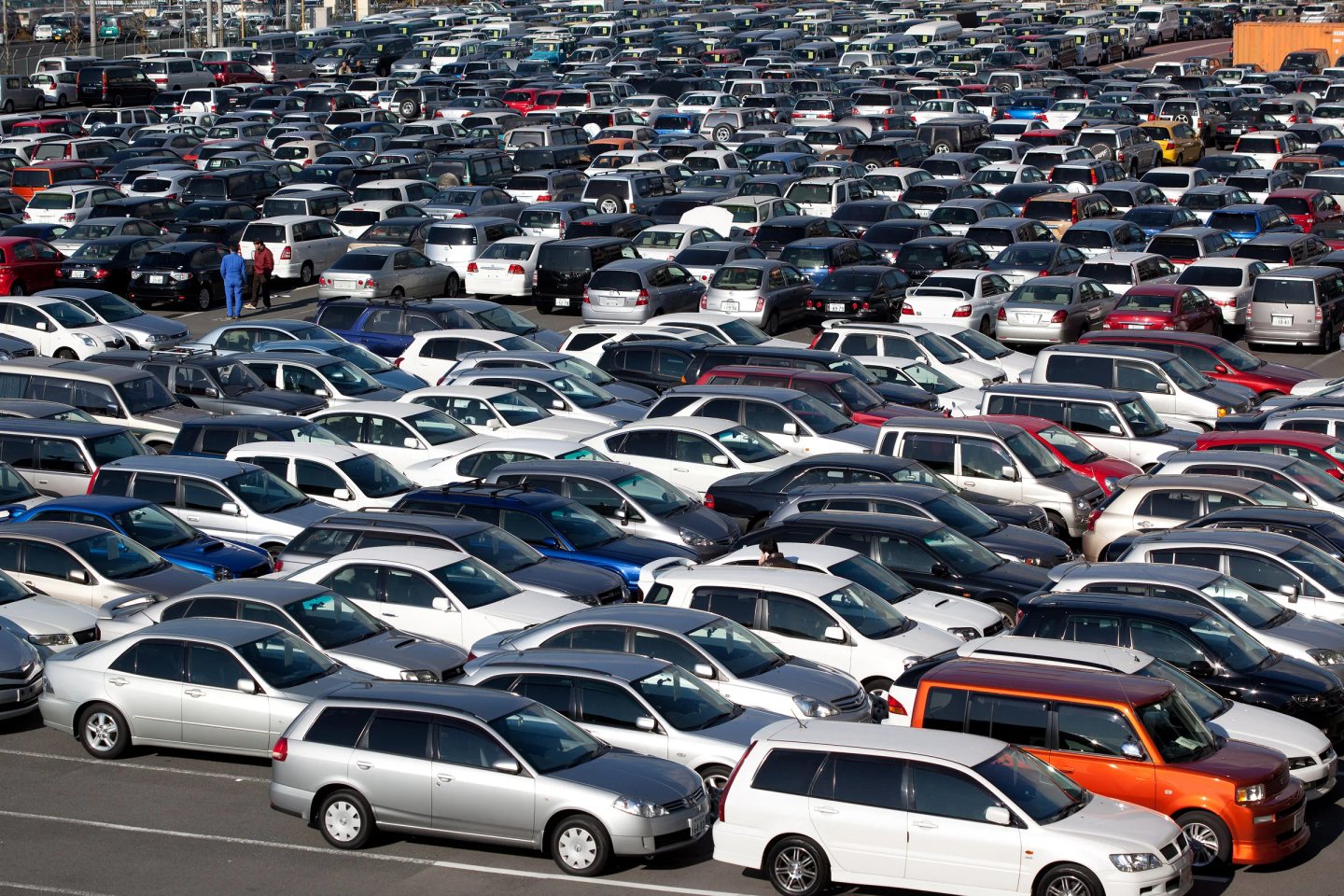
A Japanese dealer can buy a car they have never seen on the strength of one sheet of paper with a number on it. A European buying an enthusiast car drives there. They take a paint gauge and perhaps an inspector, and still do not know everything afterwards. At USS, a listed auction company with 19 sites, 3,202,002 cars were consigned in the year to March 2025 and 2,145,158 were sold. USS has each car inspected before it goes into the sale. Since 1995 dealers have also been able to take part by satellite television, and since 2005 over the internet.
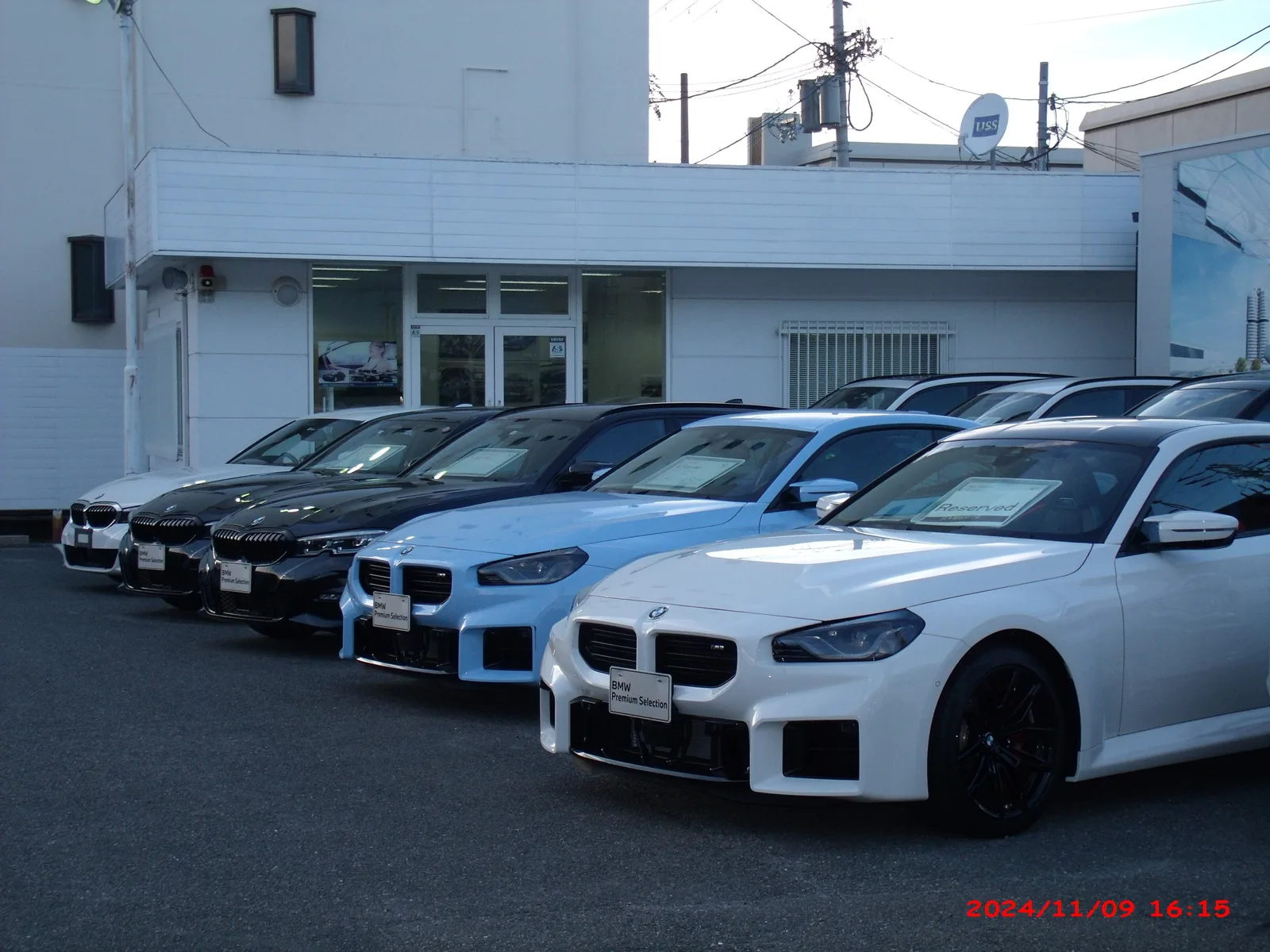
A BMW used car site in Higashi-Osaka, November 2024. On the roof is a dish with the USS logo.
That sheet answers a problem for which an economist in the late 1960s could hardly find a journal. George Akerlof described a market where buyers cannot tell good used cars from bad ones. They bid for the average. Sellers of good cars pull out and the average falls. The American Economic Review told him it did not publish papers on subjects of such triviality. The Review of Economic Studies said the same. At the Journal of Political Economy the objection was that economics would be different if he were right. The paper appeared in the Quarterly Journal of Economics in 1970, and in 2001 he shared the Nobel Prize.
Akerlof named some counterweights himself: guarantees, brand names, chains, licences. Japan has one he did not list.
What the sheet says
At USS the scale runs from S and 6 for nearly new cars down to 1 for flood damage. A 4.5 means under 100,000 km and an interior of B or better. Minor repairs would bring it close to a 5. So there is a choice built in: at 120,000 km a car cannot be a 4.5, however tidy it is. Beside the grade is a damage map with codes that differ by auction house. At CAA, A1 is a scratch of about 10 cm and U2 is a dent the size of a tennis ball.
The letter that counts is R. USS defines it as damage to the body skeleton from a traffic accident or other disaster. A rule of thumb from the Japanese motoring press: what is welded counts and what is bolted on does not. A Skyline GT-R with a replaced door gets no R, and one with a straightened chassis rail does. That line does not stop at the trade. Under Japan's fair competition code for car sales, dealers have to state in advertising and on the forecourt whether a car has that repair history. The words "accident free" in a European listing have no such line and mean what the seller means by them.
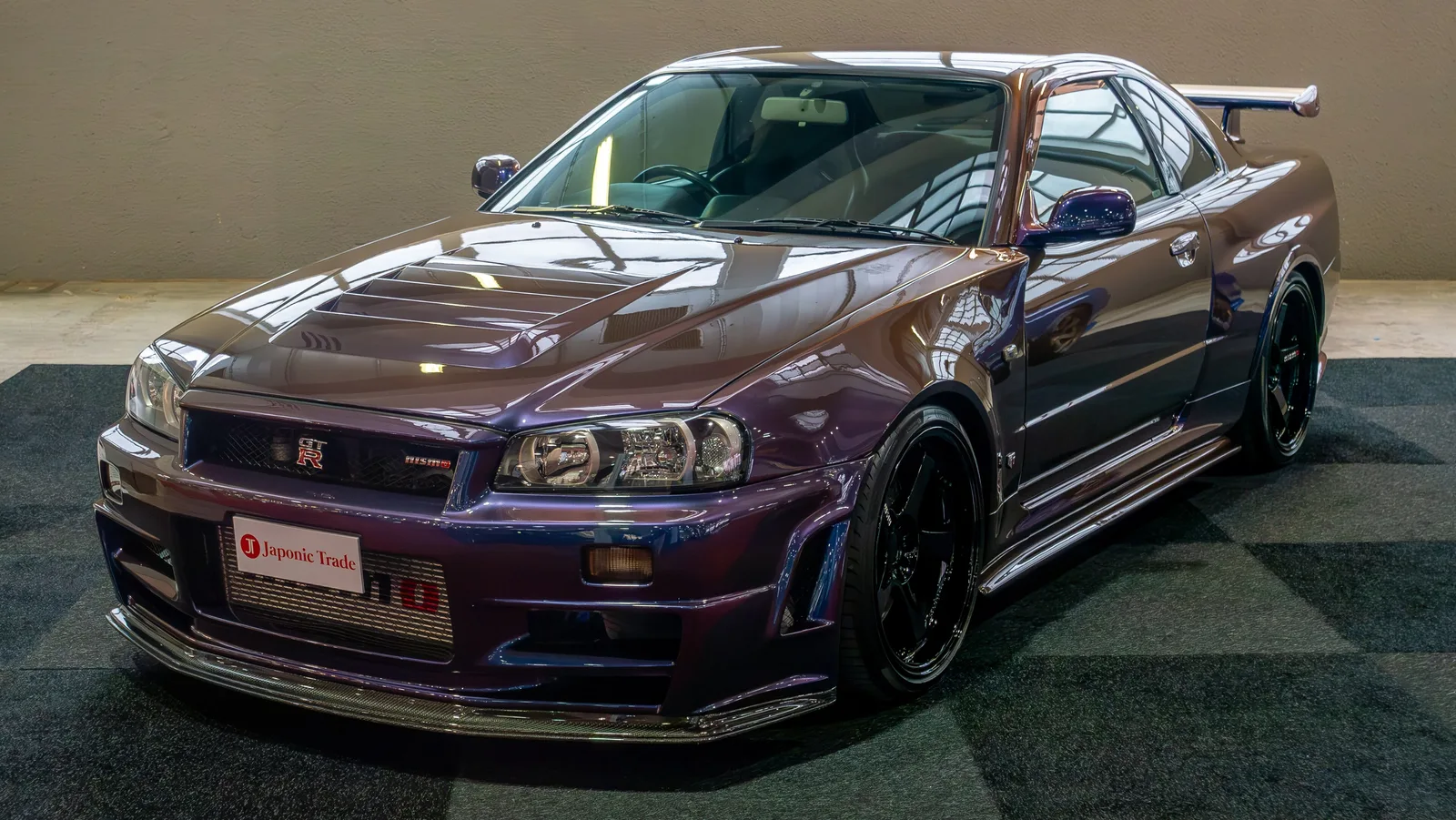
A Nissan Skyline GT-R V-spec of the R34 generation at the Brussels Motor Show in 2024.
A sheet less independent than it looks
It is tempting to see an independent inspector here, but the inspector works for the auction house. USS says its certified inspectors examine each car on the basis of the seller's declaration. At TAA, anything needing a road test or dismantling rests on that declaration. Members cannot hold USS responsible over a difference in rating. A 4.5 also means something different at TAA, where a computer calculates the grade from the data entered. One Australian importer checks for rust regardless, because a 4.5 can rust too.
Outside Japan it gets weaker. In Pakistan, checking auction sheets is a paid service because altered copies circulate, and traders advise checking every sheet against the original database. The USS claims rules stop about where a European enthusiast begins. Price-reduction claims are in principle excluded for R cars, cars from 100,000 km, cars of fifteen years or older and cars that have been exported. An R34 coming to the Netherlands falls outside on at least two counts.
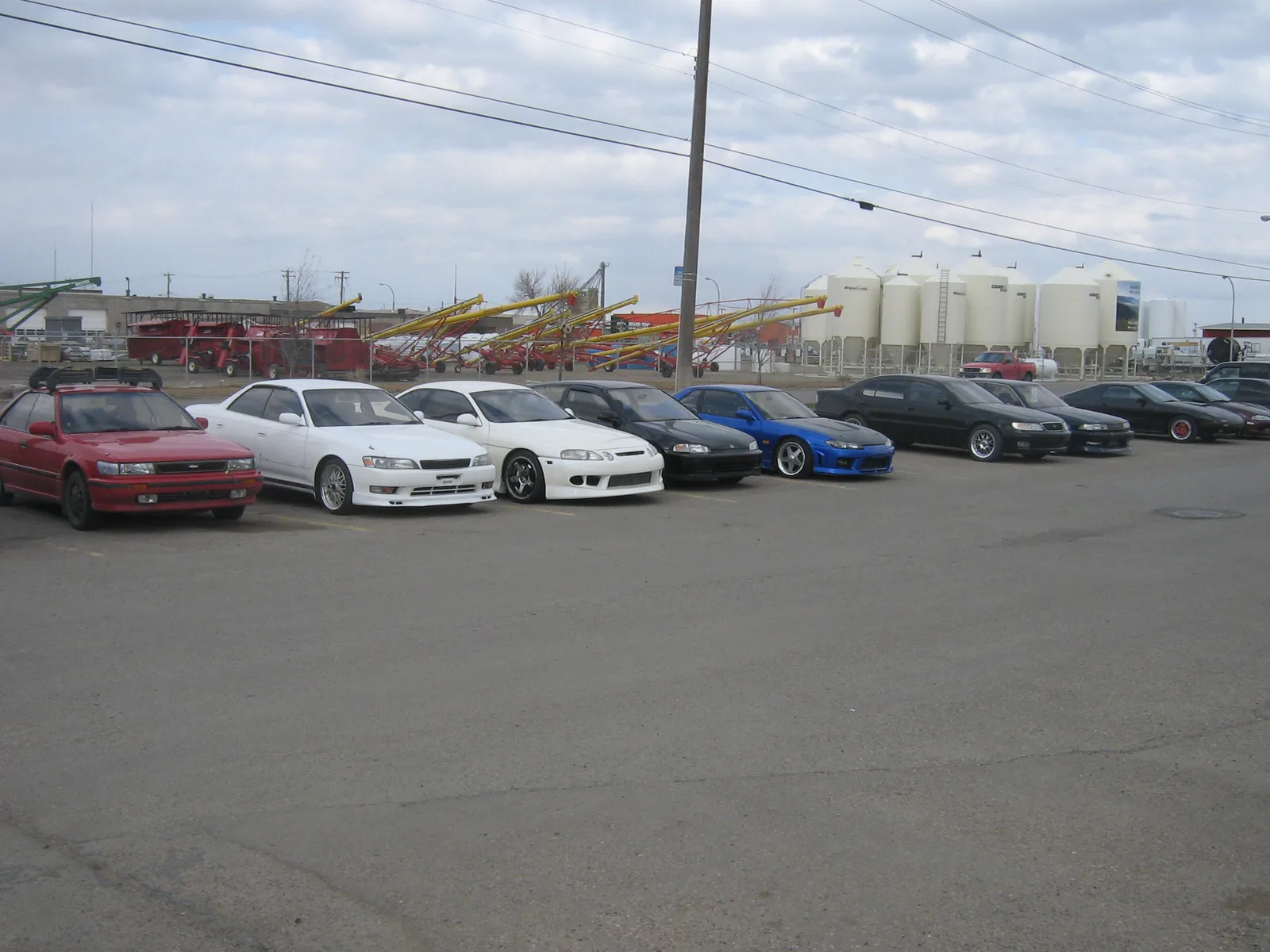
Japanese cars at an importer in Canada, where cars of fifteen years or older may be brought in.
Why it works anyway
The sheet works because its readers come back. A Japanese dealer buys week after week at the same auction, and sells there too. If a house keeps grading high, the dealer buys at a competitor. The inspector who grades the dealer's car today grades what the dealer buys tomorrow.
There is also a measurement. In the 1980s AUCNET began selling cars by television to dealers who never saw them. Ho Geun Lee, Christopher Westland and Sewon Hong compared its prices around 2000 with those at ordinary auctions. On AUCNET they were higher, mainly because better cars were offered, but still slightly higher at similar quality. Akerlof's logic would lead you to expect a bigger discount for buying unseen.
Not everyone welcomed this. According to an online summary of a Harvard case study, which we have not been able to read ourselves, the dealers' association urged members to cancel their AUCNET sign-ups, and more than half of the 1,000 prospects gave up their reservations until complaints about competition brought in the government. A dealer whose margin comes from what customers in the dealer's own region do not know has little use for a national grade.
Why Europe only has half of it
Europe does have grades, for the trade. Britain has had a five-grade scale from the trade body NAMA since 2013, and Manheim grades cars to those definitions. BCA has its own system. One British auction boss wrote in Fleet News that a standardised scale would cause confusion. The private buyer who later gets the car from a dealer does not as a rule see that sheet. The dealer knows the grade and the buyer does not.
For enthusiast cars nothing comparable exists. The seller is a one-off private owner and so is the buyer. Nobody stands on both sides. An auction company that hands out a 3.5 loses that seller to a competitor. The scale itself is a poor fit as well: at 180,000 km a 1973 911 cannot reach a 4 on that sheet, however good it is. On Octane buyers ask their questions in public during the auction. That produces information but no grade, and nobody stands behind it.
The owner of a good car currently helps pay the discount for what buyers cannot see, and has the most to gain from a grade. The owner of a mediocre car still has to sell somewhere. Who in Europe would hand out that grade, and at which auction would the owner of a 3.5 still consign?
Images: Parking lot at HAA Kobe by Laitr Keiows (CC BY 3.0); BMW Official Used Cars at Higashi-Osaka by Mr.ちゅらさん (CC BY 4.0); Nissan Skyline GT-R V-spec, BAS 24, Brussels (P1170369-RR) by Matti Blume (CC BY-SA 4.0); Japanese Import Dealer (2424594968) by dave_7 from Lethbridge, Canada (CC BY-SA 2.0). Images resized.


