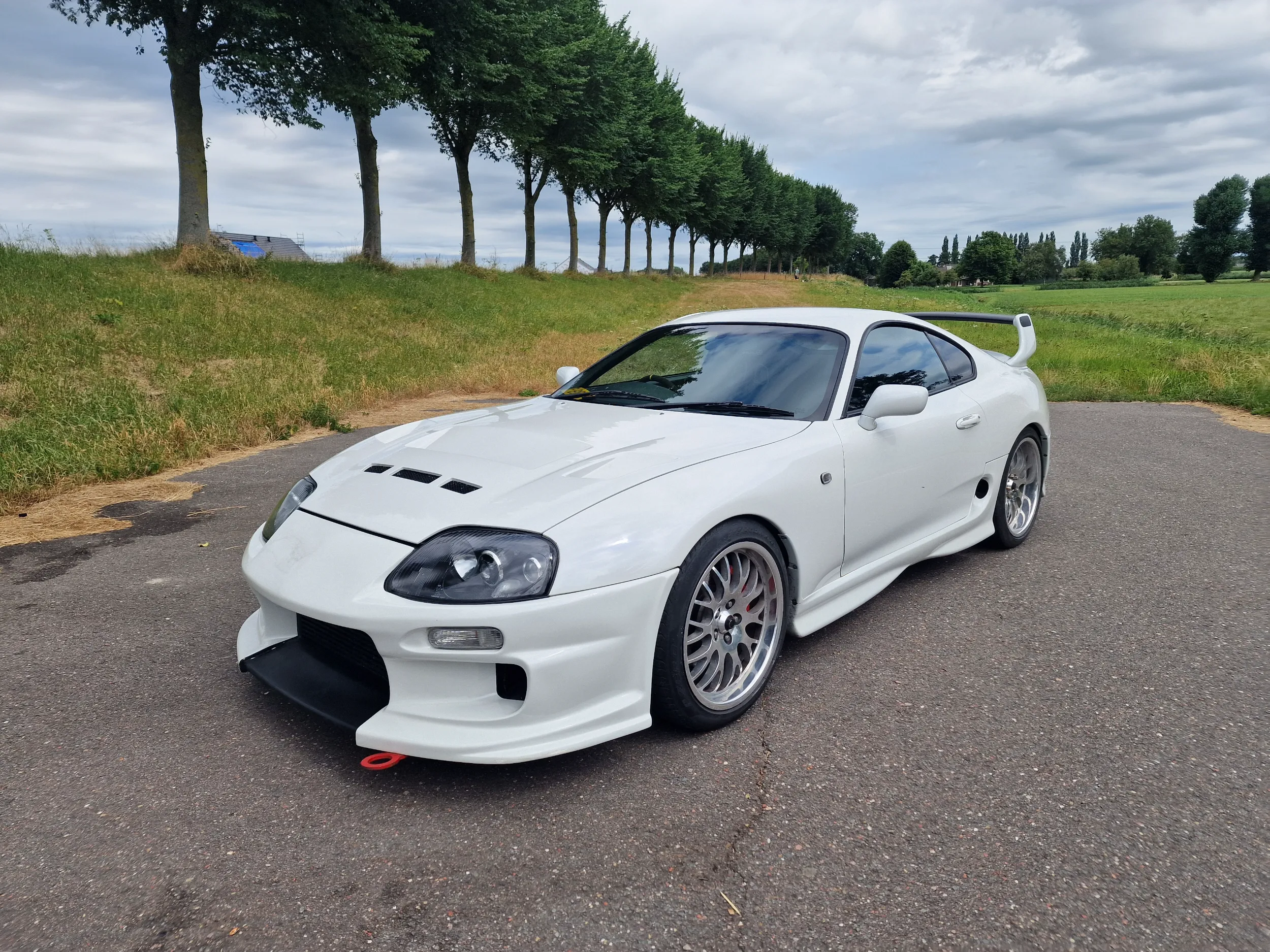
Toyota has played a striking dual role in the car world over the past decades: a global brand building dependable family cars, and at the same time a manufacturer of some of the most sought-after sports cars of the last fifty years. The 2000GT from the sixties is one of the first true Japanese supercars. The AE86, immortalised by Initial D, is Japan's answer to the hot hatch. The Supra MkIV with the 2JZ engine has built its own tuning cult. And the Lexus LFA, although under the Lexus banner, leans on decades of Toyota engineering. Owners of a sporting Toyota do not sell to just anyone. They pass the car on to someone who feels the same way about the brand.
Not sure if your car qualifies? Submit your car and our team will review it
The Toyota Supra MkIV (1993-2002, in Japan until 1998) holds a unique position in the world of Japanese sports cars. With its 2JZ-GTE 3.0 twin-turbo straight-six, the car has become a tuning icon: engines that tolerate 1000+ hp on basic internal components are not unusual. Original Japanese and European specifications differ considerably: Euro-spec cars have the auto button in the steering wheel (no automatic option) and a slightly different exhaust. On classic markets Supras are regularly sold without context: mileage, colour, price. The gap between a Euro-spec twin-turbo manual MkIV in original condition and a heavily modified tuner Supra with unknown mileage history can be many-fold.
The auction format brings together buyers who understand these nuances. A Supra MkIV with proven original condition, low mileage, and documented servicing is gold. The A90 (from 2019, with BMW underpinnings) has its own modern classic market; collectors particularly seek the Premium specification and the rare Initial Edition.
The Toyota 2000GT (1967-1970), only 351 built, is one of the most collectable Japanese cars ever. A 2000GT in concours condition is a museum piece that rarely reaches market. The AE86 (1983-1987), made legendary by touge driving and the manga Initial D, is the entry path for younger Toyota enthusiasts. An AE86 with the 4A-GE twin-cam, rear-wheel drive, and angular bodywork has all the ingredients of a 'Japanese hot hatch'. The MR2 (both the AW11 and later SW20 and ZZW30) represents Toyota's mid-engine experiment with its own collector market.
For sellers of these cult Toyotas, presentation is crucial. An original AE86 in original colour, with proven low mileage and an unstripped interior, can command a significant premium over a modified touge example. Octane brings together international buyers, and for this kind of Japanese outsider that reach is essential.
The GT86 (2012-2020), Toyota's collaboration with Subaru, represents the modern reset of the sports car philosophy: lightweight, rear-wheel drive, affordable. The GR Yaris (from 2020) is Toyota Gazoo Racing's earnest homologation gem for the WRC: 261 hp from a 1.6 turbo, all-wheel drive, limited production of a few thousand per year. For collectors the Circuit Pack specification with factory-installed differentials and refined suspension is the most desirable.
At Octane these modern sporting Toyotas find a community that knows the difference between an early GR Yaris Circuit Pack and a later Sport Pack version, or between a GT86 with factory TRD pack and an aftermarket modification. Document originality, mileage, and complete service history at Toyota or a GR specialist.
Japanese cars have varied rust profiles depending on the market they were built for. A Japanese-market JDM AE86 imported from Japan is generally far better than a European-market car that has weathered years of salted winters. When selling, buyers expect photos of the known spots: on AE86 the wheel arches, sills, and boot floor; on MR2 the subframe attachment and pop-up headlamp mechanisms; on Supra the floor pans and around the bumper mountings. A Toyota with proven JDM import history can attract a premium of five to ten percent.
For Japanese classics, originality is an increasingly important value driver. An AE86 in factory colour (think Red Black Two-Tone, Trueno or Levin specification, original wheels) with an unmodified interior can sell for ten thousand euros or more above a modified touge example. On Supra MkIV, an original Euro-spec twin-turbo manual in original colour (Royal Sapphire, Renaissance Red, etc.) is substantially more valuable than a heavily modified JDM import. For the GR Yaris, factory Circuit Pack or GR Sport Pack specifications and original tyre choice drive price.
For Toyotas imported from Japan, the JEVIC report (Japan Export Vehicle Inspection Center), original Japanese registration papers, and a Toyota Heritage history report are essential documents. They confirm year, original mileage at export, and any specification changes. A Supra MkIV with proven JEVIC report and original Japanese documentation sells far more strongly than a comparable car without that context. For modern models, Toyota's own vehicle history database supplies original specification.
Every car gets a tailored campaign: positioning, spec highlights, and distribution to enthusiasts and collectors across Europe.
The 2000GT in concours condition is by far the most expensive regular Toyota; top examples reach millions. Next come Supra MkIV Euro-spec twin-turbo manuals in original condition, GR Yaris Circuit Pack with low mileage, and original AE86 GT-APEX specifications. For collectors looking at younger classics, the Lexus LFA (technically Toyota engineering) is also of great importance.
Original Supras have matching chassis and engine numbers. Request a Toyota Vehicle History Report or have a Supra specialist do a check. Many MkIVs have received later turbos, ECU modifications, or engine rebuilds. For Euro-spec cars the production volume is limited and provable factory documentation is essential.
Yes, usually positively. JDM imports often have less rust, better service history, and original specifications. A Supra MkIV imported from Japan with JEVIC report and low mileage can attract a premium of five to fifteen percent. Document the import history in full and gather original Japanese paperwork.
With a focus on originality: factory colour, unmodified interior, original wheels (Speedstar Mark I or Mark II depending on specification), Trueno or Levin pop-up headlamp version, and proven low mileage. An AE86 with factory documentation and no touge history is worth many times more to collectors than a race car.
The Circuit Pack is usually more sought after for its factory-installed Torsen differentials (front and rear), the sport-tuned suspension, and the extended cooling. Sport Pack and standard GR Yaris are also collectable, but Circuit Pack is currently the top. Document original colour, mileage, and factory-installed accessories.
The 2JZ-GTE is highly susceptible to modification; many MkIVs have larger turbos, modified ECUs, or even internal engine work. For collectors, original cars are worth far more than tuned versions. Document all modifications clearly and keep original parts where available. A MkIV restored to factory specification can command a significant premium.
The Lexus LFA (2010-2012, 500 built) is technically a Toyota Lexus product. For the LFA specific documentation is required: factory build sheets via Lexus, complete ownership history, and service records at Toyota or Lexus. An LFA with the Nürburgring Package and low mileage can fetch multi-million figures. For an Octane sale, international reach is essential.
Registration document and ownership history, Toyota Vehicle History Report, JEVIC report for JDM imports, factory build sheets if available, all service invoices (especially engine rebuilds and turbo work), photos of known rust spots, engine and chassis number photos, and any competition or track day history. For rare models (2000GT, LFA) additionally a complete ownership chronology and provenance confirmation.
Submit your car and our team will review it within 48 hours