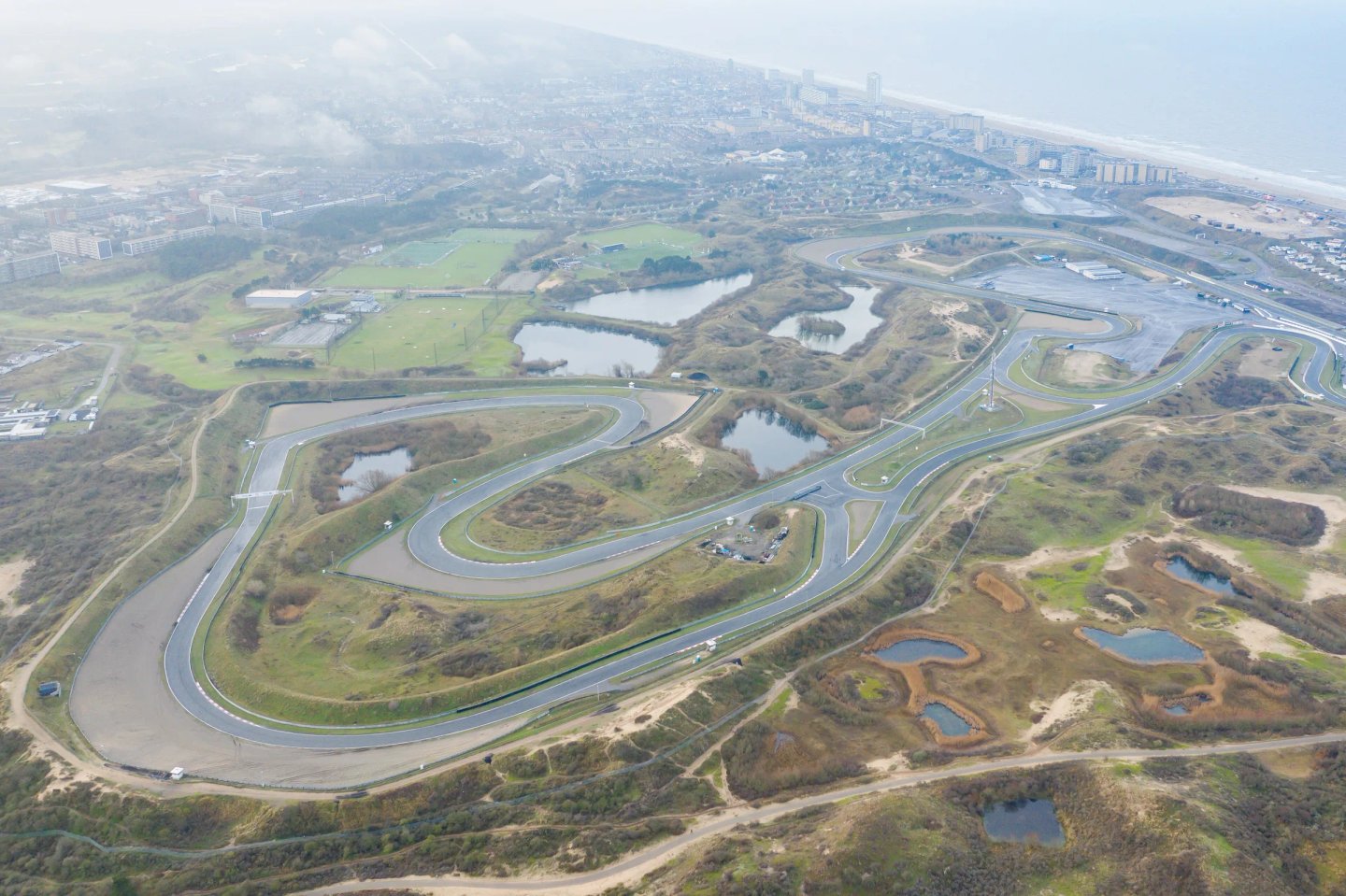
On 12 September 1997 the province of Noord-Holland gave the Zandvoort circuit a new environmental permit. In May 2024 it was replaced by stricter rules. On 24 March 2026 the district court annulled that decision, because the province was the competent authority and the municipality was not. According to press reports, that brought the 1997 permit back. Both municipality and province appealed to the Council of State, the highest Dutch administrative court. Which rules apply in the meantime is itself part of the case.
That looks like administrative law for residents and officials. It also decides what a car may do in the Netherlands. Since 16 March 2020 the daytime motorway limit has been 100 km/h, a measure that followed the Council of State's nitrogen rulings of 29 May 2019. Anything further a fast car can do is only allowed on a circuit. The country has two of any size, Assen and Zandvoort. For one of them, everything hangs on this piece of paper.
Noise as a budget
Exceptions aside, the circuit has a ceiling of 55 decibels on average per day, at points in the surrounding area. An average works like a budget. Every lap by every car takes a little of it. That is why a track day entry brings a second number, for the car itself: 92 dB at most at Zandvoort according to the organiser DriversDays, in the Dutch edition of Top Gear of 23 July 2026. A car above that can be taken off the track. At Assen the same organiser gives about 96 dB. Someone paying GP Elite about €749 for an afternoon at Zandvoort is buying tarmac and a slice of that budget.
Decibels add up in their own way. Every 3 dB doubles the sound energy, so a 95 dB car uses as much budget as two 92 dB cars. That is why the court hearing of January 2026 was about something that sounds small. The old rules allowed a 1 dB deviation and the new ones 0.1 dB. One decibel is 26% more energy, 0.1 dB just over 2%. The circuit's lawyer said this put three big events at risk.
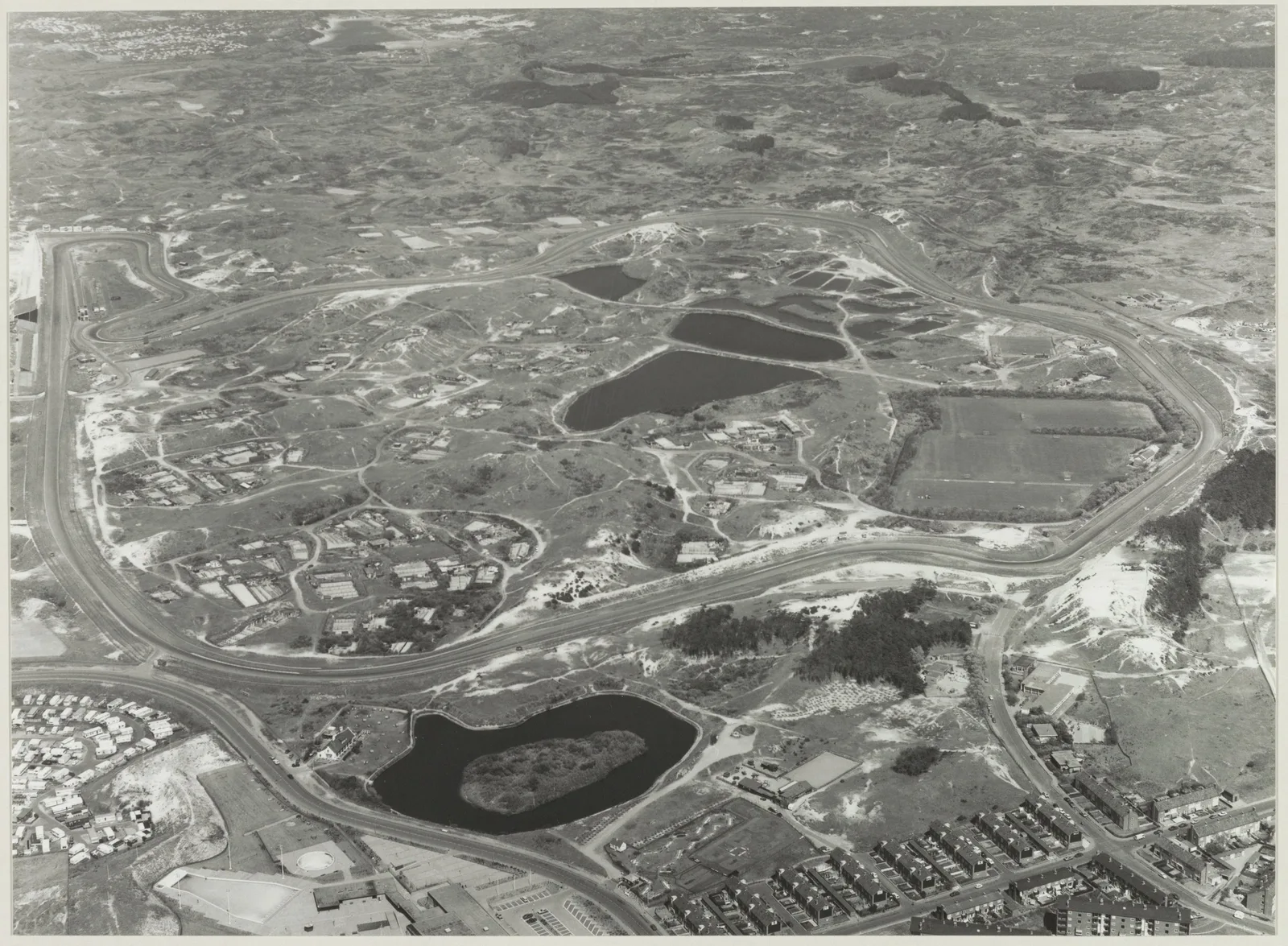
The circuit looking north, with the swimming pool and Vijverpark at bottom left and housing around them.
The exception to the budget is called a UBO day, from the Dutch for exceptional operating circumstances. On such a day the circuit may exceed the norm. The 1997 permit allowed five. Those are the days when the racing classes the public knows take to the track. On every other day, the owner of a 911 GT3 drives within the budget.
Who owns the quiet?
In 1960 Ronald Coase wrote about a sweetmaker and a doctor who were neighbours. The machines of one disturbed the practice of the other. His point was that a dispute like that has two sides. Ban the noise and you harm the sweetmaker. Allow it and you harm the doctor. If they could bargain freely, the right would end up with whoever valued it most, however the judge had ruled.
Around Zandvoort that cannot happen. On one side is a single company. On the other are thousands of residents, a few foundations and a protected Natura 2000 dune area whose sand lizards cannot make an offer. So the question stays with the courts.
The dispute is younger than the circuit. Mayor Henri van Alphen wanted to bring visitors to his seaside town and on 3 June 1939 staged the first race on a street circuit. During the war he is said to have persuaded the Germans to build a long straight road, as a Paradestrasse for a victory parade. The broadcaster NOS and the regional news site NH Nieuws both tell it, NH Nieuws with the caveat that it is a story. We found no document to support it. According to NOS, the rubble of 35 hotels and 700 houses became the base of the circuit after the war, and it opened in 1948. Noise plays no part in that story.
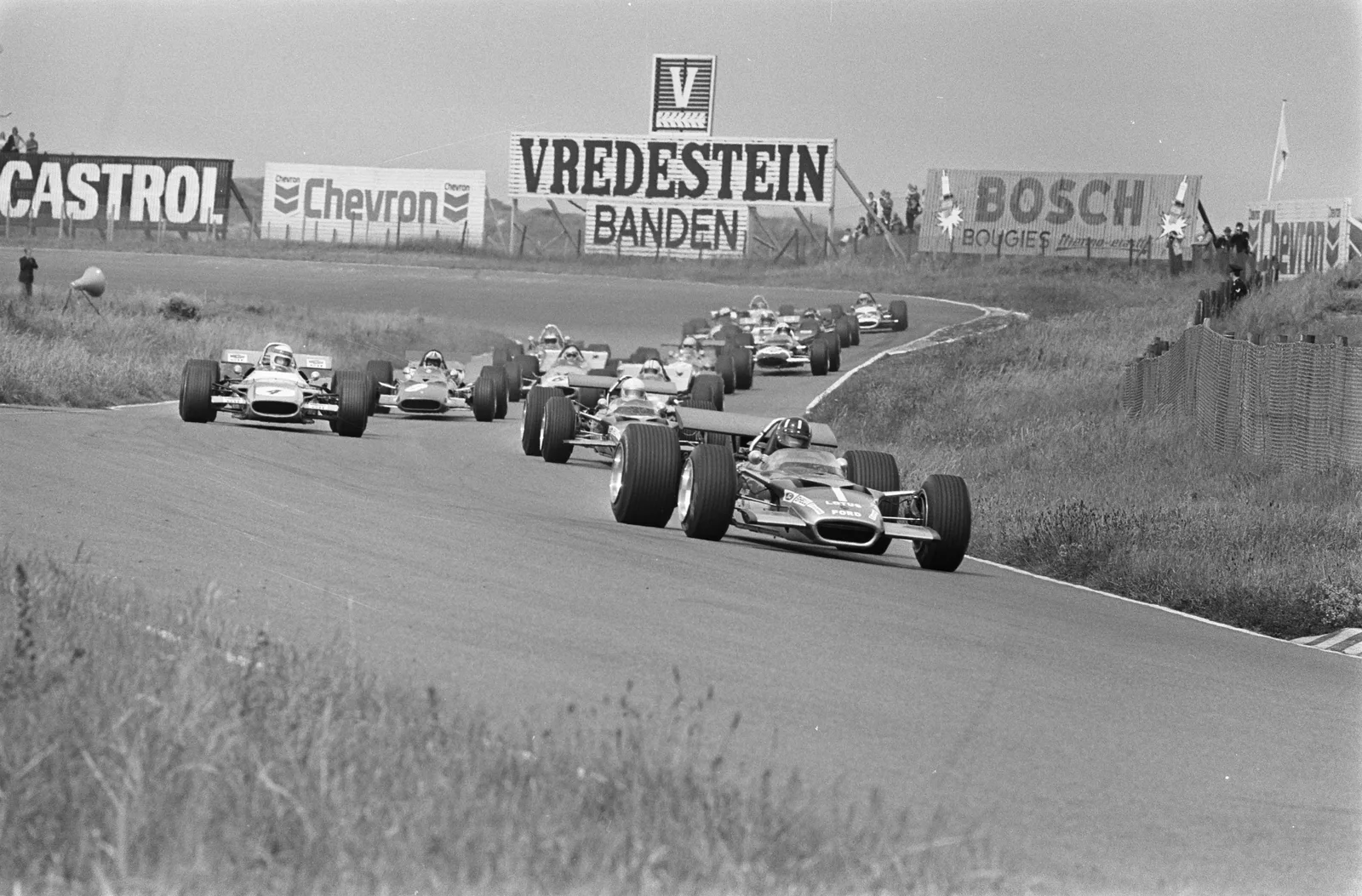
The 1969 Grand Prix at Tarzan corner, with Graham Hill on the right.
In 1983 the circuit had to meet stricter noise requirements. On 25 August 1985 Zandvoort held its last Grand Prix for 36 years. Money was the main problem then, so the noise rules do not take all the blame. From 1997 the conflict is on paper. In 2006 the circuit asked for more UBO days, up to twelve in total. The province agreed and on 21 February 2007 the Council of State struck it out. The Masters of Formula 3 moved to Zolder in Belgium for two years. In 2008 the province had a study made of moving the circuit, to Julianadorp near Den Helder. In 2011 the twelve days came after all. In April 2022 the circuit's director, Robert van Overdijk, spoke of a 35th win in court. So the circuit usually wins, and what it wins each time is a number.
What the Grand Prix cost
Formula 1's return in 2021 had to get past nitrogen. The 2019 nature permit limited the circuit to a maximum of 337 race days a year, 28 fewer than the 365 of 1997. On 5 July 2023 that permit survived at the Council of State. According to the judges, an F1 race emits no more nitrogen than a race on the UBO days of the old permit, and the new one contains a maximum for both days and nitrogen.
The Grand Prix was one weekend. The 28 days apply to everyone. It is a ceiling, and it does not say how many days the circuit really uses. The trade is clear, though: the big event was partly paid for with the small days around it.
What changes when the Grand Prix has gone
The organisers decided for themselves to stop after 2026, because of the cost. That changes the next round. In the cases since 2019 the Grand Prix was always on the scales. In 2022 the interim judge weighed the interests of the race above those of nature. The next permit will be written without that weight, by whichever authority the Council of State names. Twelve UBO days are harder to defend once the biggest event has gone, and we do not expect the budget to grow.
For an owner, the outcome will not appear in a ruling. It will appear on the entry form. On 23 July 2026 that said 92 dB. That is the number to follow, and it is sensible to know it for your own car before someone with a meter tells you.
Images: Formula one Circuit Park in the dunes of Zandvoort in the Netherlands (47856564401) by dronepicr (CC BY 2.0); Overzicht van het circuit met links onder het zwembad en Vijverpark, ziende naar het noorden. NL-HlmNHA 54013940 by Cees de Boer (CC0); Drivers at 1969 Dutch Grand Prix by Evers, Joost / Anefo / neg. stroken, 1945-1989, 2.24.01.05, item number 922-5522 (CC BY-SA 3.0 nl). Images resized.


