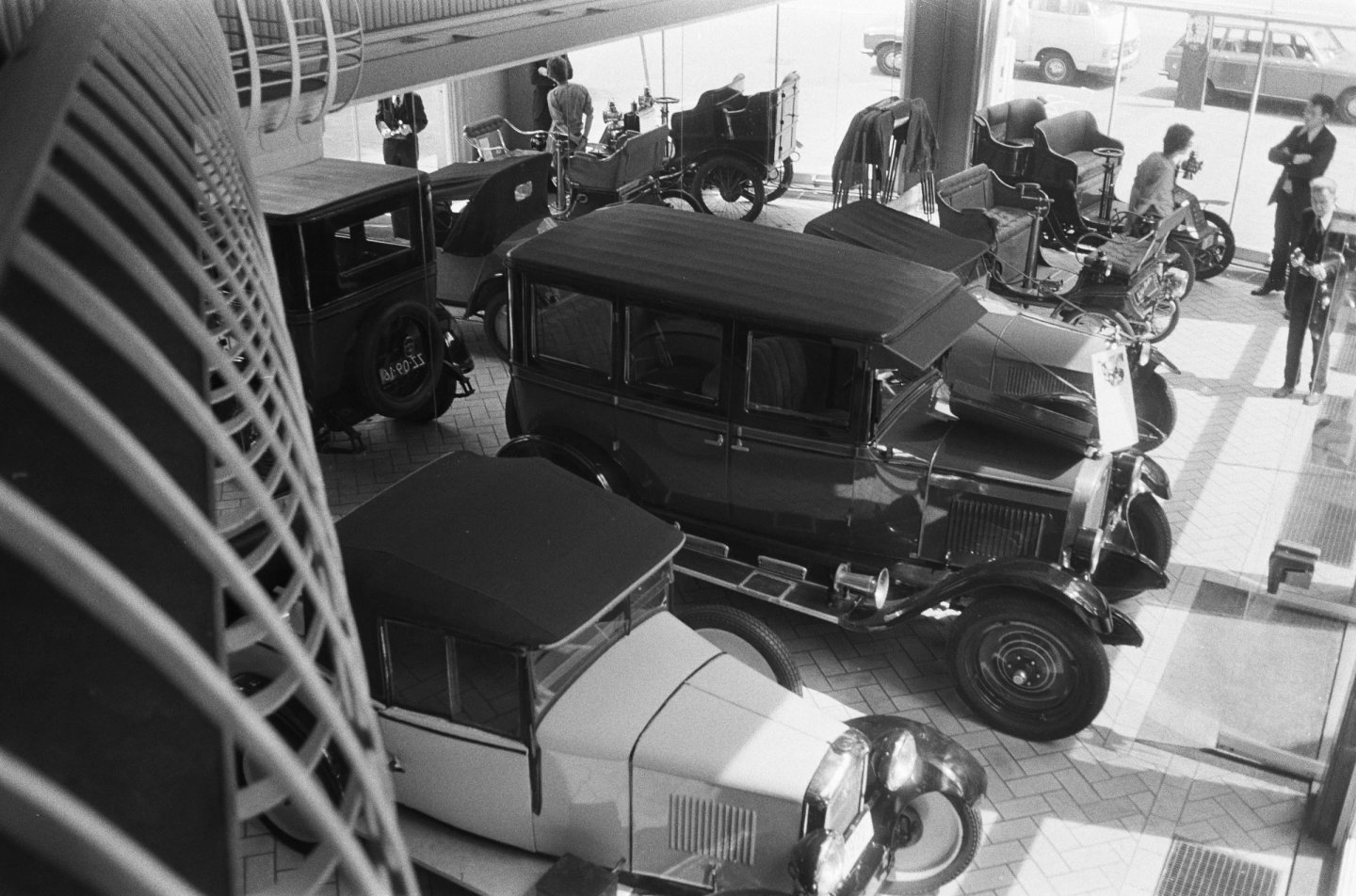
$13,018,950. That is what someone paid on duPont Registry Live in June 2026 for a 2003 Ferrari Enzo, the only one in Rosso Dino. The previous online record was $5.36 million, for a LaFerrari Aperta on Bring a Trailer in 2022. Five months earlier, the same chassis had made $11,110,000 at Mecum in Kissimmee, with an auctioneer and a room. So the same car brought $1.9 million more on a screen.
Those figures come from duPont Registry itself, and five months is a short time for a jump like that. Even so, anyone claiming a room always beats a screen has to start with this car.
At the same time, all ten of the most expensive sales of 2025 happened in a room, according to Hagerty. The dearest online sale that year, a LaFerrari on Bring a Trailer, stopped at $4.48 million. At the five Monterey auctions in August 2026, a car averaged $892,317 according to Classic.com. Online sales in 2025 came to more than 50,000 cars and about $2.5 billion, so around $50,000 each. Rooms stayed at roughly 21,000 cars.
Online has won the middle of the market. The top did not follow, although the Enzo shows it could.
What the room costs
The room is expensive. At duPont, 5% went on top of the hammer price: $12,399,000 plus $619,950. The $11,110,000 at Mecum fits exactly with a hammer price of $10.1 million plus 10%. On a $10 million car that is half a million, and whoever transfers it, it comes out of the proceeds. If the room were just an old habit, that sum would have emptied it by now.
The picture of a full room is wrong as well. The most expensive car ever sold, the Mercedes 300 SLR Uhlenhaut, went for €135 million on 5 May 2022 at the Mercedes-Benz Museum, with invited guests only. The winning bid came from the dealer Simon Kidston, for an anonymous buyer. A Lamborghini Miura SV at Broad Arrow on Amelia Island went for $6,605,000 to someone on the phone. The buyer need not be in the room at all.
An Enzo has 399 siblings
Put the Enzos of 2026 in a list.
- Mecum Kissimmee, January: $17,875,000 and $11,110,000
- RM Sotheby's Arizona, January: $9,300,000
- Broad Arrow Amelia Island, March: $15,185,000
- duPont Registry Live, June: $13,018,950
- Mecum Monterey, August: $12,100,000
- Broad Arrow The Quail, August: $10,675,000
Six times in a room and once on a screen. The screen result comes third of the seven. Colour, mileage and previous owners differ, so a ranking proves little. The screen certainly did not hold the car back. Ferrari built 400 Enzos. Every bidder can look up the last sales and knows what to check. All the auction has to settle is where on that list this car belongs.
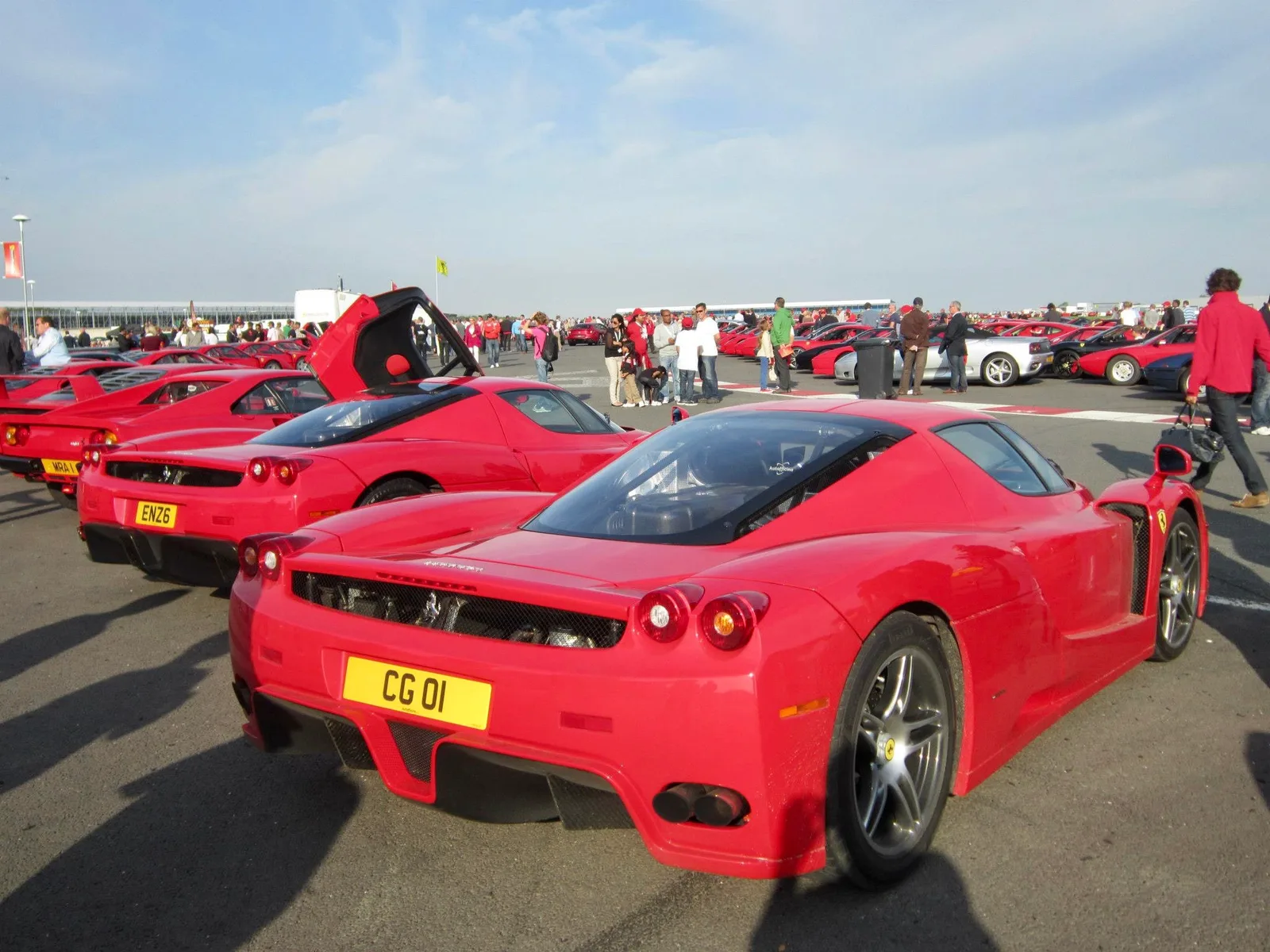
Ferrari Enzos at Silverstone in 2012.
The top lot of Monterey 2026 was a 1964 Shelby Daytona Coupe, at $42,905,000 with Gooding Christie's. Six were built, each with its own racing history. There is no list to set beside it. The top ten of 2025 looks the same: a Mercedes W196 R, a Ferrari 250 LM, a Ferrari F2001, an F40 LM. It also holds new cars and charity sales, where a price cannot be worked back to anything either.
That is where we would draw the line. The room is not there for expensive cars. It is there for cars with nothing to compare them to.
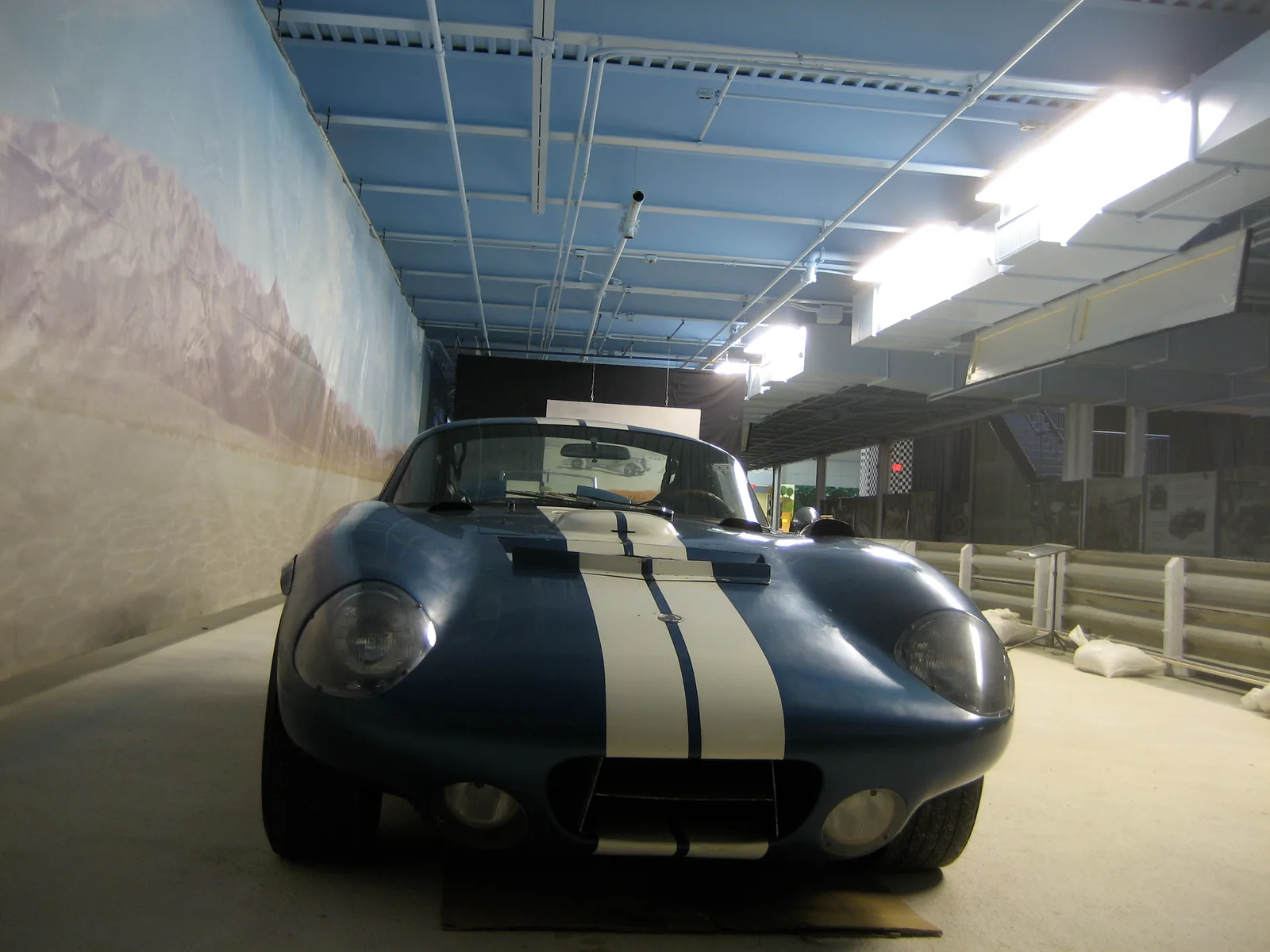
A 1964 Shelby Cobra Daytona Coupe in the Simeone museum. Not the car from Monterey.
What a room does for a car with no list
With a car like that, the best evidence of value is that someone else keeps bidding. In a 1982 model by Paul Milgrom and Robert Weber, an open auction can raise more than a sealed bid for that reason: bidders learn from each other, judge their risk to be lower and go further. That applies online just as well, since everyone there sees the bids climb too. So the theory does not point to the room.
We think the difference lies in who that other bidder is. A bid is only information if you believe there is someone behind it who can pay and who has looked at the car. A house like RM Sotheby's can ask bidders for bank references and a deposit. The car stands in one place for days, where each bidder can send a specialist to go through chassis, engine and body. Online, the car is often at the seller's and the rival is a username. For an Enzo that is no obstacle. For a car where the first question is which parts still date from 1964, it is.
That does not make the room cleaner. In many places auctioneers may take bids out of the air up to the reserve. As far as we know, nobody has measured any of this for cars either. It is our reading.
Publicity explains something else. In 2018 a Ferrari 250 GTO reportedly changed hands privately for $70 million. In the same year a 250 GTO sold at RM Sotheby's for $48.4 million. Everyone saw the second price, while the first is a number from the press. That is why such cars do not all go privately. It does not explain why they stay offline, because an online result is public too.
What this means for an online platform
Octane sits in that middle itself. Our auctions run for seven days and the car stays with the seller. That suits a car whose buyer can look up the earlier sales and knows where the weak spots are. It does not suit a racing car of which six exist. A car like that belongs in a room. We would rather say so ourselves.
The risk to this argument lies in the age of the dearest cars. According to Hagerty, cars over $1 million at auction have become nearly 12 years newer in five years. A newer car has more siblings and a better recorded history, which is what a screen needs. Each year more of the top falls under the rule of the Enzo, and the room is left with pre-war cars, racing cars and one-offs. That may prove too little to fill five auctions in one week. And if the next Daytona Coupe makes $40 million online, this article is wrong.
Images: Oldtimers voor de veiling, Bestanddeelnr 927-9881 by Fotograaf Onbekend / Anefo (CC0); Ferrari Enzos at Silverstone in 2012 by Ank Kumar (CC BY-SA 4.0); Shelby Cobra Daytona Coupe (Simeone) 01 by Peter & Laila (CC BY 2.0). Images resized.


