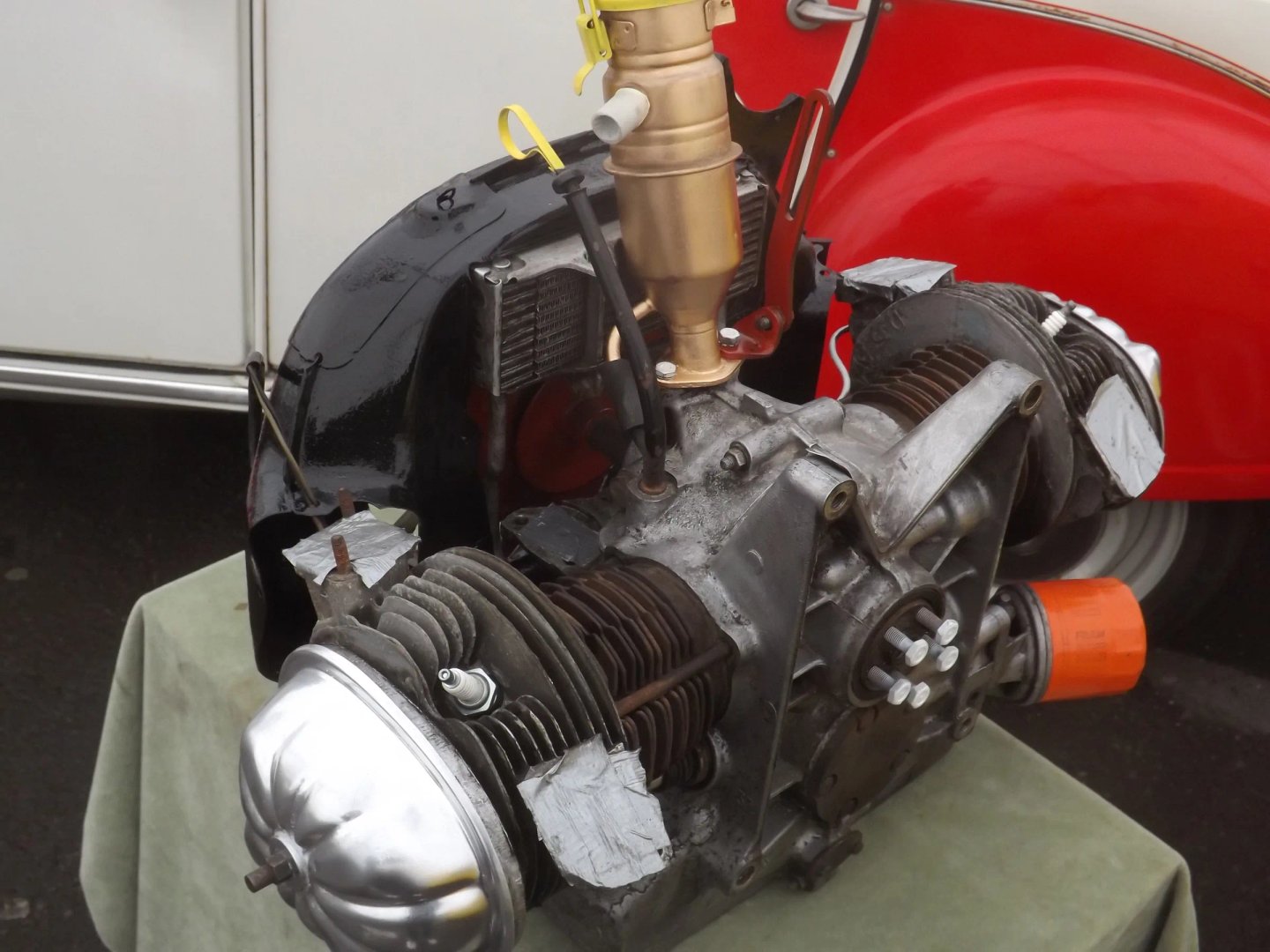
The usual answer is the simplest car you can find, and in the Netherlands that quickly means a Citroën 2CV: two cylinders, air-cooled, no radiator, no water pump, no thermostat. What is not there, a beginner cannot break.
That answer lumps two things together, simple and known. A simple car has few parts. A known car has many people who have already broken it and written something down. For a beginner the second matters more, because the hard part of fixing a car is seldom the fixing.
Look at what a beginner actually does on a Saturday. The car will not start after a night of rain. Something is dripping. A bolt snaps, a connector will not go back, the part that arrives looks different from the old one. The job itself takes an hour. Working out what is wrong, which part it should be and whether to dare start takes the weekend. In 1961 George Stigler wrote a famous paper on what it costs people to find information. Economists call those search costs, and for a beginner they are the biggest costs of all.
Search costs fall with the number of people who searched before you. A forum has answers only if it has owners. A dealer stocks parts only if there is demand. For each manual Haynes strips a whole car and rebuilds it, and a publisher does that only if enough people will buy the book.
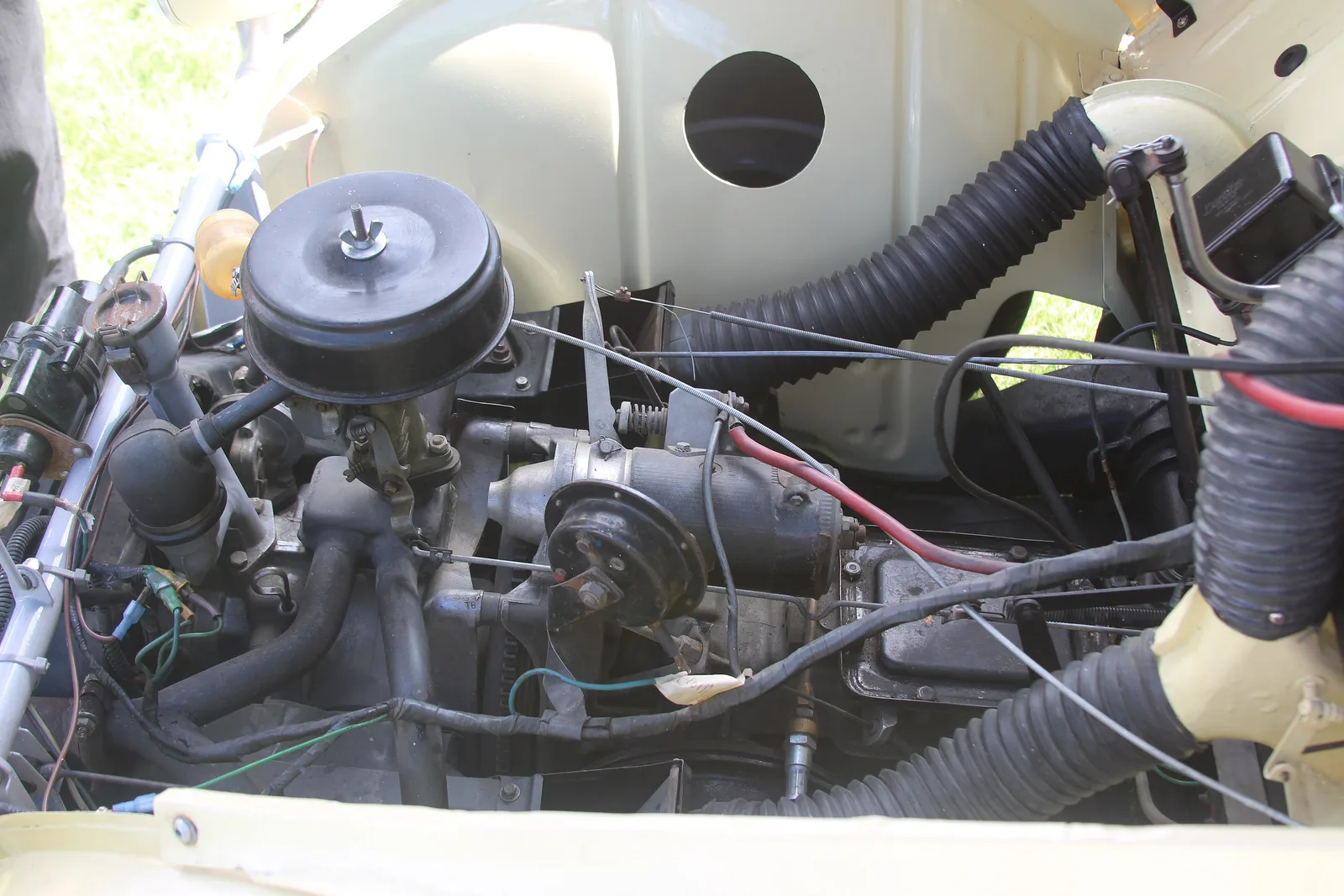
The engine bay of a 1968 2CV. The thick hoses carry air, because there is no radiator.
How many people are there already
Worldwide, about 3.87 million 2CVs were built, leaving out the vans, along with 5.38 million Minis and 6.3 million second-generation Golfs. The Dutch register, run by the RDW, tells a different story. On 3 November 2026 it held about 9,700 2CVs, 7,400 Golfs first registered between January 1984 and July 1991 (cabriolets excluded) and 2,500 Minis from before 2001. For comparison, the Fiat 126 also has a small air-cooled twin and was built 4.7 million times, and 430 are on Dutch plates.
That 126 is as simple as a 2CV. But 3.3 million were built in Poland, so such answers as exist are probably mostly in Polish. And the 2CV camp has a point: here, the simplest car is also one of the best known. So why not start with it?
Why not the 2CV
The first reason is that what you learn on a 2CV applies mostly to 2CVs. There is no coolant and no water pump, and since October 1981 the front brakes have sat inboard by the gearbox instead of at the wheels. Those discs run on LHM, a mineral oil, while nearly every other car uses DOT brake fluid. Pour in the wrong bottle out of habit and, according to owners on Citroën forums, you damage the rubber seals, which are made for mineral oil. A beginner on a Golf never even meets that mistake.
The second reason is price. In October 2026 the Dutch edition of Top Gear gave asking prices of about €2,500 for a project, from €5,000 for a running car and €10,000 to €15,000 for a tidy one. Learners break things, preferably on something that did not cost €12,000. And the thin bodywork sits on a chassis with its own price tag: a new 425cc platform costs €1,550 from the Méhari Club in Cassis.
If you want a 2CV because you want a 2CV, buy one and learn to fix it along the way. That is a good reason, but it is an answer to a different question.
The Mini and the flywheel
For a beginner the classic Mini is technically the worst of the three. The gearbox lives in the sump and shares the engine's oil. Everything is cramped. Changing the clutch means pulling the flywheel off. The forums are full of flywheels stuck solid. Even so, it makes the point best.
Search The Mini Forum for a stuck flywheel and you get thread after thread. Do not buy a cheap puller, members write, because many are junk that breaks. Pull it square, not at an angle. Heat the assembly and have someone tap the back with a brass bar while you tension the puller. One member describes a flywheel that has fretted itself onto the crank. It is a horrible job. But every stage of it has already gone wrong for somebody, who then wrote down how. The clutch kit itself was listed by Mini Mania at $168.90.
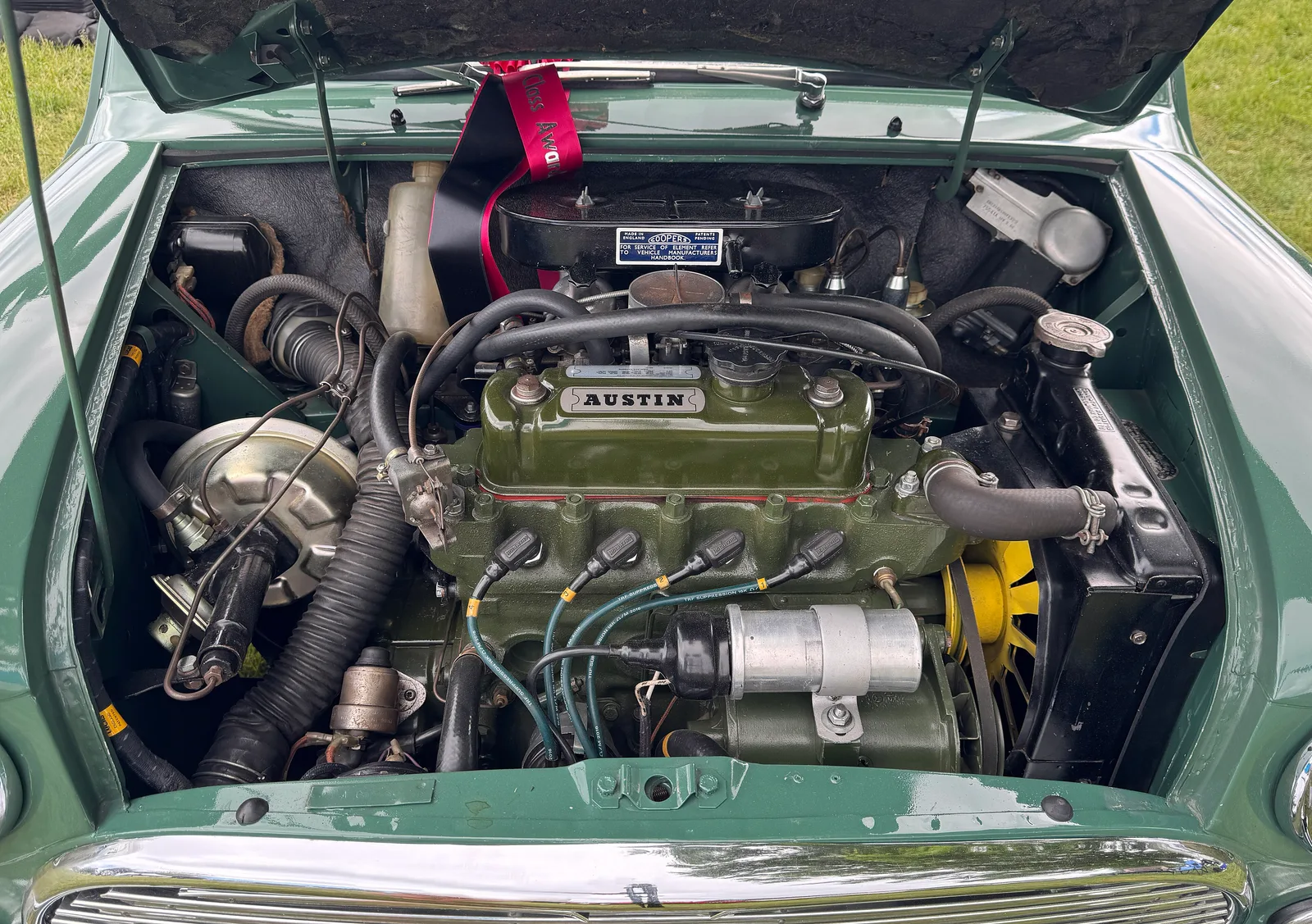
The A-series in a 1966 Mini Cooper S. The gearbox sits in the sump below it.
Why the Golf
If the aim is to learn, we would pick the second-generation Golf. Not the GTI. It has more to go wrong than a 2CV, and that is the idea: water cooling, a timing belt, an ordinary hydraulic brake system. Most of what you learn on it holds for the ordinary cars that came after. Haynes covers it (number 1081), as it does the Mini and the 2CV.
Leave the GTI alone because its 1.8 runs on K-Jetronic, a mechanical injection system with habits of its own. A seal costs €1.58 and a fuel accumulator from Volkswagen Classic Parts €202.99. Setting it up is no job for your first year. The second-generation Golf was the last with carburettors, and that is the engine you want.
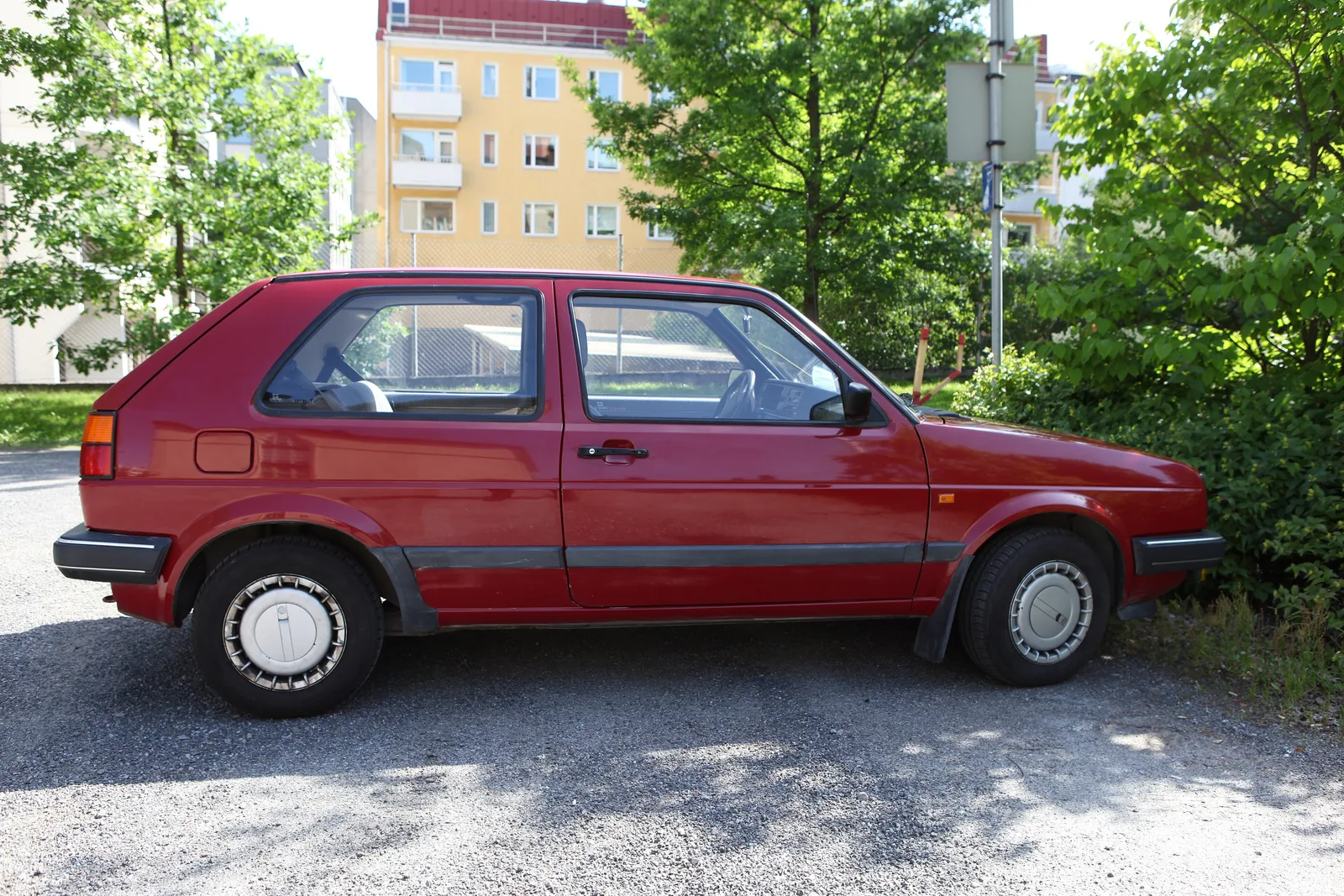
A second-generation Golf with a 1.6 engine, from 1989.
Before you buy anything, there is a test that takes one evening. Go to the car's forum and search for the job you dread most. Count the threads, see whether the photos still load and whether the last reply dates from this decade. Do the same for the car you would most like to own. If you find nothing, you know what you will be missing on the Saturday it refuses to start and nobody has been there before you.
And if you start with the 2CV anyway: LHM seals are green and DOT 4 seals are red. A litre of LHM costs €14.90 from the Méhari Club, a new master cylinder €64.90.
Images: Citroen A-series 2CV 602cc Engine (18770871302) by Andrew Bone from Weymouth, England (CC BY 2.0); 1968 Citroen 2CV engine - Flickr - dave 7 by dave_7 from Canada (CC BY 2.0); A-series engine in a 1966 Austin Mini Cooper S by Mr.choppers (CC BY-SA 4.0); Volkswagen Golf mk II, 1.6 (1989) 1 by Trogain (CC BY-SA 4.0). Images resized.


