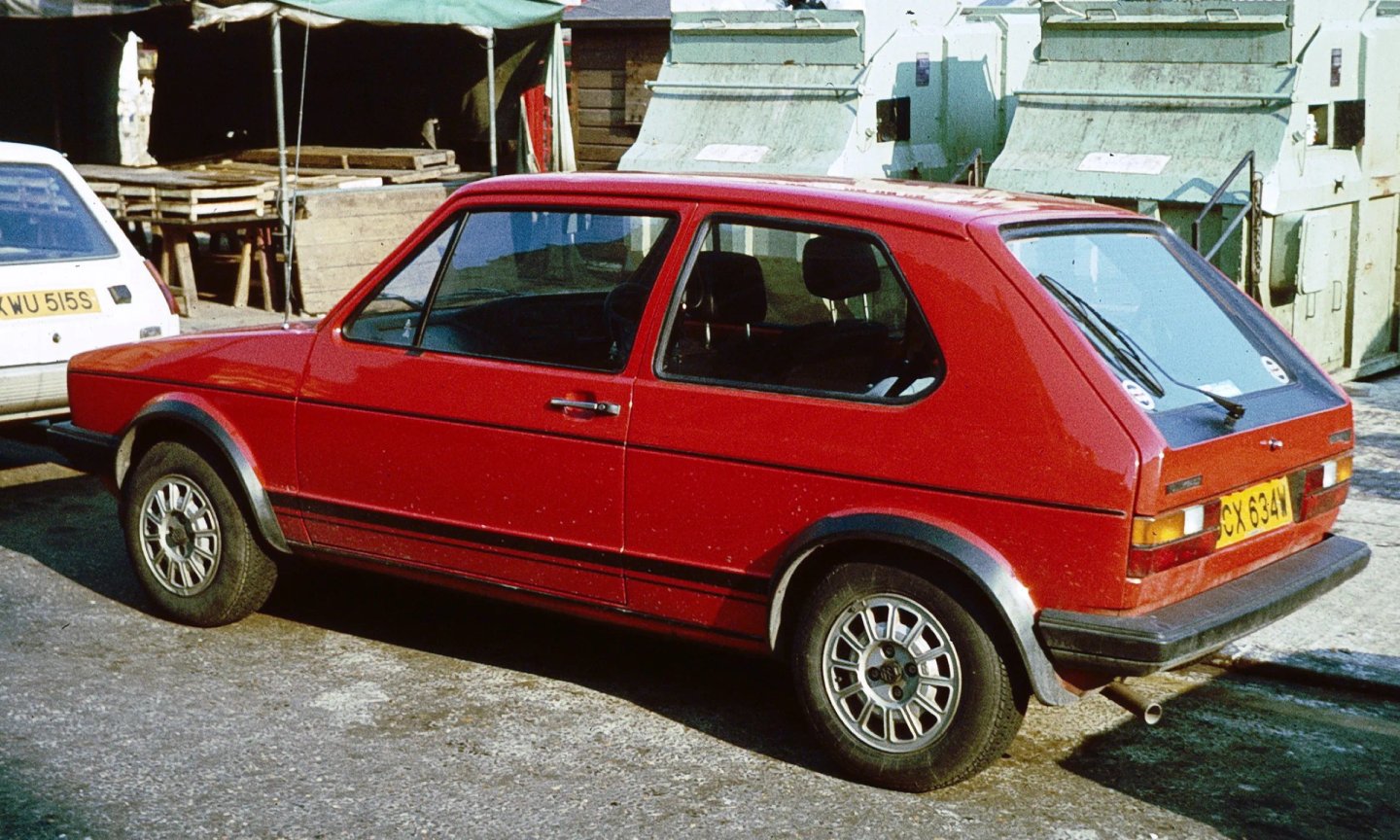
Between the first Golf GTI and the latest lie 531 kg, if you weigh them the same way. The Dutch vehicle register puts the 1976 GTI at 832 kg empty and the 2020 to 2025 car at 1,363. The usual comparison is bigger: 810 kg, the figure Volkswagen itself gives for the first GTI, against 1,463 on the spec sheets of the eighth generation. That 1,463 is mass in running order. Under the EU definition it includes a tank at least 90% full and a notional driver of 75 kg. In the Dutch register, these cars get 100 kg on top of their empty mass: 832 becomes 932 and 1,363 becomes 1,463. Almost one kilo in five in the usual comparison is therefore paperwork.
The familiar story says buyers grew decadent: heated seats, screens, big wheels. The other story points at Brussels: airbags, crash tests, particulate filters. Both can be checked.
What the register shows
The register holds dozens to thousands of GTIs per generation, identifiable by engine size and power. This is the middle value for each generation of the Volkswagen on Dutch plates:
- Golf 1 GTI (1976-1978): 832 kg
- Golf 2 GTI 16V (1986-1989): 933 kg
- Golf 3 GTI 85 kW (1992-1997): 1,064 kg
- Golf 4 GTI 132 kW (1998-2004): 1,254 kg
- Golf 5 GTI (2005-2008): 1,303 kg
- Golf 6 GTI (2009-2012): 1,314 kg
- Golf 7 GTI (2013-2019): 1,308 kg
- Golf 8 GTI (2020-2025): 1,363 kg
Two things follow. Of those 531 kg, 471 were already there by 2005. And between the fifth and seventh generations almost nothing happened: 5 kg more, while power went from 147 to 169 kW. The picture of a car that just keeps getting heavier holds for the GTI up to 2005.
Between six and seven sits the very diet Volkswagen announced in 2012: up to 100 kg less, with 23 kg from the body, up to 22 from the engine and 26 from the suspension. In the register the GTI went from 1,314 to 1,308. That is 6 kg. The weight does not sit in one place, and what comes out can just as easily go back in.
The test Volkswagen ran itself
In May 2017 Volkswagen presented the up! GTI, explicitly as a tribute to the first GTI: 115 PS against 110, 0-100 km/h in 8.8 seconds against 9.0, and according to the company similar in size inside and out, at 3.60 metres against 3.70. You will not get closer to the same recipe under 41 years of new rules. Volkswagen itself gave the weights, 810 and 997 kg. It pointed to high-strength steel and more airbags. To Autoblog the company cited safety and emissions equipment, including the particulate filter. The Dutch register has most up! GTIs at 970 kg.
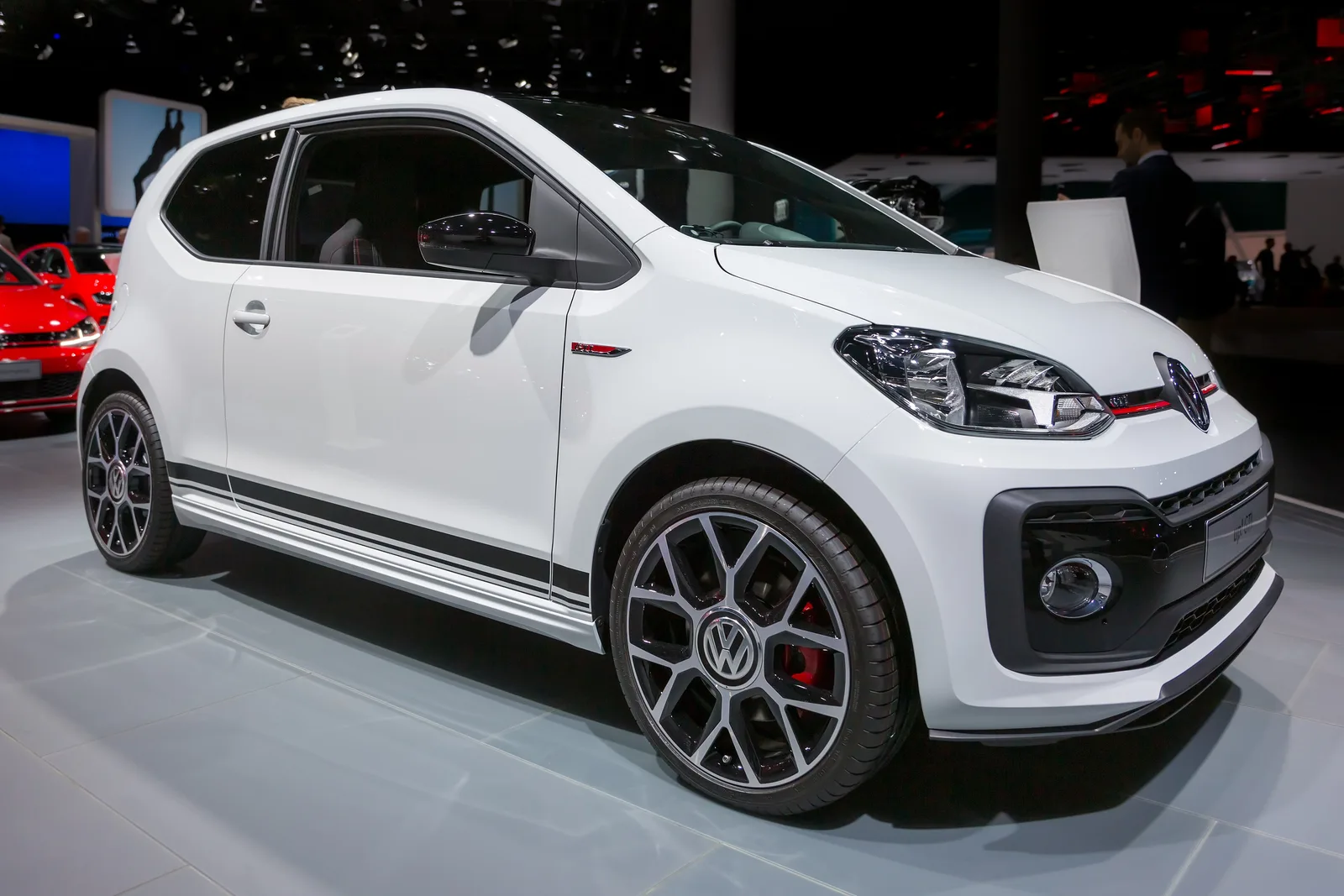
A Volkswagen up! GTI at the Frankfurt IAA in 2017.
That gives 138 kg from the register and 187 from Volkswagen. A small three-cylinder helps, and it is not quite the same car. It is a fair upper limit all the same for what stiffer steel, airbags, catalyst and filter cost in a car this size. Against those 531 kg it comes to between a quarter and just over a third. How much of it is steel and how much is exhaust, Volkswagen does not say. We found no public breakdown item by item.
The rest was ordered by someone
That leaves 350 to 400 kg. The eighth GTI is 4.29 metres long, almost 60 centimetres more than the first. It has 180 kW instead of 81, and tyres up to 235/35 R19. Each of those pulls something else along: more power and mass want larger brakes, those want larger wheels and those in turn want stronger suspension. A larger car also needs more crash structure, so this is not wholly separate from the law.
But no law required the Golf to grow by 60 centimetres. It grew because a larger, faster Golf sold. Call that decadent if you like. It was on the order form all the same, and the buyer paid for it.
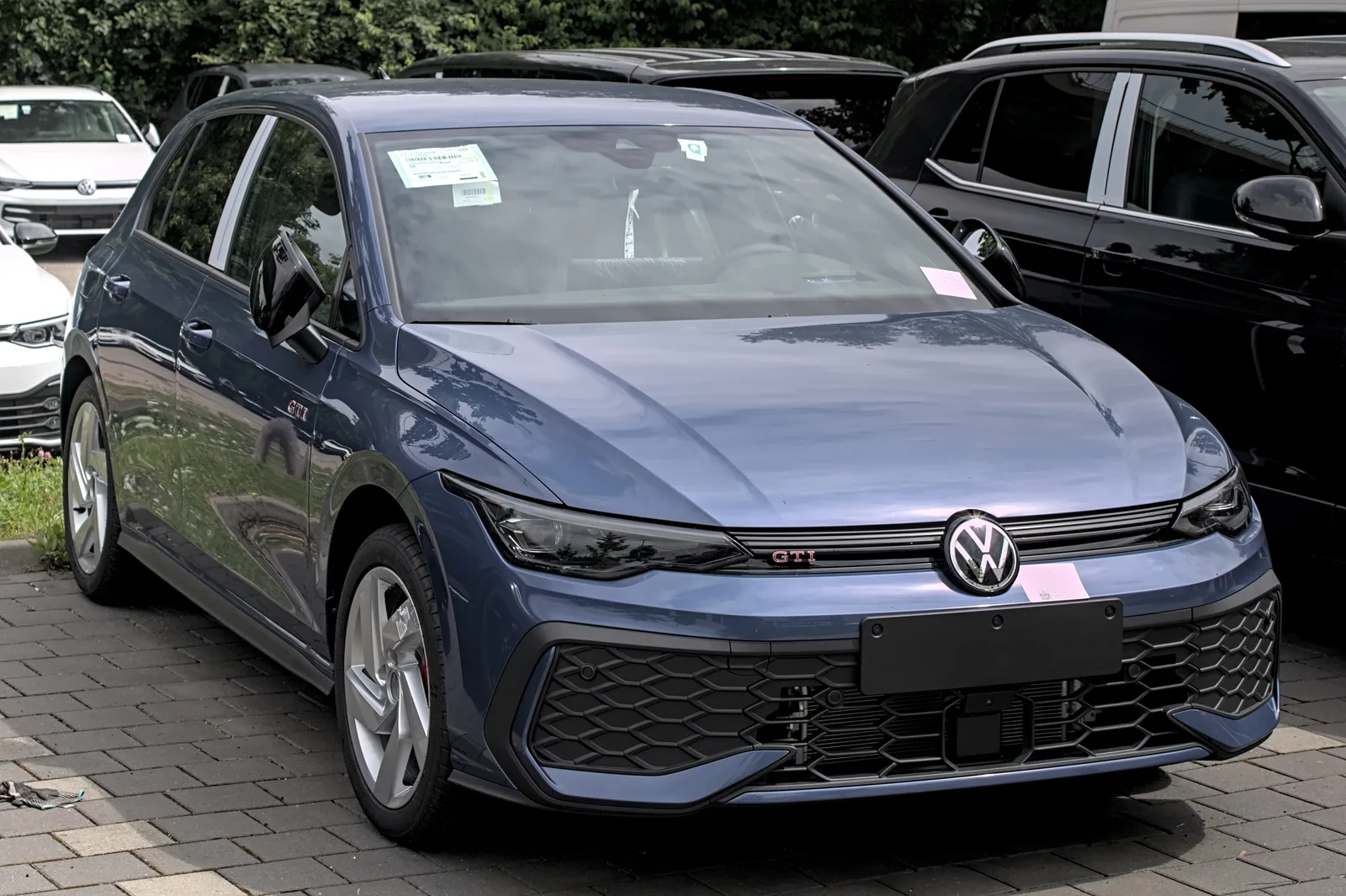
An eighth-generation Golf GTI, after the facelift, in Stuttgart.
Who can still buy light
A light new car has two routes: an exception in the rules, or a buyer who says no to something. The Caterham Seven 170 takes the first. Caterham quotes 440 kg and the Dutch register has the car at 465 to 470. The engine is a 660 cc Suzuki three-cylinder. There are no airbags, no ABS and no traction control. According to a report from 2009, Caterham then held the European approval for small series, which in the EU is capped at 1,500 cars a year.
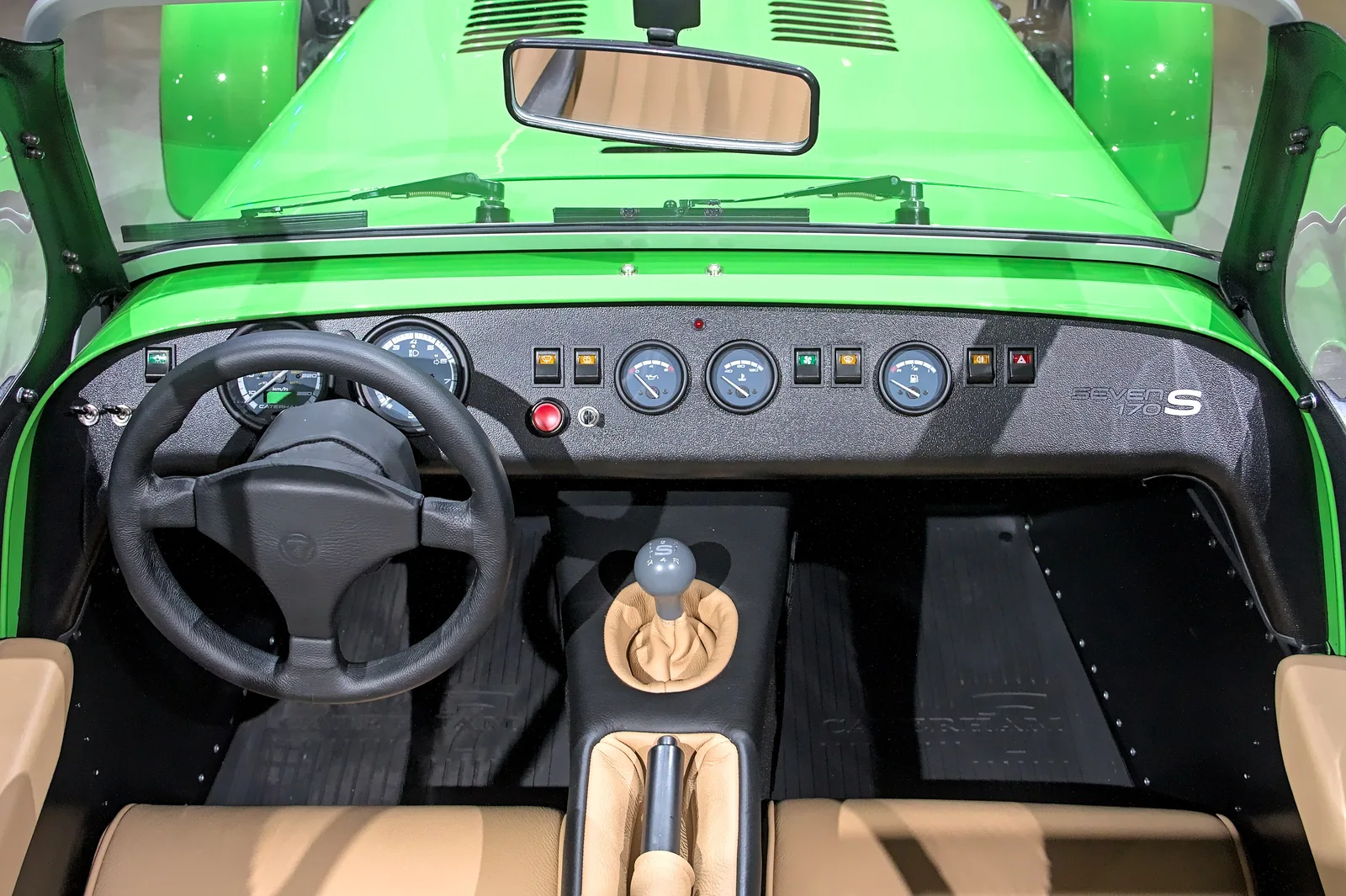
The dashboard of a Seven 170S at Auto Zürich in 2021.
The Mazda MX-5 takes the second. The Dutch register has the 1.5 from after August 2024 at 978 kg: two seats and a small boot. It was still taking new plates in September 2026. The Alpine A110 sat between the two: aluminium, two seats, 1,061 to 1,084 kg in the register. According to chief engineer Robert Bonetto, speaking in 2022, it could not meet the European safety rules of 2024, including speed assistance and a centre airbag. It stayed on sale in Europe under the small-series exception. Production was planned to run until mid-2026.
The up! GTI has gone as well. Volkswagen stopped building the up! in the fourth quarter of 2023. Brand chief Thomas Schäfer called a new electronics architecture for the cybersecurity rules of mid-2024 "schlichtweg zu teuer", simply too expensive. A rule like that weighs almost nothing. It is a sum per model, however many are sold. That is why it falls hardest on small cars: a Golf can carry that bill, and an up! or an A110 cannot.
For the used market, that means a finite stock. In the Netherlands just over 1,200 up! GTIs got a registration, the last in January 2024. No more will join them.
Images: Golf GTI 1 Market Hill with skips by Charles01 (CC BY-SA 3.0); Volkswagen Up GTI, IAA 2017, Frankfurt am Main (1Y7A2905) by Matti Blume (CC BY-SA 4.0); Volkswagen Golf VIII GTI Facelift IMG 0426 by Alexander-93 (CC BY-SA 4.0); Caterham 7 170 Auto Zuerich 2021 IMG 0526 by Alexander Migl (CC BY-SA 4.0). Images resized.


