The back of the Talbot-Lago was stove in. The car, a 1949 T26 Grand Sport with a Saoutchik body, had spent at least thirty years in a lean-to and, according to the sale report, needed serious restoration. Artcurial estimated it at €400,000 to €600,000. On 6 February 2015 in Paris it made €1,702,000.
It came from the collection of Roger Baillon: 59 cars, all sold, €25.15 million in total, often at double the estimate. The best known was a Ferrari 250 GT SWB California Spider, chassis 2935 GT, once owned by Alain Delon. Of the 56 built it was probably the most original and also the one needing the most attention to get back on the road. Estimate €9.5 to €12 million, result €16,288,000, a record for the model.
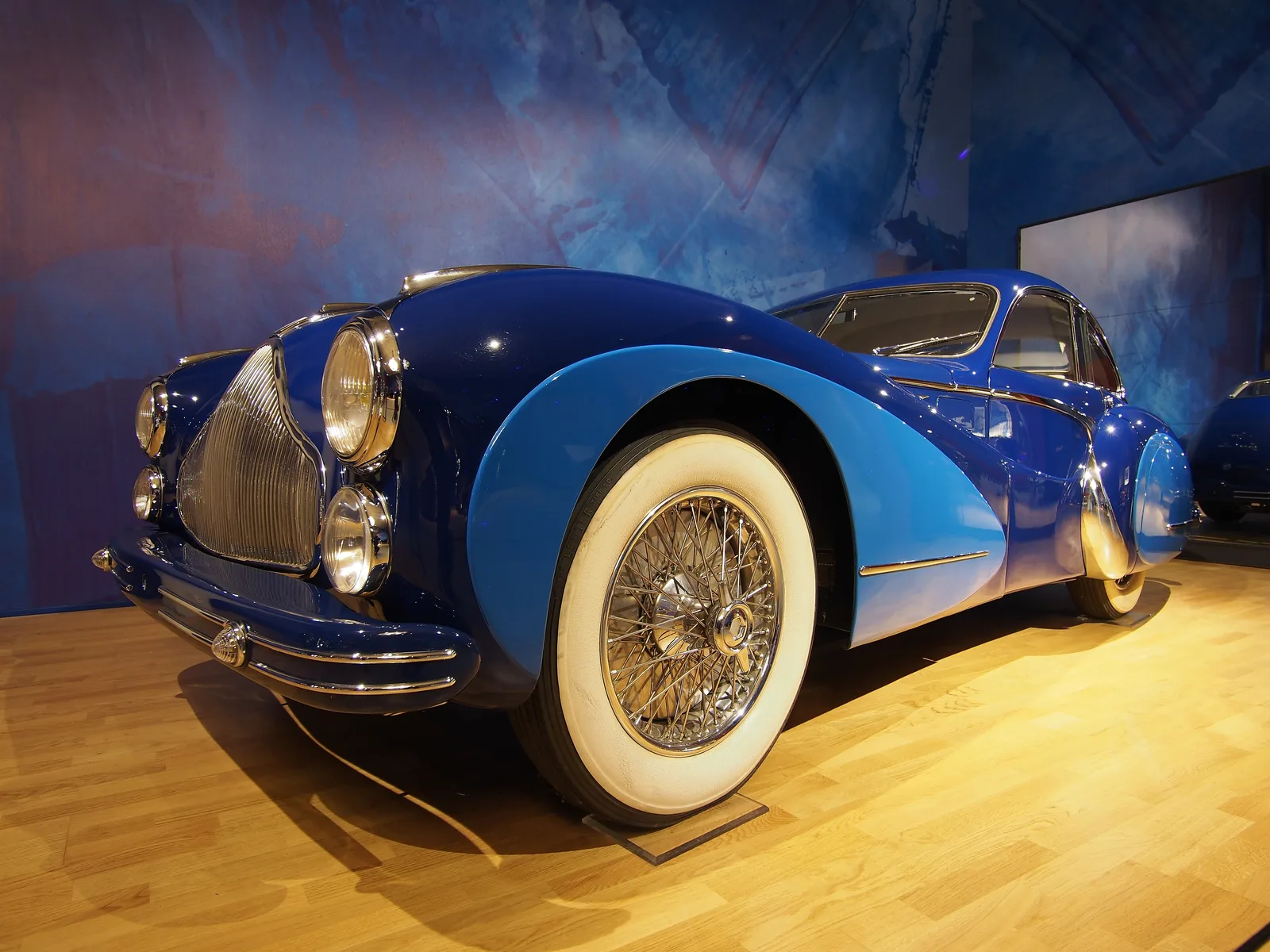
Another Saoutchik T26 Grand Sport, from 1948, in the Louwman Museum in the Netherlands.
Anyone reading this as proof that rust simply is worth money is looking at an opinion younger than the cars in question.
How long it took
The Pebble Beach Concours d'Elegance was first held on 5 November 1950. In 1999 it gave its first prize to a car for being well preserved. A class for prewar cars that had never been restored came in 2001, and a postwar one in 2007. In 2024 such a car won Best of Show for the first time, a 1934 Bugatti Type 59 Sports. In 74 years, that makes once.
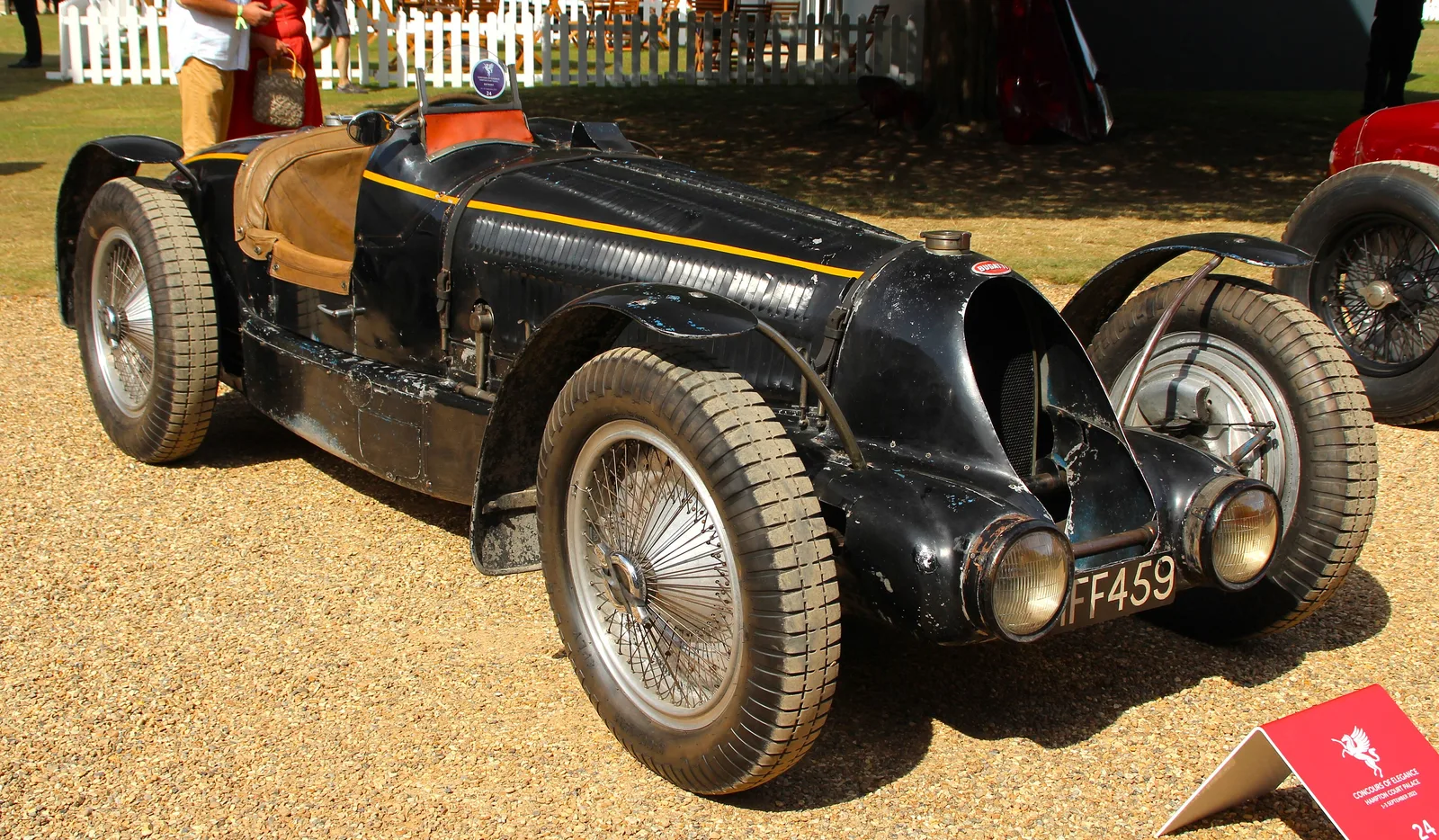
A 1934 Bugatti Type 59 Sports at the Hampton Court concours in 2023, its paint visibly worn.
FIVA, the world federation of historic vehicle clubs, followed. On 27 October 2012 it adopted the Turin Charter, which took effect in January 2013. The text says changes from a car's ordinary life are testimony to its history, and a car need not be returned to how it looked on the day it was built. Restored areas should remain recognisable on closer inspection. That last one is the opposite of what a concours restoration tries to do. The charter is voluntary and binds nobody. It did give the opinion a text.
The row buildings had first
That text did not start in the car world. FIVA itself says the charter is based on the Venice Charter of 1964, which covers monuments. And that in turn goes back to a quarrel from the nineteenth century.
The French architect Eugène Viollet-le-Duc restored churches and castles, and from 1857 Pierrefonds for Napoleon III. In his Dictionnaire raisonné he set out what restoring means: putting a building back into a complete state that may never have existed at any given moment. John Ruskin had already written the opposite in The Seven Lamps of Architecture in 1849. Of restoration he said: "The thing is a Lie from beginning to end."
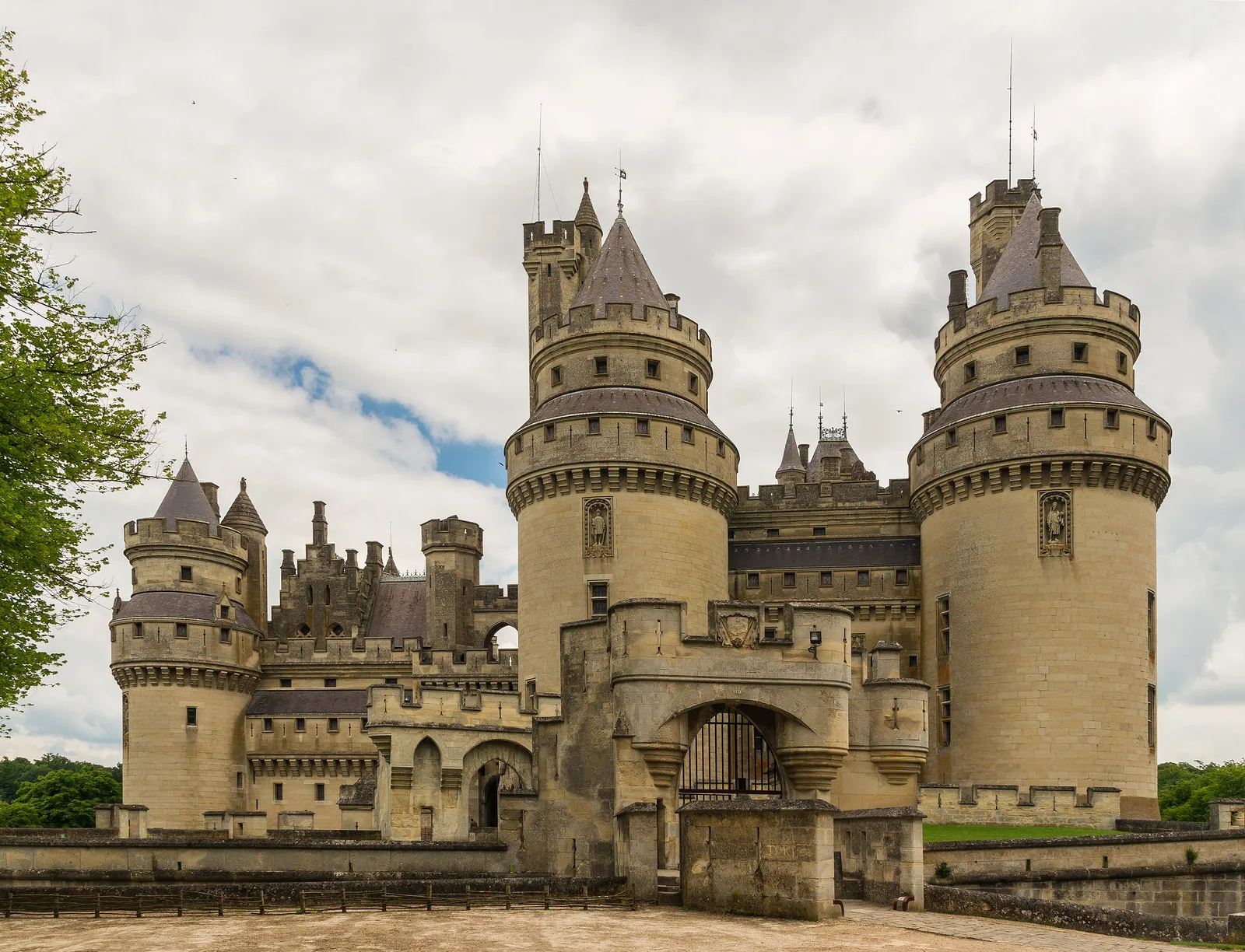
The Château de Pierrefonds, as Viollet-le-Duc rebuilt it for Napoleon III.
A car better than new is Viollet-le-Duc: paint, panel gaps and chrome in a state the factory never delivered in 1961. Ruskin is the California that needs the most attention. The car world had the same argument, a century and a half late.
Why so late? This is our explanation and not a measurement. As long as a car is merely old, wear is overdue maintenance. In 1975 a 1961 Ferrari was an old sports car with tired leather. Two things had to change first. Every restoration takes a car out of the stock of untouched examples, and it never goes back. After enough restorations, the untouched car became the rare one. And perfect paint had to be for sale. Once anyone with enough money can have a car made flawless, flawless says less. Fifty-year-old paint cannot be ordered.
What Baillon does and does not prove
The 2015 sale looks like proof that the new taste had won. That is too quick, because three things are mixed up in it. Originality as evidence: on a car never restored, nobody has hidden anything. Wear as taste: someone prefers tired leather to new. And the car as a project: someone pays for the starting point and has it restored afterwards. Nobody pays €1.7 million for a stove-in tail because they like the look of it. What happened to 2935 GT after 2015 we have not been able to find, so we do not know whether the buyer left the paint alone. Delon and the barn were in the price too, and Artcurial dimmed the room when the car appeared.
Later prices make it less clear still. According to one record of auction results, another SWB made $17,160,000 in March 2016, one $18,045,000 in March 2023 and one $17,176,000 in February 2026. The Baillon car had cost $18,649,760 in 2015. The record fell in August 2025, at $25,305,000 for chassis 2383 GT, a car restored by Dino Cognolato. It is also an alloy-bodied Competizione, so rarer than the rest. These are nominal figures and different cars. They do show that the most expensive California is not an untouched one.
What could still move
An opinion that formed in a quarter of a century can move again. We would watch two things.
The first is the stock. The Turin Charter wants cars driven, on public roads included. Driving uses up what makes an untouched car special: rubber, trim, hoses. Every preserved example will one day face the choice between standing still and replacing parts.
The second is the material. So far patina has mostly meant old paint, leather and chrome. Many cars from the 1980s and 1990s have clear coat that can peel off in sheets, and plastics that warp and turn sticky. Those cars are the next candidates for the preservation classes. The first time a jury honours a car with flaking clear coat because it was never resprayed, we will know whether patina was a principle or a liking for old paint.
Images: Needs Restoration - Facel Vega Facellia (5072443344) by JOHN LLOYD from Concrete, Washington, United States (CC BY 2.0); 1948 Talbot Lago T26 Grand Sport Coupe Saoutchik p6 by Alf van Beem (public domain); 1934 Bugatti Type 59 Sports by MrWalkr (CC BY-SA 4.0); Château de Pierrefonds exterior Oise by Jebulon (CC0). Images resized.


