Between 1998 and 2017, classic cars at auction rose by an average of 5.63% a year. The figure comes from Dries Laurs and Luc Renneboog at Tilburg University, who analysed about 29,000 auction sales worldwide. They say themselves that this is a return before transaction costs. Storage, insurance, servicing and tyres are missing too, because none of them is in an auction price.
The number measures the car. The owner also pays for the years between buying and selling.
What it costs to hold a car
Finance calls this the cost of carry: what you pay to keep hold of an asset. A share costs next to nothing to keep and may pay a dividend. Gold sits in a vault. A car needs a dry roof, a policy, services on a schedule and tyres replaced by age, whatever tread is left on them.
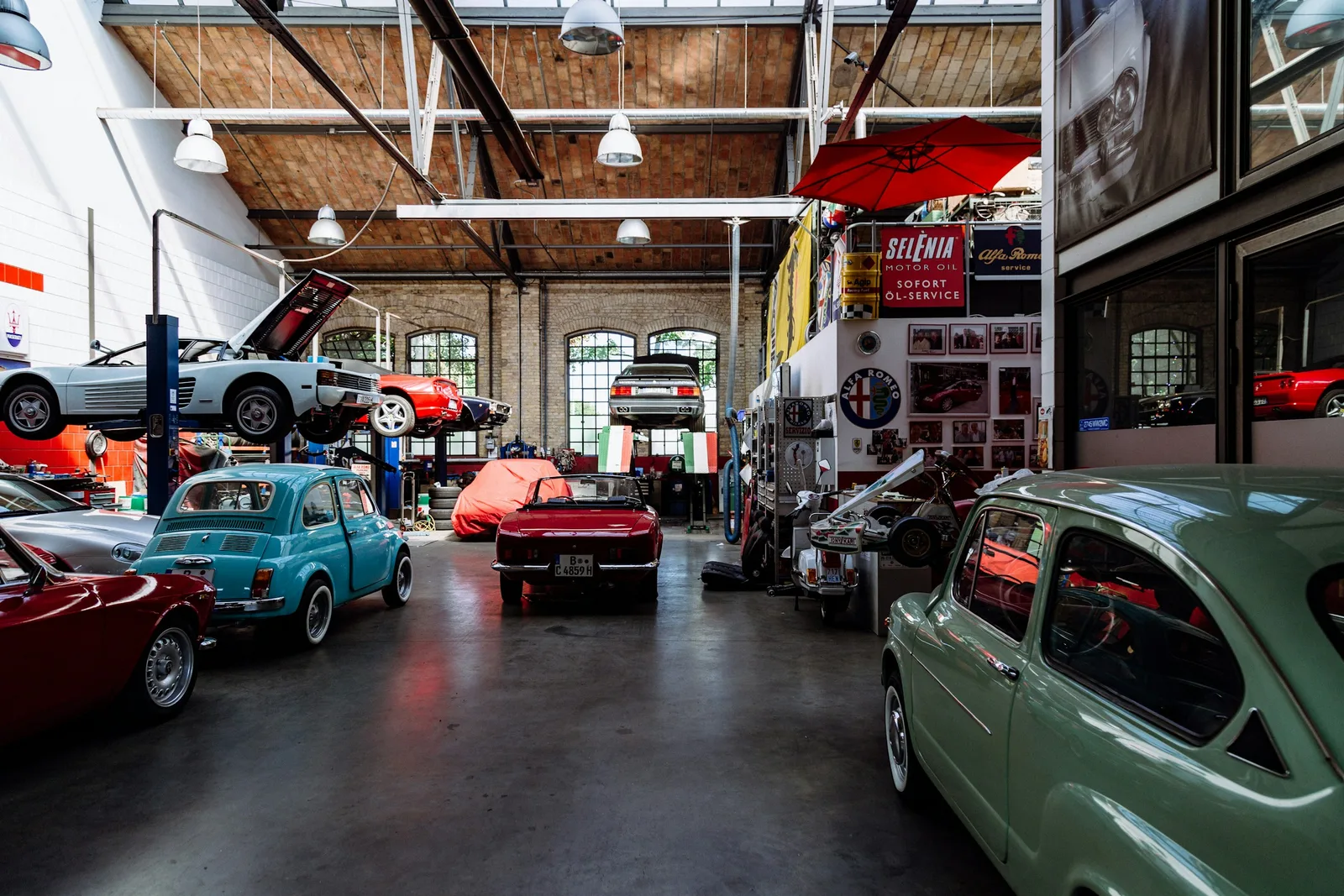
A specialist's hall, with classics on lifts and under covers. The bills keep coming when the car stands still.
Say you buy a car for €80,000 and keep it for five years. The figures below are assumptions rather than quotes, set roughly at Dutch prices.
- Dry storage: €1,500 a year
- Insurance: €900
- Road tax: €1,100
- Servicing, small and large jobs averaged: €2,200
- Tyres: €300, from a €1,800 set that lasts six years
That comes to €6,000 a year, or 7.5% of the purchase price. An online auction adds commission. At Octane the buyer pays 3%, here €2,400, and the seller pays nothing. In a saleroom it is more: according to a summary of the Tilburg paper, auction houses charge buyer and seller roughly 25% between them.
After five years the car has €112,400 in it: €80,000 to buy, €2,400 commission and €30,000 in costs. To break even it has to rise 7% a year. That money could also have been working somewhere else. Charge it 3% and the car needs to fetch almost €127,400, which is 9.7% a year.
Investors call that the hurdle rate: what an asset has to earn before anything is left over. Here it is 9.7%, against that 5.63% from Tilburg.
The hurdle also depends on the price, and it runs the wrong way. Storage costs the same for a €30,000 car as for a €300,000 one. Assume €4,000 of annual costs on a €30,000 car and you are at 13% of the purchase price. In the Tilburg data, blue chips made 12.5% a year and affordable classics 6.3%. On paper the expensive cars cleared their hurdle and the cheap ones did not. The expensive ones also moved around more, with volatility of 22.6% against 15.2%.
A BMW in a warehouse
One company has run this experiment, and its books are online. RSE Collection, known for the Rally app, sold shares in cars and kept the cars in private warehouses, not registered for road use. It reports to the US regulator, the SEC, so the figures for each car are public.
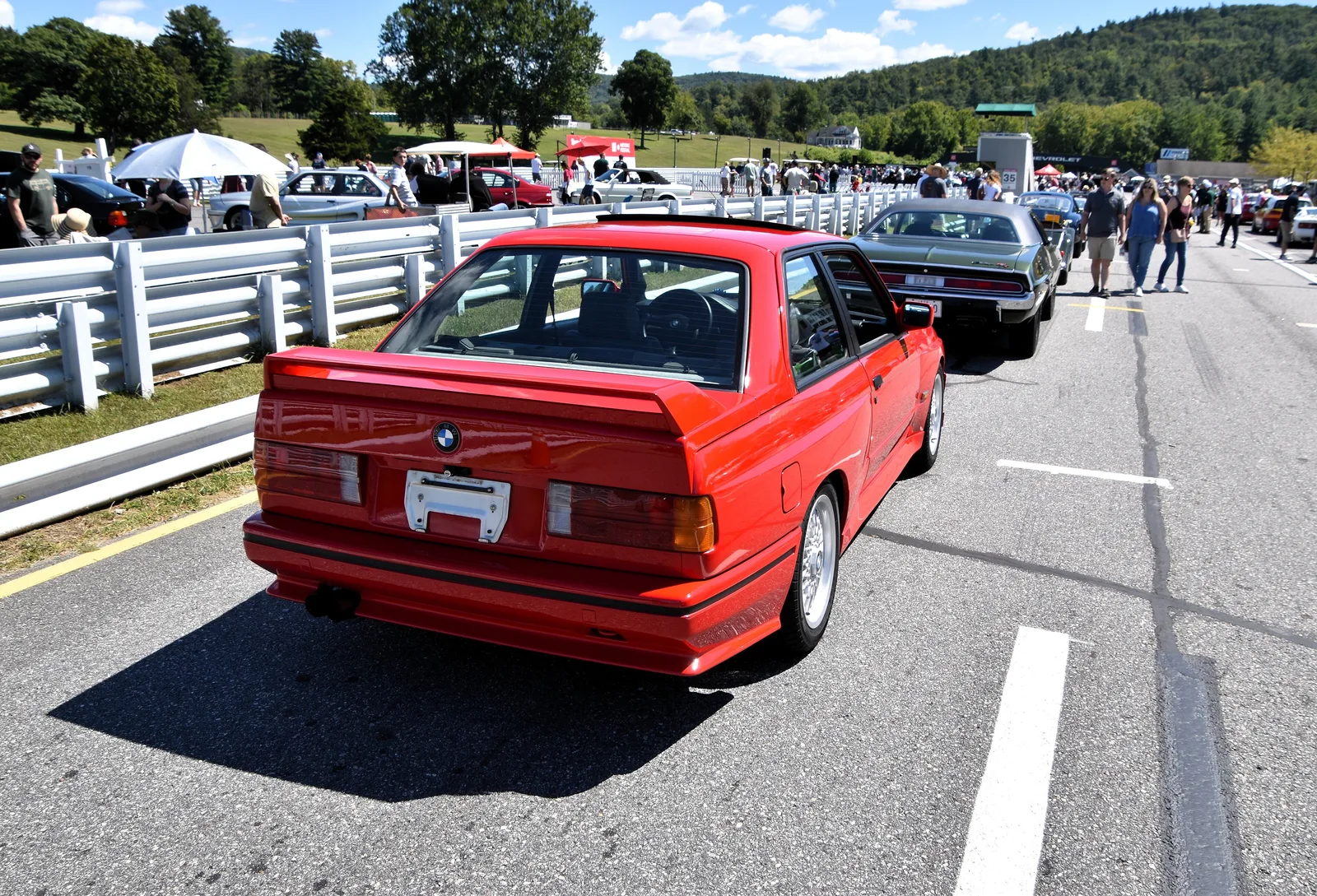
A BMW M3 coupe of the E30 generation, built in 1990. Rally's car was a 1988.
One of those cars was a 1988 BMW E30 M3. Rally bought it on 18 November 2018 for $135,000. In February 2019 investors put in $141,000, as 3,000 shares at $47. On 21 December 2023 an offer of $141,000 was accepted, exactly what the investors had put in. Over five years the car rose by $6,000, less than 1% a year. The 2023 balance sheet shows $14,312 of capital contributed to this series, the line where the manager books running costs. If most of that is costs, it comes to about $2,900 a year and more than twice the gain in price. That is 2.1% of the purchase price, the rate for a warehouse holding dozens of cars that never see the road. For a private owner it is the floor.
One car proves nothing. From the same filings: a Countach LP400 S Turbo, offered at $635,000, went for $1,181,250 in March 2024. A Porsche 944 Turbo S, offered at $66,000, went for $62,000. The 18 cars sold by then fetched $4.33 million against $3.31 million at offering, and more than half of that difference came from the one Countach. Cars still in the warehouse are not in that sum.
At Rally, the price is the only thing a car earns.
The car that is only an investment
In the Netherlands, an owner who holds the car only as an investment gets one more bill. A car for personal use falls outside box 3, the Dutch tax on savings and investments. A classic held at least 70% as an investment falls inside it in principle, ABN AMRO MeesPierson wrote in January 2026, with the burden of proof on the inspector. For 2026, box 3 assumes a 6% return on such assets and taxes it at 36%. On €80,000 that is €1,728 a year for anyone above the tax-free allowance (€59,357 per person), unless they can show a lower actual return. Without that, the hurdle becomes 11.3%. Plans to change box 3 from 2028 were not yet law on 3 October 2026, and whether a given car falls inside it is a question for a tax adviser.
What driving means for tax shows in what is known as the Ferrari ruling. The Dutch Supreme Court decided that a classic can be a work of art, but not this Ferrari, one of a numbered series of twelve, because it was sometimes used on public roads and the circuit.
What driving is worth
An owner who does drive gets something else back. Dutch tax law has the idea already, for houses. Anyone living in their own home adds a notional sum, the eigenwoningforfait, to their income, because living without paying rent is worth something. Economists call this imputed rent. A car you drive produces the same thing: rent you do not pay.
In October 2018 the Dutch magazine JFK listed what it cost to hire a Porsche. A 911 on the car-sharing site SnappCar ran from €150 a day (a 1999 cabriolet) to about €500 (a 2010 car), and a GT3 from a rental firm cost €1,100. Use €500 and the €6,000 from our sum is twelve days of hire. Someone who drives twelve days a year, and would otherwise have hired for those days, gets the annual costs back in kind. The hurdle then falls from 9.7% to 3.6%, below the Tilburg average.
Those days are not free. Mileage can pull the sale price down, on some cars more than others. And the sum only works if you would have wanted to hire on that day anyway.
You can add up the running costs of your own car in an evening. The days are as easy: the last two roadworthiness certificates (APK in the Netherlands, MOT or TÜV elsewhere) give the mileage between them. Divide that by what you cover on a day out. Divide the costs for that period by the result. That is the price of a day. Would you hire that car at that price?
Images: Photo by helen1 on Pexels; Photo by Alex Suprun on Unsplash; BMW M3 Coupé (E30, 1990) (54800876562) by Charles from Port Chester, New York (CC0). Images resized.
