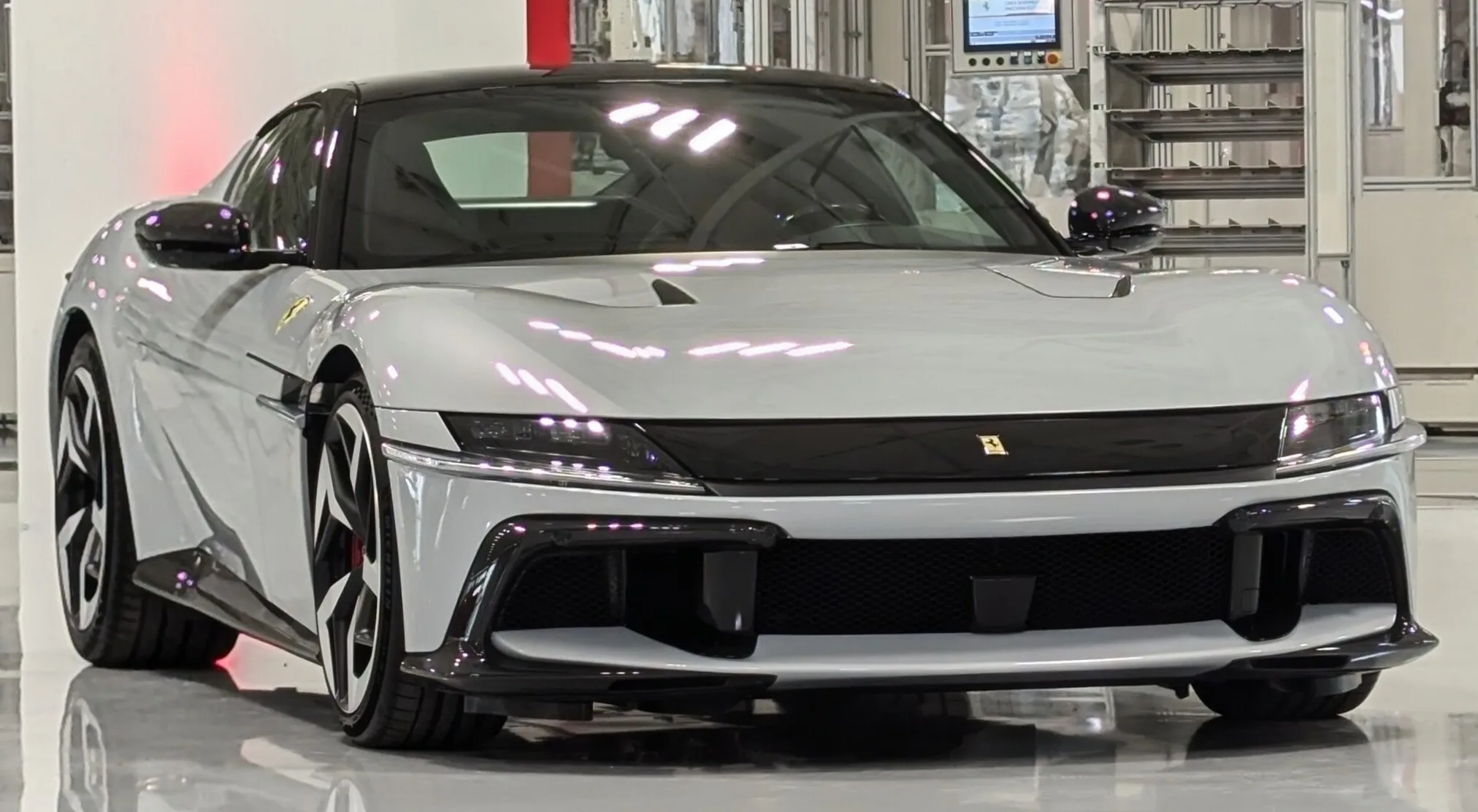
830 cv. That is what the Ferrari 12Cilindri makes from a naturally aspirated 6.5-litre V12. It is also what the Ferrari 296 GTB makes, from a 2.9-litre V6 and an electric motor. Both reach 100 km/h in 2.9 seconds. The 296 weighs 1,470 kg dry and the 12Cilindri 1,560 kg. At launch in Italy the 296 GTB started at about €269,000 and the 12Cilindri at €395,000.
Same maker, same power, same sprint and €126,000 between them. That is €21,000 per extra cylinder, if you ignore the rest of the car. Of course you cannot. The 12Cilindri is a large front-engined GT and the 296 a mid-engined coupe. The prices date from 2021 and 2024. The V12 also has things the V6 does not: 9,500 rpm and no battery to carry, although the car without a battery is 90 kg heavier. Even so, Ferrari is showing here what it no longer needs in order to reach 830 cv: twelve cylinders.
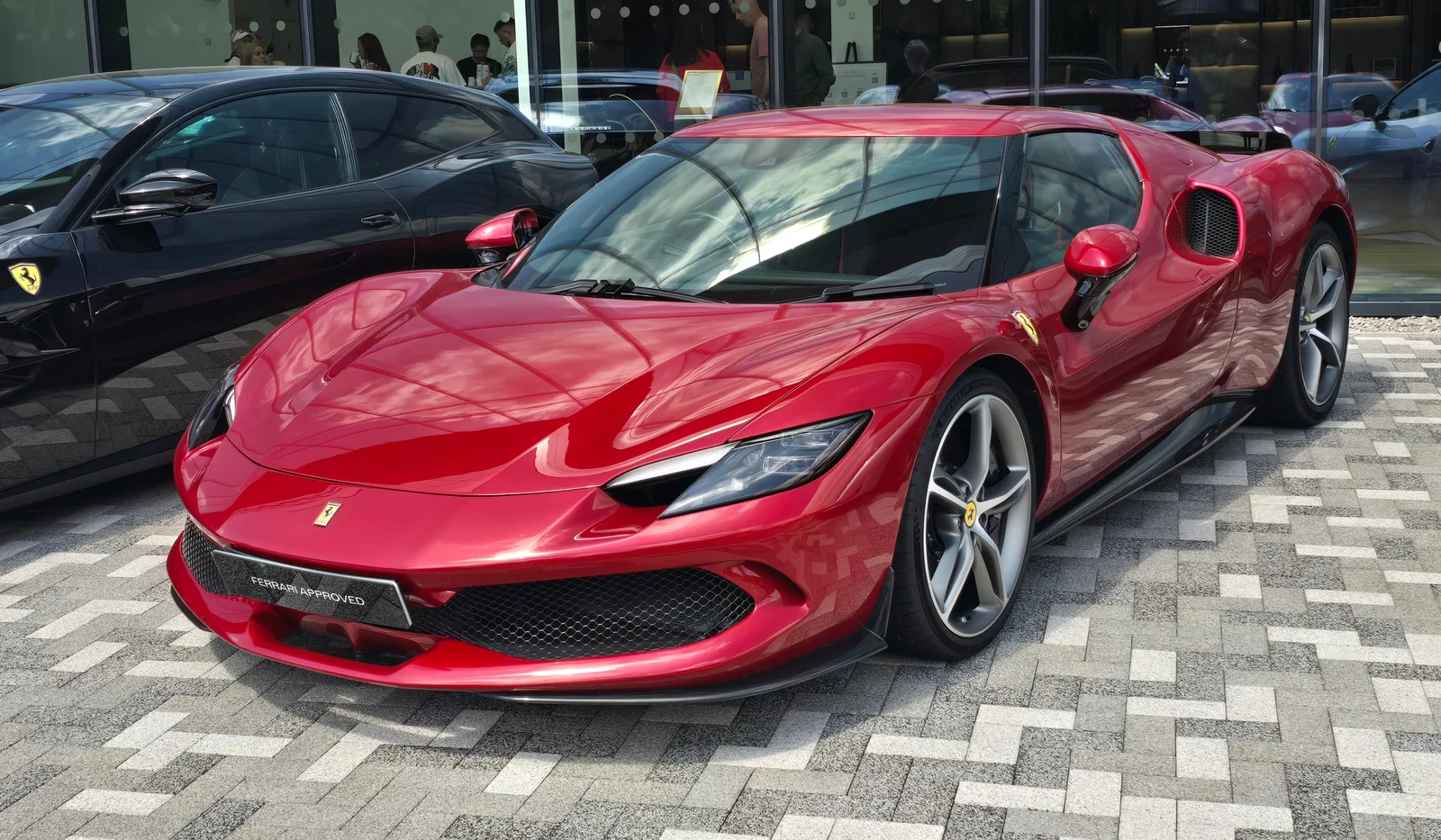
A Ferrari 296. Here a V6 and electric motor make the same power as the V12 in the 12Cilindri.
Why twelve cylinders once made sense
Ferrari's first car, the 1947 125 S, had a 1,497 cc V12, about 125 cc per cylinder. It made 118 bhp at 6,800 rpm, roughly 79 bhp per litre. For a litre and a half that looks like a lot of trouble. There was reasoning behind it. To get more power from a limited capacity without a turbo, an engine has to rev higher. Many small pistons manage that better than a few big ones. They weigh less, travel a shorter stroke and between them leave more room for valves.
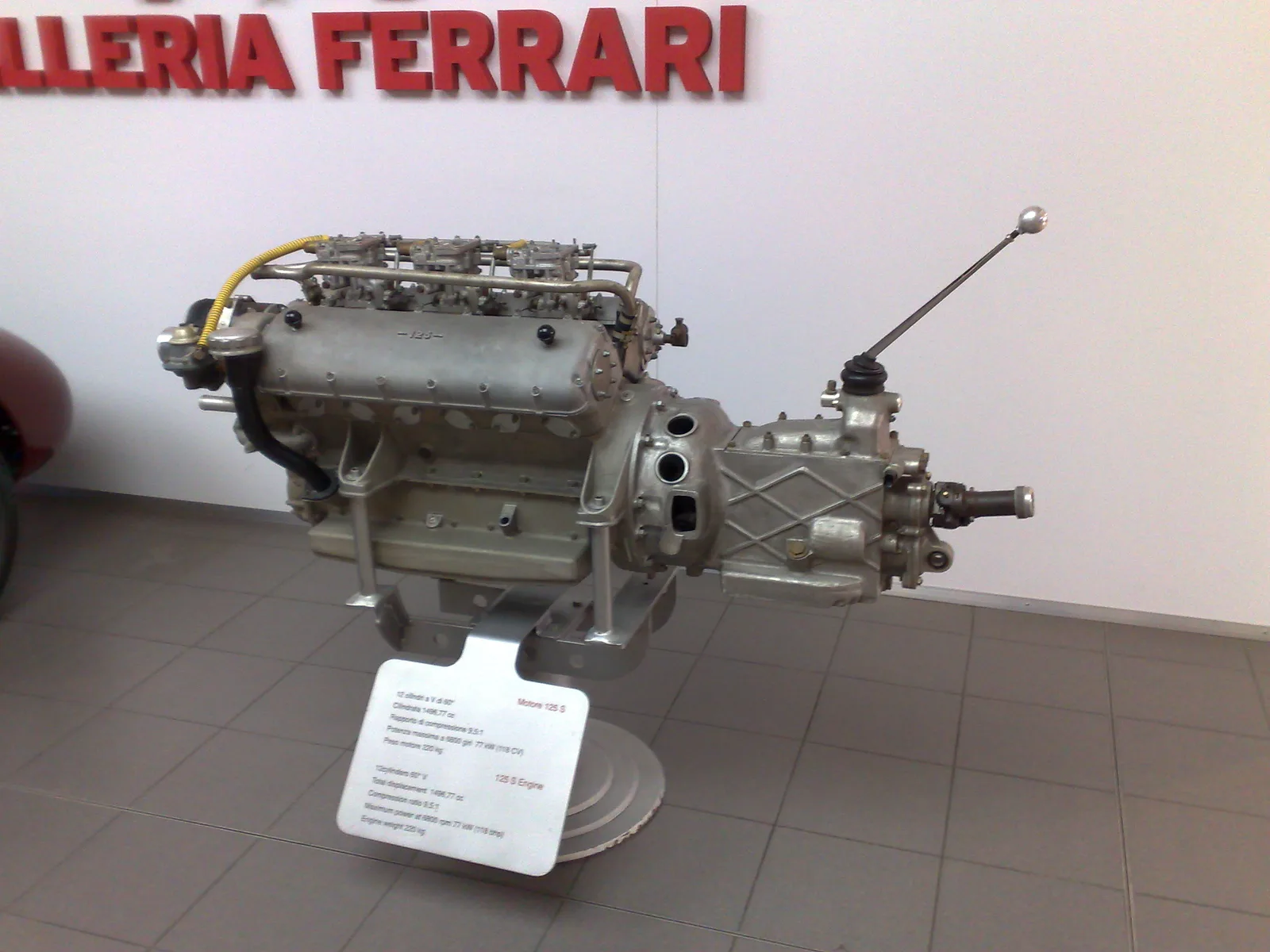
The engine of a Ferrari 125 S in the Galleria Ferrari at Maranello.
That problem has gone. A turbo forces more air into the same cylinder and an electric motor supplies torque that needs no revs. The V6 in the 296 gets 663 cv from 2,992 cc, about 222 cv per litre. The V12 in the 12Cilindri manages about 128 cv per litre. In 1947 more cylinders meant more power per litre. With these two Ferraris it runs the other way.
Formula 1 got there first. The 1995 Ferrari 412 T2 was the last F1 car with a V12, and that year in Canada it won the last race for such an engine. The French V10 used by its rivals was lighter, needed less cooling and was easier to drive, according to Auto Motor und Sport. By 1996 Ferrari had a V10 as well. In that sport only the lap time counts, and that settled the matter.
Then there is smoothness, the other classic argument. A V12 is in effect two straight sixes, and those are already in balance on their own. Twelve cylinders add shorter gaps between power strokes. But if silence and even torque are the aim, that too has a successor: an electric motor has no power strokes.
The strongest objection comes from Gordon Murray. His T.50 has a naturally aspirated 3.9-litre Cosworth V12 that revs to 12,100 rpm, in a car of 986 kg. High revs and instant throttle response are real properties, and anyone who says a V12 does nothing is wrong. But that is different from an engineering reason in the old sense: faster, lighter or more economical. It concerns what the engine does to the driver. That driver pays accordingly: £2.36 million, for 100 customers.
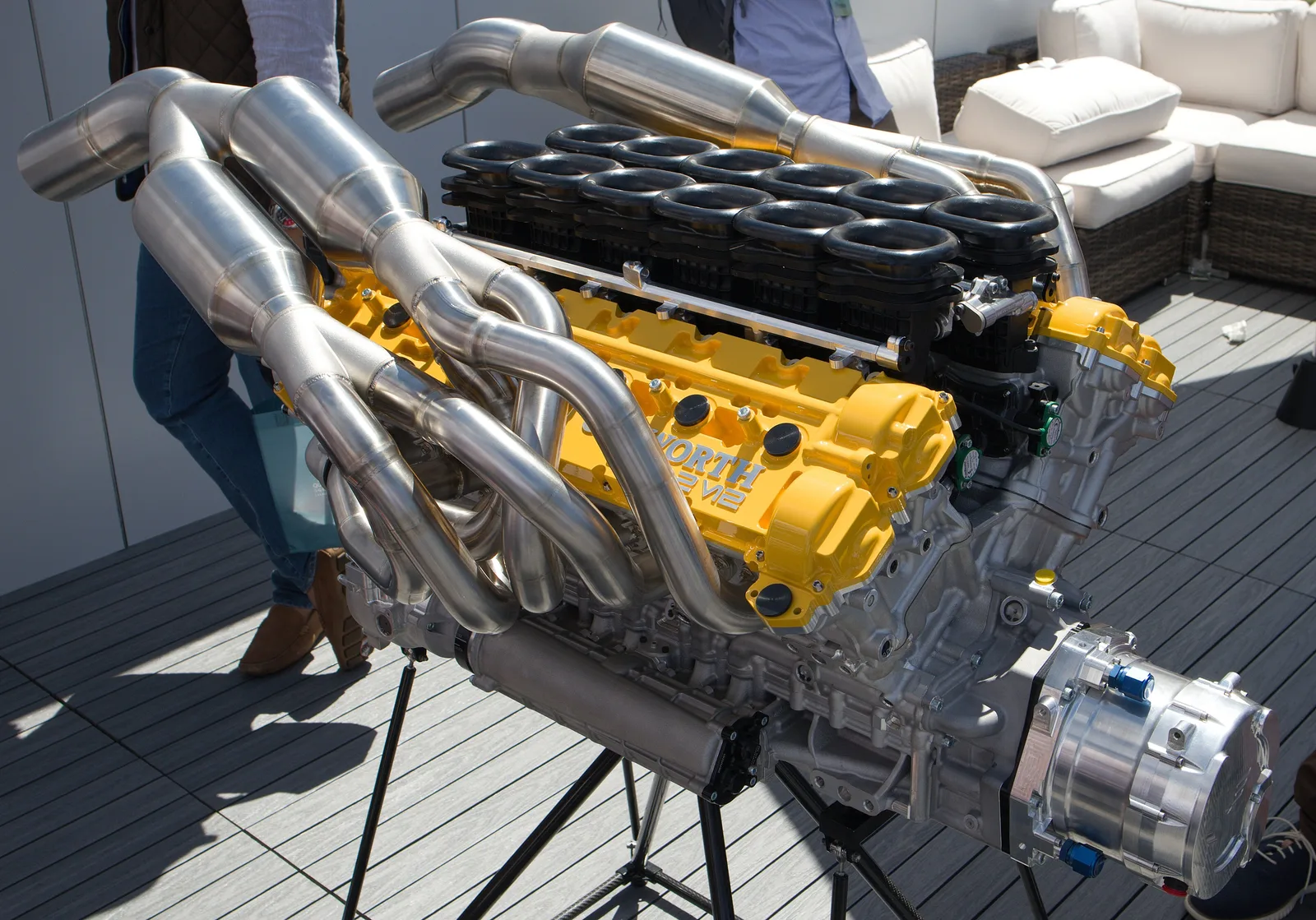
The Cosworth GMA V12 at The Quail in 2023.
What quartz did to the watch
Watchmakers have been through this already. On 25 December 1969 Seiko launched the Astron, the first quartz watch. Quartz keeps better time than a mechanical movement and costs a fraction as much. The number of Swiss watchmakers fell from 1,600 in 1970 to 600 in 1983, and jobs fell from about 90,000 to 28,000 by 1988. What survived moved up the price list. In 2023, according to the Swiss watch federation, quartz supplied three quarters of the growth in volume and mechanical watches almost 80% of the growth in turnover.
So outdated technology does not disappear while someone will pay more for it than for its replacement. Not everyone survives the move, though. Two thirds of the Swiss jobs went before it worked. The same sorting is under way among twelve-cylinder engines. Bentley ended the W12 in April 2024 after more than 105,000 units and put hybrid engine lines in its place. Ferrari carries on, and so does Lamborghini, with the hybrid Revuelto. This is our reading and not a measurement: at Bentley the engine was a means of going fast without effort, which a hybrid can also do. At Ferrari and Lamborghini it is part of what the buyer came for.
What we would watch is that €126,000. What will a 12Cilindri and a 296 GTB cost on the used market in a few years? If the gap shrinks, the meaning has lost value. Nothing guarantees that buyers keep paying it.
Where the comparison stops
A mechanical watch has one advantage over a V12: nobody has to permit it. The EU gives manufacturers registering 1,000 to 10,000 new cars in a calendar year a derogation from its CO2 targets until the end of 2035. The press calls this the Ferrari amendment, although it is disputed whether Ferrari itself, with more than 10,000 sales a year worldwide, qualifies. In December 2025 the European Commission also proposed softening the 2035 requirement to a 90% cut in CO2. Parliament and Council have to agree, and in November 2026 we found no final decision. A Swiss watch may run as inaccurately as its buyer will accept. A V12 needs a derogation, and under the current text that lasts until the end of 2035.
Images: Ferrari 12Cilindri at Maranello by Russell Bray's Ghost (CC BY-SA 4.0); Ferrari 296 GTB 3 by Calreyn88 (CC BY-SA 4.0); Ferrari 125 S Engine by Aiace90 (public domain); Cosworth GMA engine at Quail 2023 by Prova MO (CC BY-SA 4.0). Images resized.


