
On the sidewall of a tyre there is an oval stamp with a code, and its last four digits are a date. 0223 means week 2 of 2023. On tyres from before 2000 there are only three. On a car that covers 2,000 km a year, that stamp matters more than all the tread on the tyre.
A tyre has two clocks. One measures wear, in millimetres. The other measures ageing, in years. Dutch law looks only at the first on a passenger car: at least 1.6 mm of tread. According to the Dutch motoring club ANWB there is no rule on maximum age.
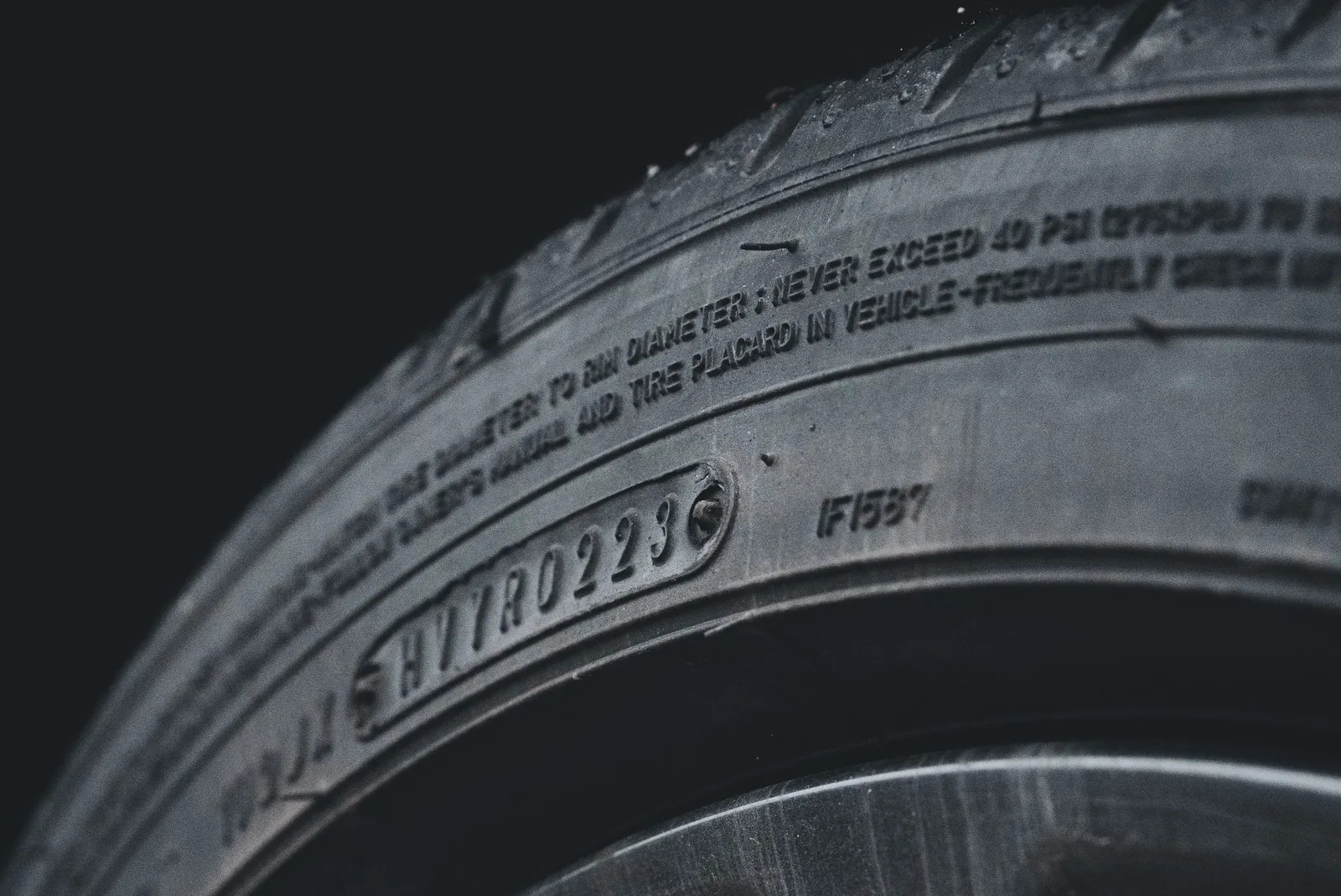
The stamp on the sidewall. The last four digits, 0223, stand for week 2 of 2023.
For the average car that is a reasonable system. James Gutting, then head of General Motors' tyre laboratory, said in 2005 that most tyres wear out before they age out. A driver doing 15,000 km a year never sees the second clock run down.
An enthusiast's car falls outside that average. Say a set lasts 30,000 km. That is an assumption, because it varies a lot between tyres and cars. At 2,000 km a year that set is not worn out for 15 years. By the tread gauge, the tyre from week 2 of 2023 is good until 2038. Nobody who has anything to say on the subject goes that far.
Six, eight or ten years
Anyone looking for a number finds several.
- Michelin: a yearly inspection from five years, replacement at ten as a precaution, spares included.
- Continental: replace anything over ten years old.
- ANWB: after 8 to 10 years.
- Nissan, in the 2024 X-Trail handbook: no tyre over six years old, driven on or not.
- Ford and DaimlerChrysler, in 2005: six years. General Motors at the time declined to name a fixed term.
- The German rules: a caravan may run at 100 km/h only on tyres under six years old.
- British law, since 1 February 2021: ten years, on the front axles of lorries and buses. Cars are not included, and neither are historic vehicles not used commercially.
The short term comes from carmakers and a caravan rule. The long one comes from tyre makers, who would earn the most from a short one. At first sight that is odd.
Read the wording and it becomes less odd. Continental writes that the service life of a given tyre cannot be predicted in years, and leaves the decision with the owner. Michelin writes that no single rule determines how long a tyre will last. The US regulator NHTSA researched the question for years and in 2008 issued advice with no age limit: see what the manufacturer says. The US trade body RMA said in 2006 that there was no firm evidence for an expiry date.
Our reading is that a number is a liability. A maker who says eight years has a problem with every blowout at seven, because eight was then too generous. Say ten and call it a precaution, and the choice sits with the owner. We cannot prove that. It is what those texts do, though.
The tyre that stood still
On 10 September 2012 a coach was returning from the Bestival festival in England when its front nearside tyre blew. The coach mounted an embankment and hit a tree. The driver and two passengers died. The tyre was about 19.5 years old. At the inquest in July 2013 an expert said it had been deteriorating from within for months and believed it had spent a long time as a spare or in storage. Reports describe a tyre that was half worn, though they are not consistent on this. The coroner, Richard Travers, noted that the law set no age limit and that age can make a tyre dangerous in ways that cannot realistically be detected.
Frances Molloy, the mother of one of the victims, campaigned for more than eight years for the British law in the list above. It does not apply to a classic. The owner stands where that coach operator stood in 2012: for the owner the age of a tyre has no legal limit. A classic weighs less and often goes more slowly, so the comparison only goes so far. If that expert was right, though, the life of that tyre resembled the life of many classic car tyres. Few kilometres, many years.
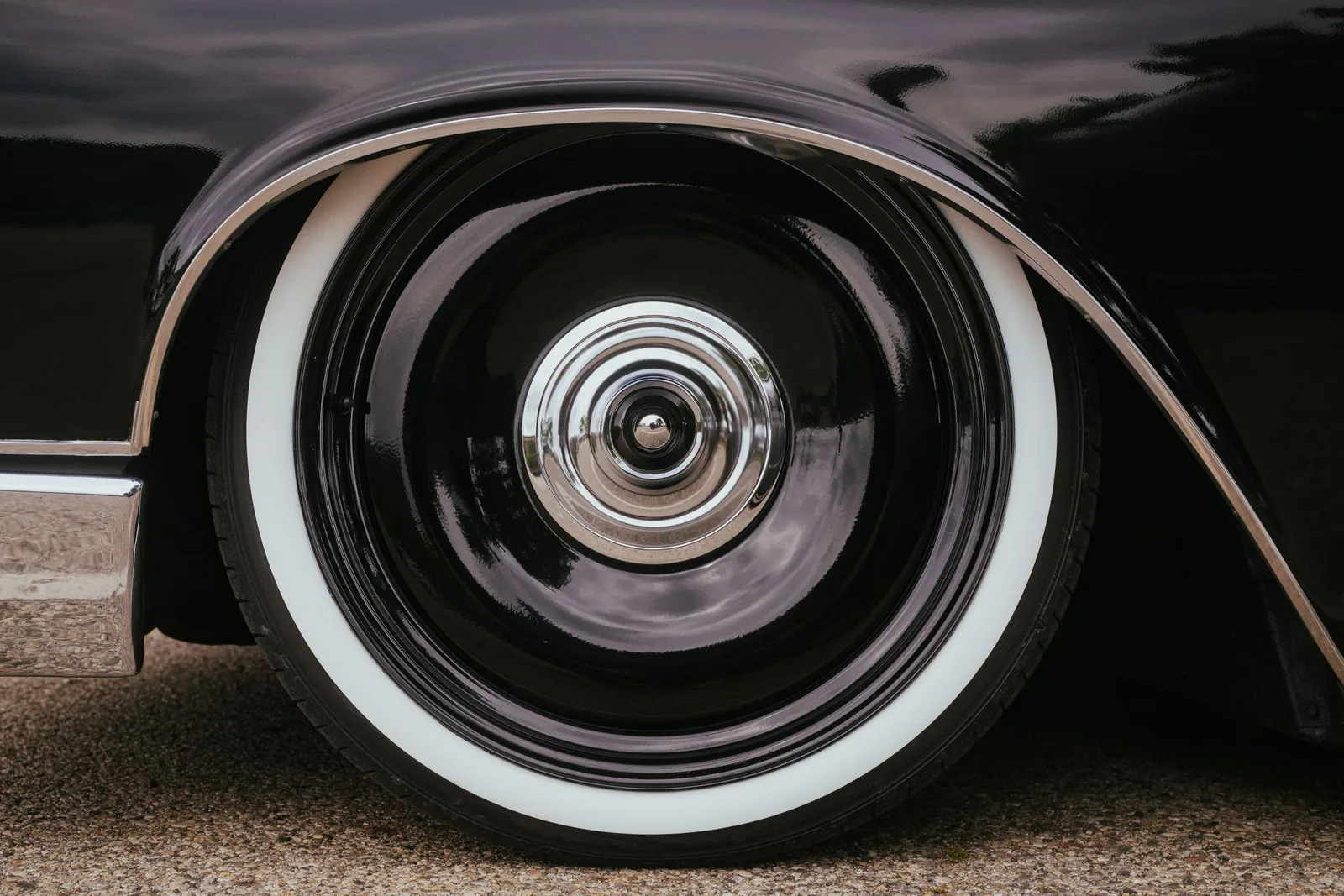
A cared-for tyre can look good for years. Michelin points out that ageing does not always show on the surface.
An invoice for new tyres says nothing about the date on the stamp. According to Continental, an unused tyre stored properly can be sold as new at up to five years old. Against Nissan's six years, that leaves one.
What the choice costs
Say a set costs €1,200. Replace it after six years and it costs €200 a year. After ten, €120. The whole difference is €80 a year, or four cents a kilometre at 2,000 km. A €3,000 set differs by €200 a year, ten cents a kilometre. Those are our assumptions, so put in your own figures.
That makes the choice easier than the sources suggest. On a car that regularly goes faster than 130 km/h or sees a track, we would keep to six years. On a classic touring on back roads, we would treat ten as the outer limit and have the tyres inspected every year from five, as Michelin says. That is an opinion. Ten is the longest term any maker names, and a heated garage does not turn it into eleven.
At the next service, read the stamps on all the tyres, including the spare. If you are selling a car, put the digits in the listing. If you are buying, ask beforehand for a photo of each stamp. Then write two dates in the car's folder: six and ten years after the code. For 0223 those are January 2029 and January 2033.
Images: Photo by engin akyurt on Unsplash; Photo by Erik Mclean on Pexels; Photo by Mike Norris on Pexels. Images resized.