
They mostly built far more of them than we remember. Mercedes sold about 2.7 million W123s. In Germany, its home market, 17,534 of them carried an H plate, the German historic registration, in 2015 according to the federal vehicle office. That is a little over half a percent. More W123s than that are still running, because not every owner applies for the plate and many cars left the country. Still, this is the car sent out to prove the saying. What we see of it is the result of a selection.
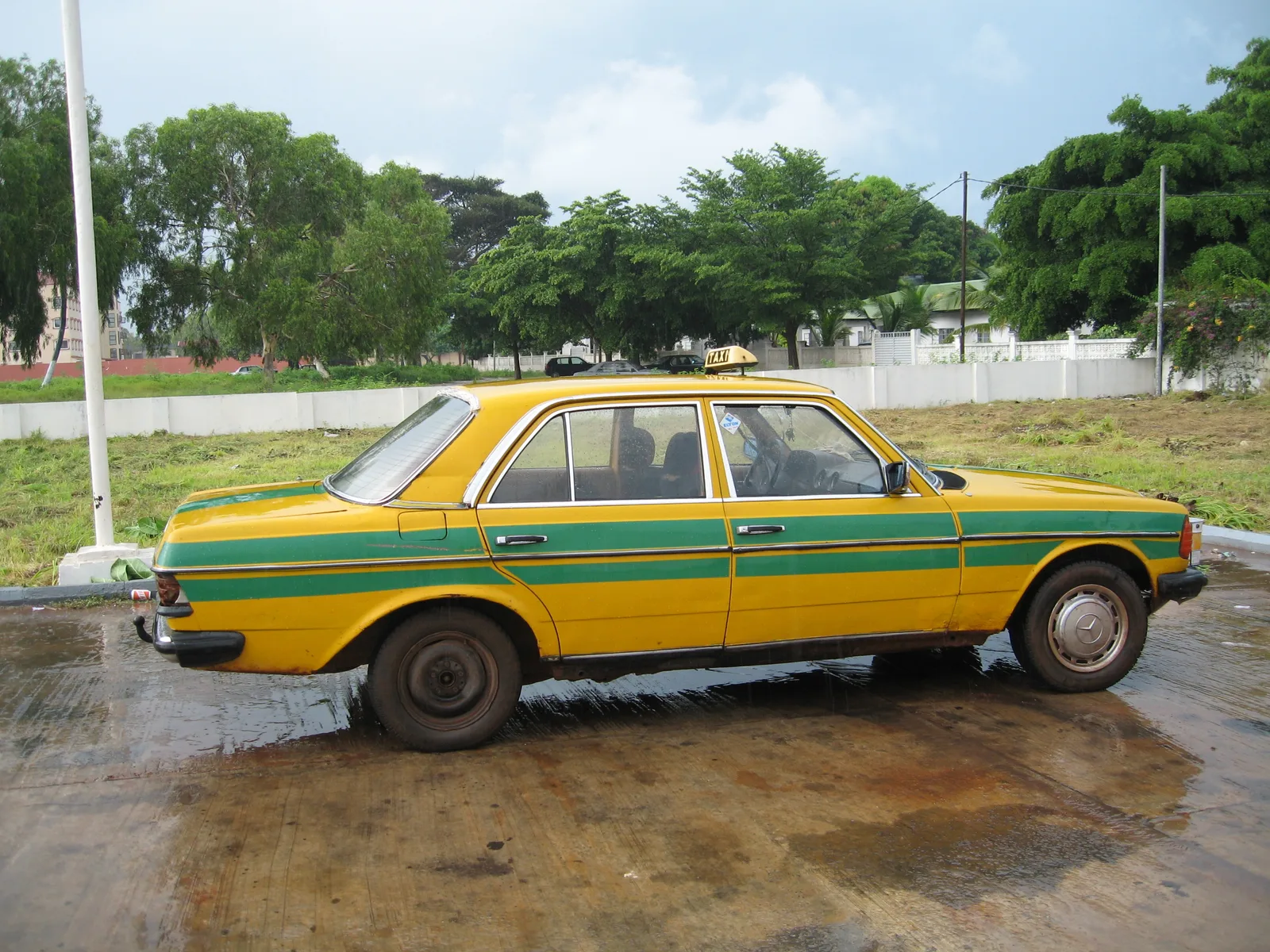
A W123 taxi in The Gambia. This part of the production run carried on too, out of sight of the European classic show.
Wald's problem
During the Second World War Abraham Wald worked for the Statistical Research Group at Columbia University. One set of his memos later appeared under the title A Method of Estimating Plane Vulnerability Based on Damage of Survivors. The version that goes round, with generals wanting armour where the bullet holes are and a mathematician saying it belongs everywhere else, has probably been improved in the telling. A column for the American Mathematical Society found little evidence for the best bits. The problem itself is in the memos, though. You only have the damage from aircraft that came back. What does that tell you about the chance that a hit on a given part is fatal?

A B-17F of the 385th Bomb Group. This aircraft failed to return from a raid on Bremen on 8 October 1943.
Our memory of cars works from the same sample. The W123 at a classic show is an aircraft that came back. Perhaps it was kept dry, never saw road salt, had an owner who paid for every service or has been rebuilt from the ground up already. The cars that rotted at the battery tray, the inner wings and the jacking points, the places buying guides still name, disappeared without anyone taking a photograph. And that is the car people hold up as the example of solid construction. Nobody tells stories about the average car from those years, because none of it is left.
That is why the usual comparison fails. On the street a W123 stands next to a ten-year-old car. The W123 is what is left after forty years of sifting. The other is a random car in the middle of its life. A fair comparison can no longer be made, because the random car from 1980 is gone.
What the figures say about the average car
For the average you have to look at what was left of the whole fleet. In 1981 Greene and Chen calculated that American passenger cars in the period 1966-1977 had a median lifetime of 9.9 years. Half of them were gone within a decade. For 2020 a later estimate comes to about 17 years. These are American figures and they are not a pure measure of quality. Whether a car is scrapped also depends on what a repair costs, what a replacement costs and what the old one will still fetch. But the direction is not what the saying claims. A car that lasts seven years longer, while wages have risen and the technology has grown harder to work on, has not been built worse.
The German motoring club ADAC shows something similar over a shorter span. In 2015 a ten-year-old car had a 6.5% chance of a breakdown in its statistics, and in 2025 that was 3.1%. The club credits sturdier components and more stable production, and notes that manufacturers' own breakdown services can distort the picture. We found no comparable series from the 1970s, so the biggest step cannot be shown here.
Irv Gordon's Volvo
Now the best objection. On 30 June 1966 Irv Gordon bought a red Volvo P1800S for $4,150, and by his death in November 2018 he had driven it more than 3.2 million miles, over 5 million kilometres. In 2010 the body, engine block, gearbox and differential were still original. This is no fond memory but a recorded world record, and this one case seems to prove the saying.
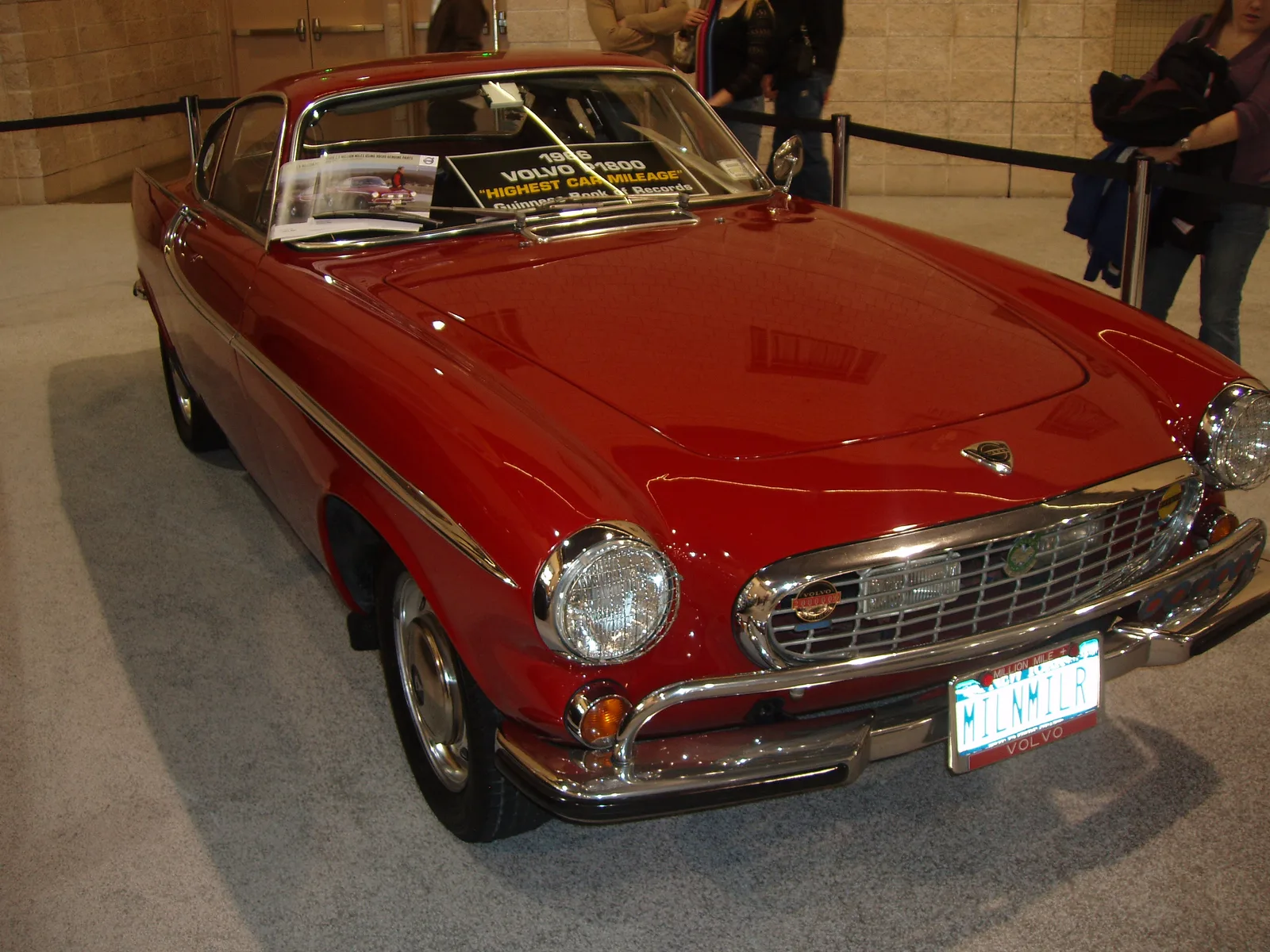
Irv Gordon's P1800S at the Philadelphia motor show in 2007, with the sign about its record.
Look at what went into it. Early on Gordon drove about 125 miles a day to work and back. He changed the oil himself and did his own brakes. From 1979 he had the same mechanic. At about 680,000 miles he had the engine rebuilt as a precaution, although the dealer said there was no need. It happened again in 2009, this time for worn bearings and piston rings. His advice was to follow the factory manual and replace worn parts at once. An experiment with one subject mostly tells you about the subject.
Volvo built 47,492 P1800s. Nobody put the mileages of the other 47,491 in a book. The first 6,000 or so were assembled in England by Jensen, until the contract ended early amid quality problems. The S in Gordon's P1800S stands for Sverige. Production went there in 1963.
What is true in it
There is something true in the saying, but it is not solidity. Gordon said his tune-ups took less than five minutes. A 1980 Mercedes or a 1966 Volvo can be kept alive with ordinary tools for as long as someone wants to. That is repairability. Solidity is how long a car lasts without that attention. The old car demanded a lot of attention and allowed it. The new one demands much less and allows less. People who say they built them better often mean the first and think the second. The classics we see today have all had someone like that.
The average car ADAC was called out to in 2025 was nearly 14 years old. In the American figures for 1966-1977, half of all passenger cars had by then been gone for more than four years.
Images: Autofriedhof Kaufdorf by Ambroix (public domain); W123 Taxi, The Gambia (3518515282) by Jurgen from Netherlands (CC BY 2.0); 385th Bombardment Group B-17F Flying Fortress 42-30275 by United States Army Air Forces (public domain); Volvo P1800S The Guinness Book of World Records by Shuvaev (public domain). Images resized.


