The Lancia Stratos HF Zero is 84cm tall. You get in through the windscreen, which hinges at the top. A rubber mat on the nose is there to wipe your shoes on. In the middle of the car sits the V4 from a crashed Lancia Fulvia. Marcello Gandini drew it for Bertone, who showed it at Turin in November 1970.
It did not have to do much more than move, because it had another purpose. Bertone had no working relationship with Lancia and wanted one. In the best-known version of the story, Nuccio Bertone drove the Zero to the factory himself, under the closed barrier and into the car park where Lancia's people would see it. Sources disagree on the date but not on the result: Bertone got the job, and the Stratos won the World Rally Championship in 1974, 1975 and 1976.
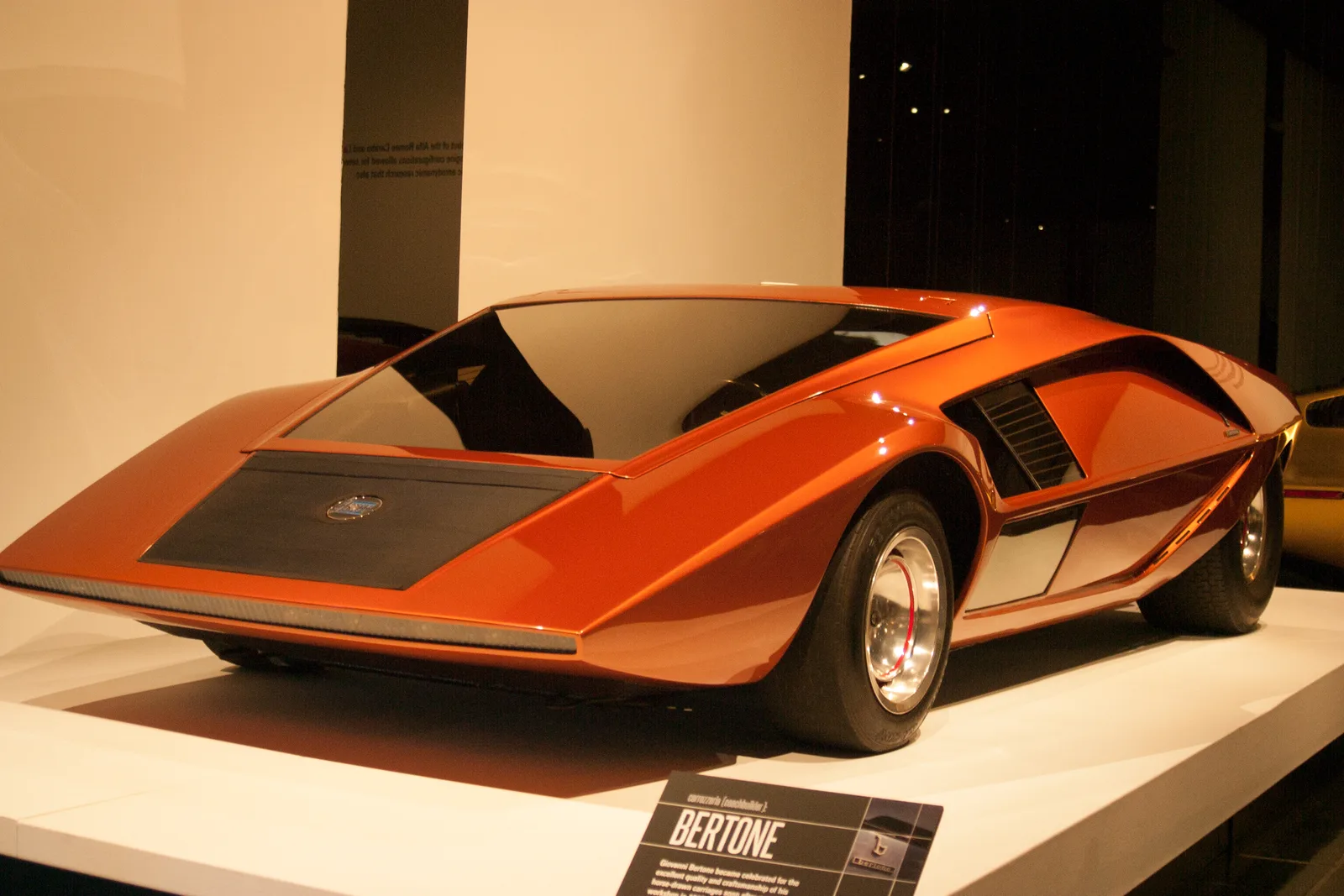
Bertone's Stratos Zero at the Petersen Automotive Museum.
That Stratos was 111cm tall, 27cm more than the Zero. The two had little in common. The wedge had done its work in the car park.
Two things we call the wedge
The wedge is really two decisions: a cabin pushed far forward and straight planes in place of curves. The first has an engineering reason. The second does not.
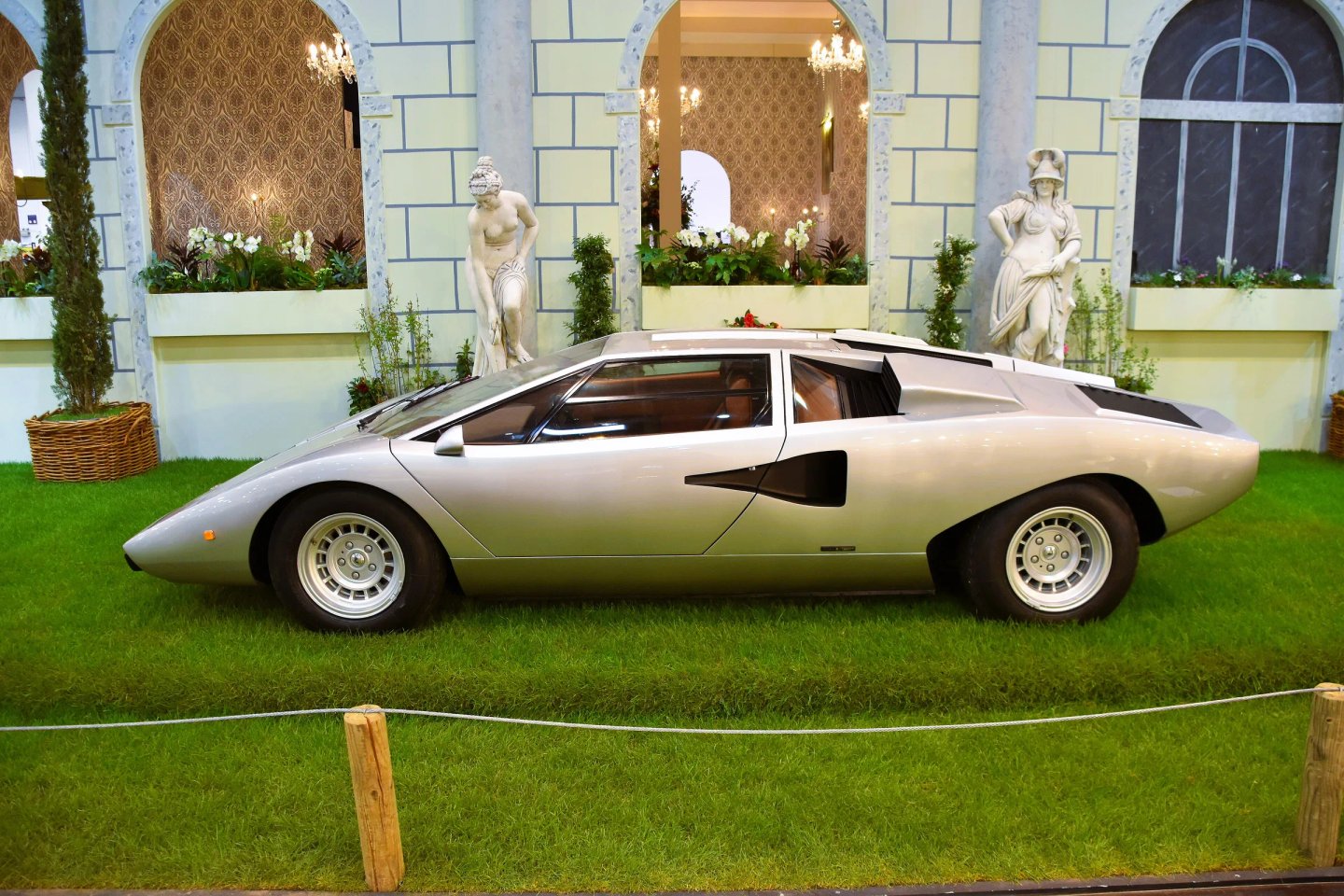
Gandini also drew the Miura, shown at Geneva in 1966: V12 in the middle, about 105cm tall, curves everywhere. In March 1971 the same show had the Countach LP500, again by Gandini and again with a V12 in the middle, this time all straight planes. It was on Bertone's stand. Lamborghini's own stand had the Miura SV.
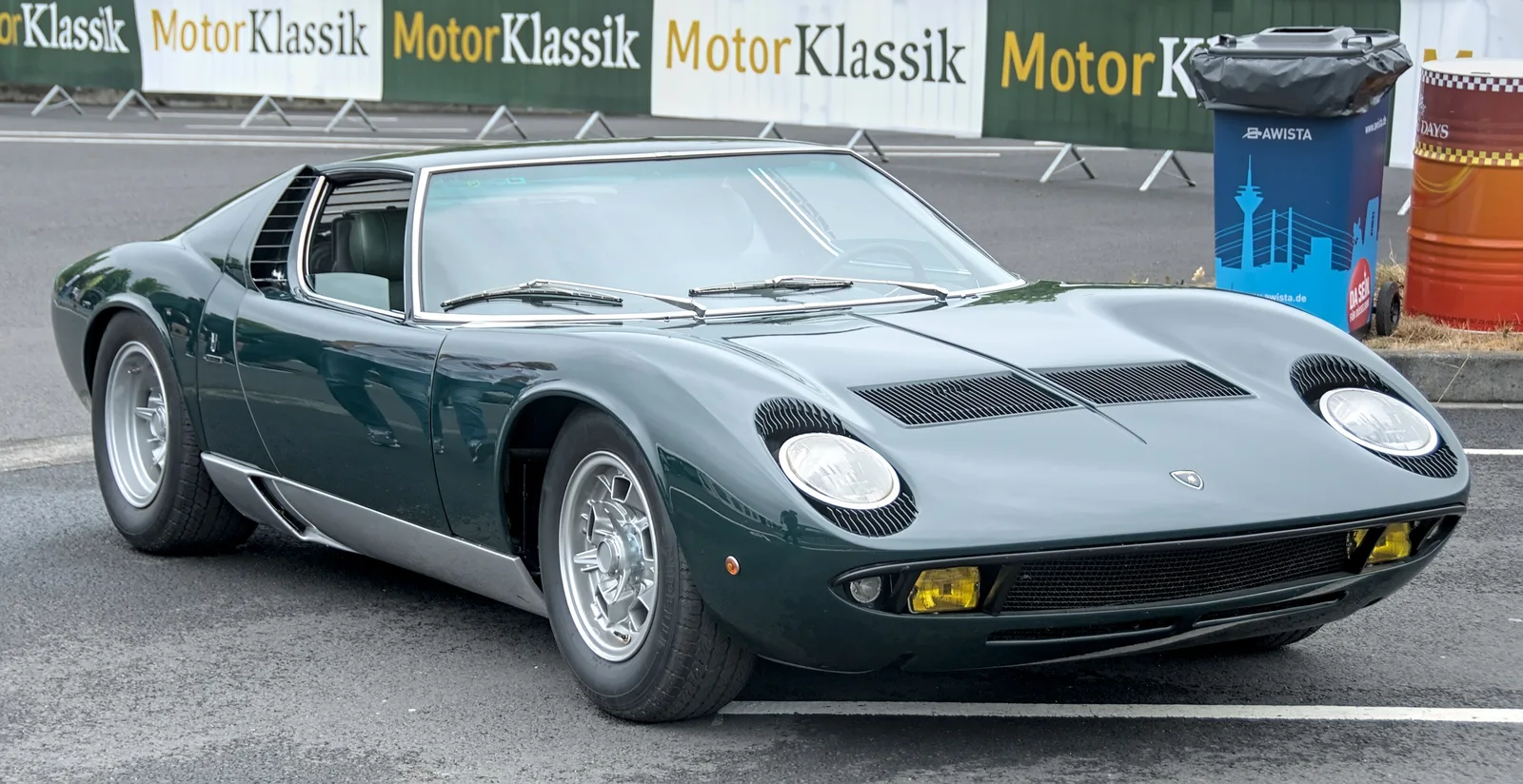
A Miura P400 S, a later version of the car shown at Geneva in 1966.
Part of the difference is engineering. The Miura's V12 sits across the car. The Countach's sits lengthways, with the gearbox ahead of it, between the seats. That explains why the cabin moves forward and the wheelbase is 50mm shorter. It does not explain the straight planes.
What the shape did in the air
Aerodynamics is the obvious explanation, and it does not hold up. According to The Drive, the Countach never went in a wind tunnel. The engineers Paolo Stanzani and Massimo Perenti glued tufts to the bodywork and photographed them on the motorway, and Lamborghini only used a tunnel when Chrysler required it for the Diablo. The drag coefficient came out at 0.42. Ordinary family cars of the period were around 0.45, according to CAR magazine. The Citroën GS of 1970, also a family car, was at about 0.36. At high speed the Countach also had lift at the front axle.
The engineering arrived afterwards. At Geneva the orders came in while the car was nowhere near ready for production. Road testing showed that the louvres behind the side windows could not keep the engine cool enough, so the LP400 that entered production in 1974 got NACA ducts in its flanks and air boxes that stuck out of the bodywork. In 1978 the LP400 S brought the wing, copied from Walter Wolf's Countach. It cost at least 16km/h of top speed and most buyers ordered it anyway. What it gave back is disputed. The Drive says its angle was set to zero, because more load at the rear made the front lift worse. The same piece says the factory fitted it in the car park: electric drill, ten minutes a car.
The wedge that did something
The strongest objection comes from motorsport. The Lotus 56 ran at Indianapolis in 1968 as a wedge, and the Lotus 72 that followed it won the constructors' title in 1970, 1972 and 1973. There the shape had a function: radiators in the sidepods, a flat nose and a car that went through the air better. At Lotus the wedge answered an engineering question, and when a better answer came along it became secondary. The Lotus 78 of 1977 kept the basic shape but took its downforce from underneath, with sidepods shaped as inverted wings and sliding skirts.
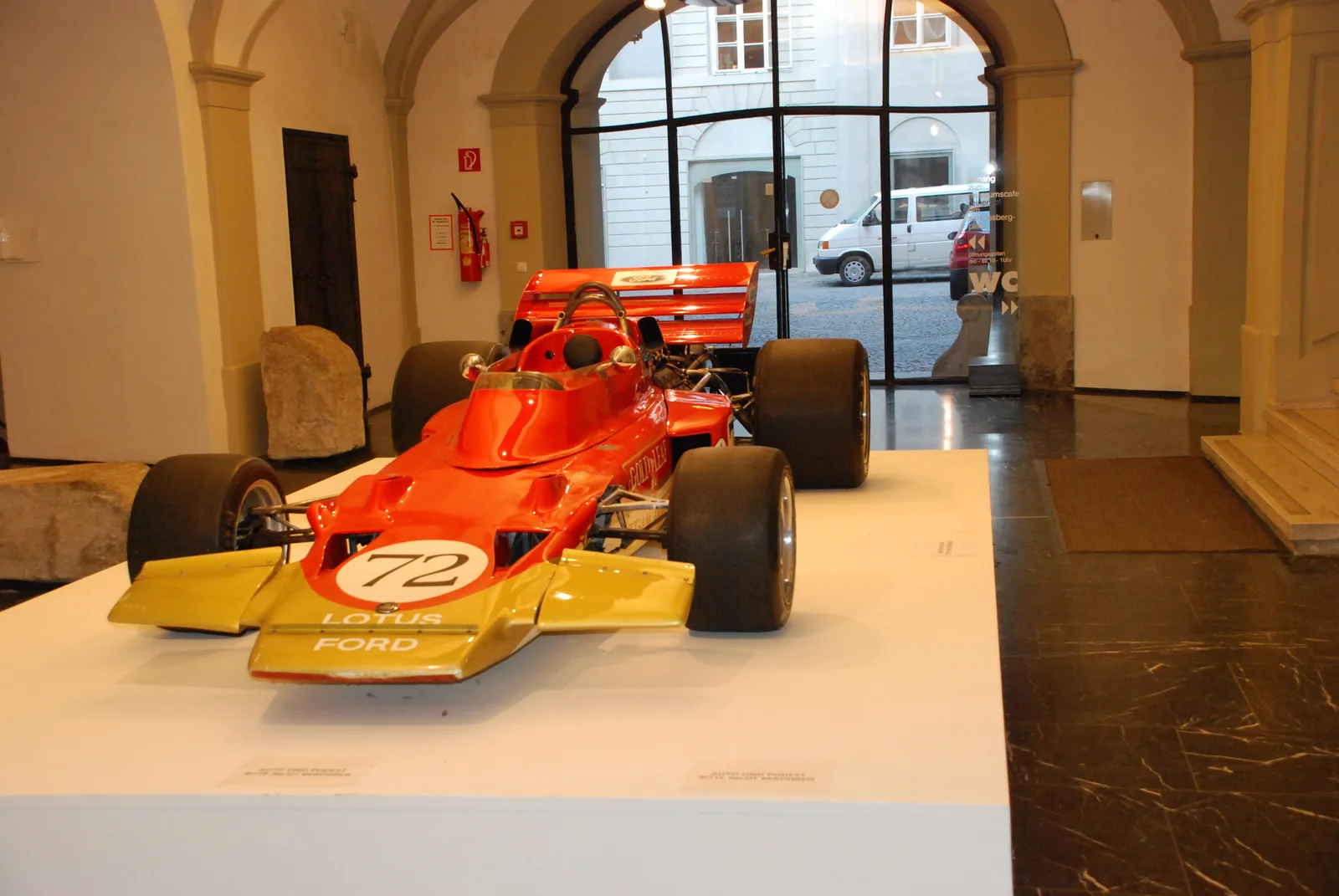
The Lotus 72, with its radiators in the sidepods.
Since then the top of a fast car has had less to do. The Aston Martin Valkyrie gets its downforce mainly from two Venturi tunnels under the cockpit, which keeps the upper body free of add-ons. Lamborghini claims 66% more downforce for the Revuelto than for the Aventador Ultimae and points to the active rear wing, the diffuser and a roof that channels air to that wing.
Our reading, not a measurement: as long as the numbers come mainly from under and behind the car, a sharp upper body costs little. So it can stay. Not everyone chooses it. Ferrari and McLaren draw curves over the same forward cabin. At Lamborghini the straight planes are still there.
What that shape earns
In August 2021 Lamborghini presented the Countach LPI 800-4: 112 cars, named after the development code LP 112, on the base of the Aventador. The press reported a price of $2.64 million and a quick sell-out. The Aventador Ultimae, launched the same summer, listed in the US at $498,258. How much of that gap belongs to the shape cannot be worked out, since the LPI 800-4 also has hybrid hardware and a run of 112 against 600. But Lamborghini sold it as a Countach.
The objection came from the man who drew the shape. On 22 October 2021 Gandini said he had not taken part, and that repeating a past model was "the negation of the founding principles" of his work. Lamborghini replied that it had never credited him with a role.
A diffuser stays on the car for as long as it finds lap time. The wedge stays for as long as buyers pay for it. Gandini thought such a shape should not be repeated. The 112 buyers disagreed.
Images: Lamborghini Countach LP 400 Periscopio (1975) (52866385009) by Charles from Port Chester, New York (CC BY 2.0); Lancia Stratos Zero (7522598642) by Dustin May from Detroit, MI (CC BY-SA 2.0); Lamborghini Miura P400 S Classic-Days 2022 DSC 0086 by Alexander Migl (CC BY-SA 4.0); Lotus 72 by Erika39 (CC BY 3.0). Images resized.


