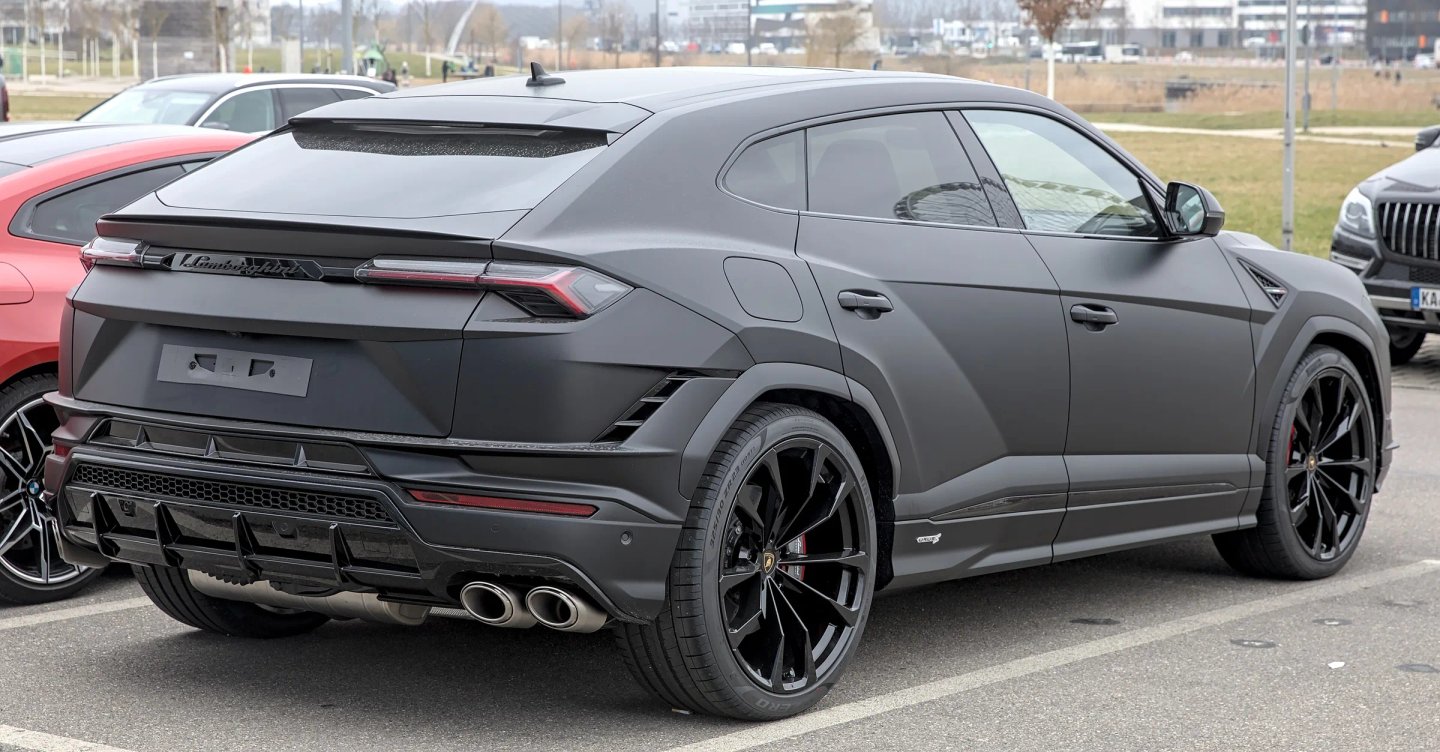
Lamborghini delivered 3,815 sports cars in 2017: 2,642 Huracáns and 1,173 Aventadors. Six years later it delivered 4,025: 3,962 Huracáns and 63 cars with a V12, because the Revuelto had not reached customers yet. That is 210 more sports cars.
Over the same six years the total went from 3,815 to 10,112. The difference is the Urus, at 6,087 in 2023. Turnover rose from €1.0 billion to almost €2.7 billion, and operating profit reached €723 million.
That is where the line on every forum comes from: the SUV pays for the sports car. Enthusiasts say it through gritted teeth. It sounds like a conclusion from these numbers, but it is a claim about accounts nobody outside can see.
What a cross-subsidy is
Economists have a strict definition, set down by Gerald Faulhaber in 1975 with public utilities in mind. A product is subsidised if its revenue does not cover its own extra costs, meaning the company would earn more by dropping it. The payer is the product that brings in more than it would cost to make entirely alone, factory and development included.
Lamborghini publishes no profit per model, so nobody outside Sant'Agata can run that test. There is one data point, though. 2017 was the final year without a Urus. The company consisted of sports cars alone, turned over €1,009 million and closed with a positive operating result despite heavy upfront spending. Lamborghini later described its €614 million result for 2022 as more than double the 2017 figure. A company that builds only sports cars and makes a profit on them does not need an SUV for them to exist. In the strict sense the forum line fails, as far as anyone can see from outside.
What the Urus does pay for
The Urus pays for the size of the company. Before the first one was delivered, the Sant'Agata plant had doubled from 80,000 to 160,000 square metres, good for more than 7,000 cars a year, with 500 new jobs. Those costs were taken on for the SUV, and they do not go away if the SUV sells less.

The factory at Sant'Agata Bolognese, which doubled in floor area around the arrival of the Urus.
What that buys could be seen in the first nine months of 2025. The Huracán ran out at 633 cars and the Temerario had not been delivered yet. Of 8,140 deliveries, 5,995 were Uruses: 74%, against 60% in 2023. That picture is temporary, but turnover still reached €2.41 billion. A second product gives a maker a model change with no hole in the accounts. In 2017 a change like that would have hit the company harder.
So the dependence sits in the costs and not in the V12. At Lamborghini it has not been tested, because the Urus kept selling. At Porsche it has.
Porsche has already run the test
Porsche delivered 279,449 cars in 2025, of which 165,214 were Macans and Cayennes: 59%. The 911 reached 51,583, a record. In the same year the return on sales fell from 14.1% to 1.1%. Porsche puts that mainly down to the cost of its change in strategy, US import tariffs and China, where deliveries fell 26%. The Cayenne lost 21%, though Porsche calls that partly a catch-up effect from the year before. In the first half of 2026 deliveries fell another 16.5%, and 32% in China, while the 911 sold more. On top of the 3,900 jobs going by 2030, another 5,000 will go by 2035.
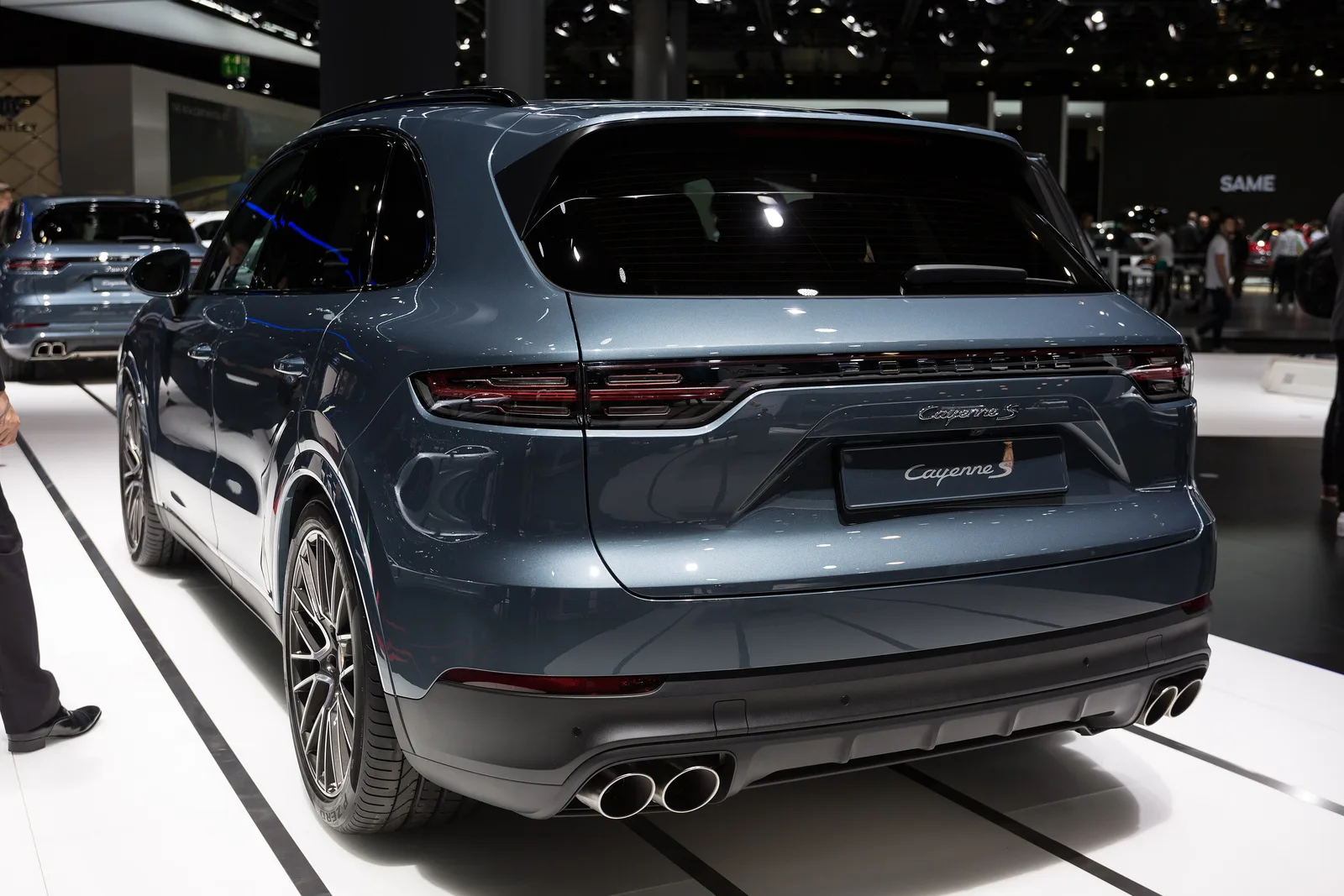
A Porsche Cayenne S at the 2017 IAA. The Cayenne lost 21% in 2025.
In those years the 911 was the stable part. The trouble lay in the electric plans, the tariffs and the volume that vanished in China. And when choices had to be made, this happened: at its 2026 Capital Markets Day, Porsche confirmed that the next 718 will be electric only, with 2028 as its first full production year. The combustion 718 went out of production in October 2025. For that same 2028 there is a new Macan planned with a petrol engine and a plug-in hybrid. Porsche will have more reasons than volume, but the smallest sports car gets no more petrol and the SUV does.
It can be done without
Ferrari shows it is not compulsory. It delivered 13,640 cars in 2025 at an operating margin of 29.5%, and chief executive Benedetto Vigna has said that the Purosangue, which Ferrari prefers not to call an SUV, will never exceed 20% of deliveries. So a sports car maker can manage without SUV volume, if its prices will carry it. Lamborghini had that choice in 2017 as well. It chose growth.
That choice ties things the other way too. The Urus sits on the same MLB Evo platform as the Porsche Cayenne, the Audi Q7 and the Bentley Bentayga. Whatever a buyer pays extra to make it a Lamborghini, they pay for the name. The name comes from the Revuelto and its predecessors. The SUV pays for the factory, and the sports car pays for the SUV's price.
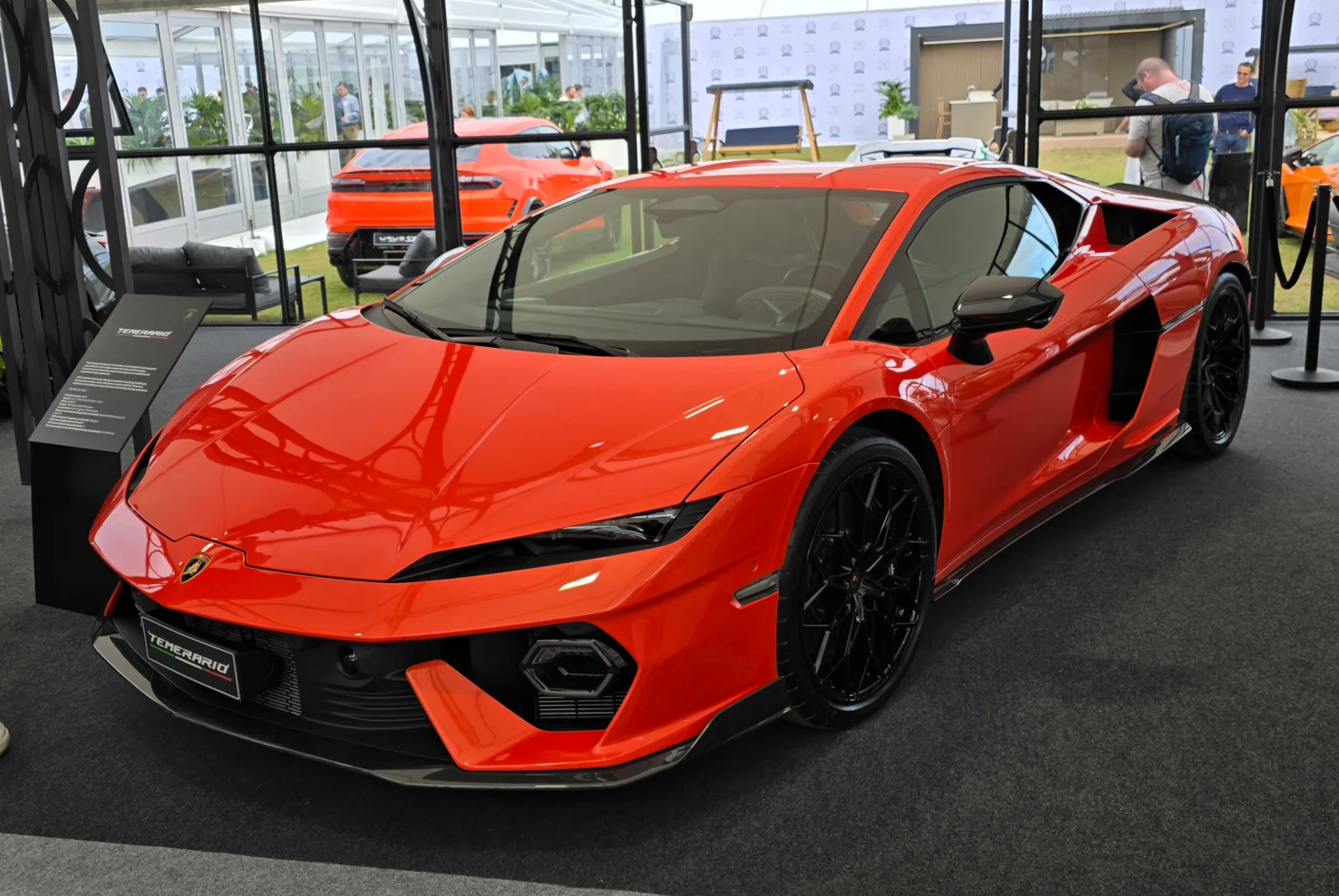
The Lamborghini Temerario, successor to the Huracán. It had not been delivered in the first nine months of 2025.
Meanwhile Lamborghini is leaning on this arrangement for longer. In March 2026 it emerged that the electric Lanzador and the Cor Tauri programme were off the table, and that a fully electric car will not come before 2030. The margin fell from 27% to 24% in 2025, with US import tariffs going from 2.5% to 15% in a market worth about 30% of sales. The figures for 2026 are the first full year with the Temerario. They hold the number we would follow: how many cars are delivered alongside the Urus, with the 4,025 from 2023 as the bar. If Lamborghini clears that comfortably, it stands on two legs. If the Urus stays at three quarters, it mostly builds SUVs. The V12 will then be judged by what it does for the SUV.
Images: Lamborghini Urus S 1X7A6798 by Alexander-93 (CC BY-SA 4.0); Lamborghini, Sant'Agata Bolognese, Bologna by Fabrizio Pivari ( Pivari.com ) (CC BY-SA 4.0); Porsche Cayenne, IAA 2017, Frankfurt (1Y7A2761) by Matti Blume (CC BY-SA 4.0); Lamborghini Temerario 2025 6 by Calreyn88 (CC BY-SA 4.0). Images resized.


