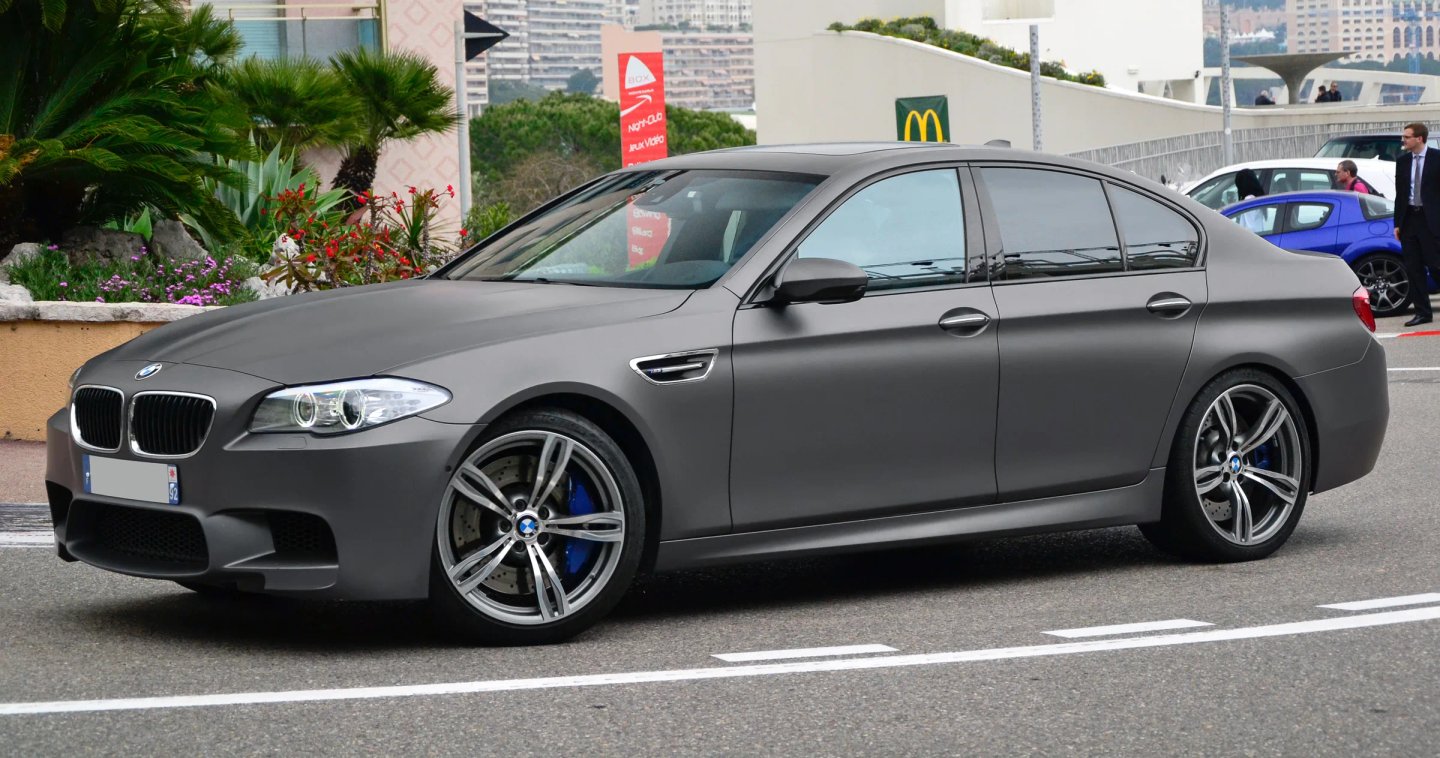
In the fuse box of a 2012 BMW M5 there is a fuse that makes the engine quieter. In March 2017 the Swiss broadcaster SRF published a comparison: the same cabin and the same V8, first with Active Sound Design on and then with the fuse out. Without it the car sounded much tamer. The engine had not changed. The speakers had gone silent. An analysis on the blog Not Just Car Noises in November 2022 worked out what they add at 3,000 rpm and half load: 12 dB at 50 Hz and 14 dB at 75 Hz. Ten decibels sounds roughly twice as loud.
The usual reading is that noise rules caused this: the state demands quiet cars, so the maker fools the driver with a recording. That is only half right, because the rules are not about the driver. They are about the neighbours.
What the rule measures
A European car gets its noise approval on a test track. A microphone stands on each side, 7.5 metres from the centre line and 1.2 metres high. The car passes at 50 km/h, including at full throttle. There is no microphone inside. What the driver hears falls outside the rule. For the fastest category (over 200 kW per tonne, four seats at most, a low seating position) Regulation 540/2014 set the limit at 75 dB from 2016 and 74 dB for new types from 2020. Since July 2026 every new registration has had to meet 72 dB.
Economists call noise outside an externality: the cost lands on someone other than the person making it. Noise inside is just a feature of the product. The rule charges for the first and ignores the second. A maker who wants to sell sound then has two routes. Keep the noise outside for moments when nobody is measuring, or put it inside, where it does not count.
The valve, and where nobody measures
The test looks at a small part of what a car can do. The gear is chosen using a target acceleration based on power per kilo, with a ceiling of 2.0 m/s². An M5 (target about 2.33) and a Mustang GT (about 2.17) hit that ceiling and so get measured in a higher gear at lower revs. Full throttle, then, but at an engine speed where such a motor has little to say.
A valve in the exhaust is the obvious answer: shut at low revs, open above them. The British specialist RPM Technik describes how the valves on newer Porsches with particulate filters close automatically at around 1,500 to 1,800 rpm and reopen at around 4,000 rpm, and it links this to the stricter European tests. Economists call this Goodhart's law: once a measure becomes a target, it stops measuring what it was meant to.
The regulator noticed too. Annex VII of the same regulation adds requirements between 20 and 70 or 80 km/h, and every driving mode that affects noise has to meet them. Sport mode is no free pass. But the maker does not have to run those measurements at type approval. It signs a declaration, and the approval authority may go and test for itself. The annex also has a ceiling on engine speed, which depends on power per tonne. At 200 kW per tonne it sits at 62% of the speed at which peak power arrives. Work that out for 6,500 rpm and you get about 4,000 rpm, right where those valves open again. The coincidence proves no intent. It does show where the rule stops looking.
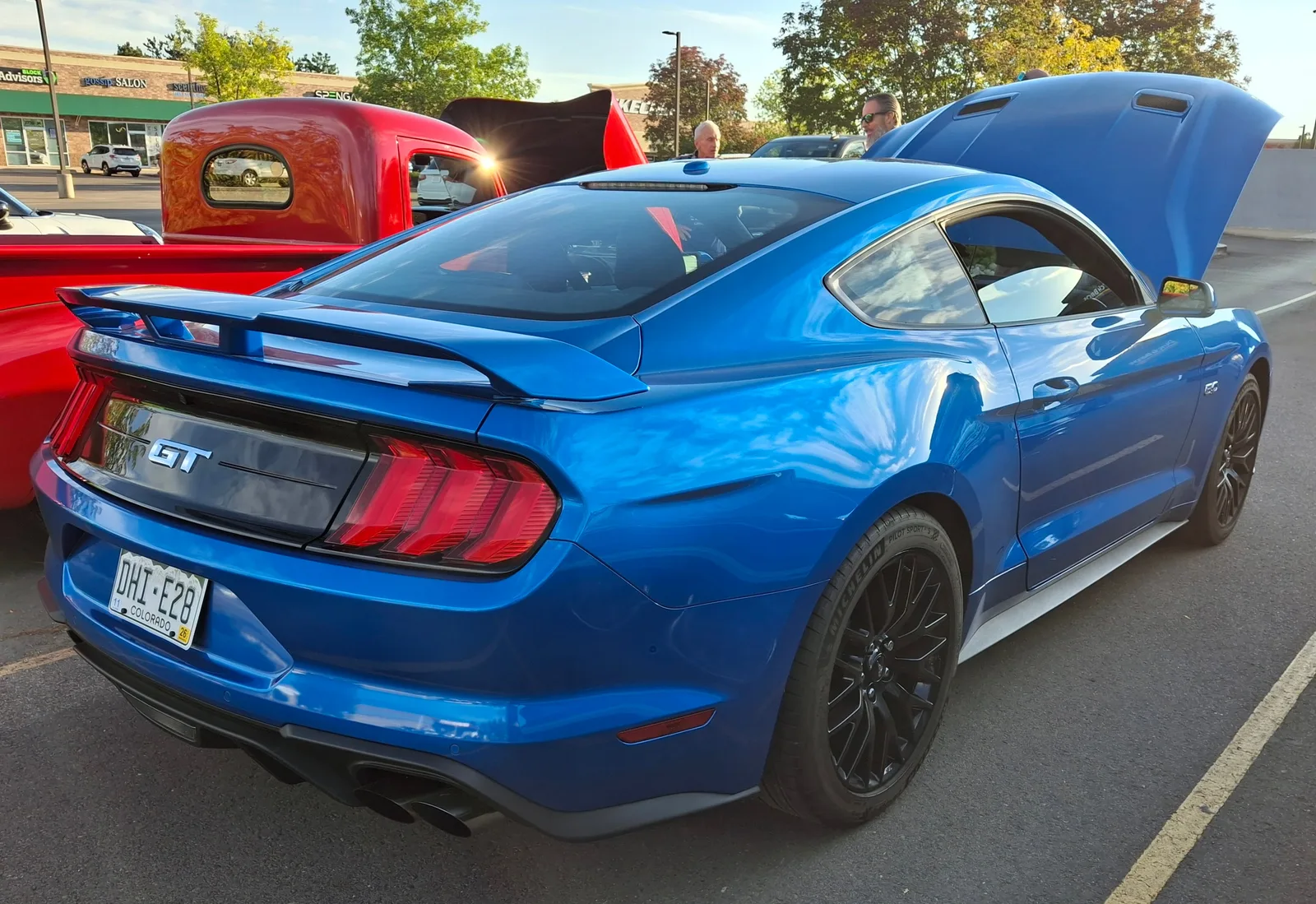
A 2019 Ford Mustang GT. With the active exhaust, the owner can set the hours for a quiet start.
Ford has acknowledged the externality in its own way. In 2017 the company told how the neighbour of its former head of vehicle engineering, Steve von Foerster, called the police when he backed a Shelby GT350 out of his drive. The answer on the 2018 Mustang GT was a quiet start: about 10 dB less, down to 72 dB, at hours the owner chooses. Ford called it Good Neighbor Mode.
The speaker, and where nobody minds
The speaker comes partly from somewhere else. The F10 M5 swapped its V10 for a smaller V8 with two turbos, facing lower exhaust limits and with a better-insulated cabin. There was less sound and less of it got in. That is downsizing and comfort as well as a noise rule. BMW described the system as an accurate reproduction of the engine's sound through the audio system. Volkswagen uses a Soundaktor in the Golf GTI. On the Ford Mustang and F-150 a computer processes the engine sound, and in some of those cars, SRF wrote, you hear the engine with the windows shut but not with them open.
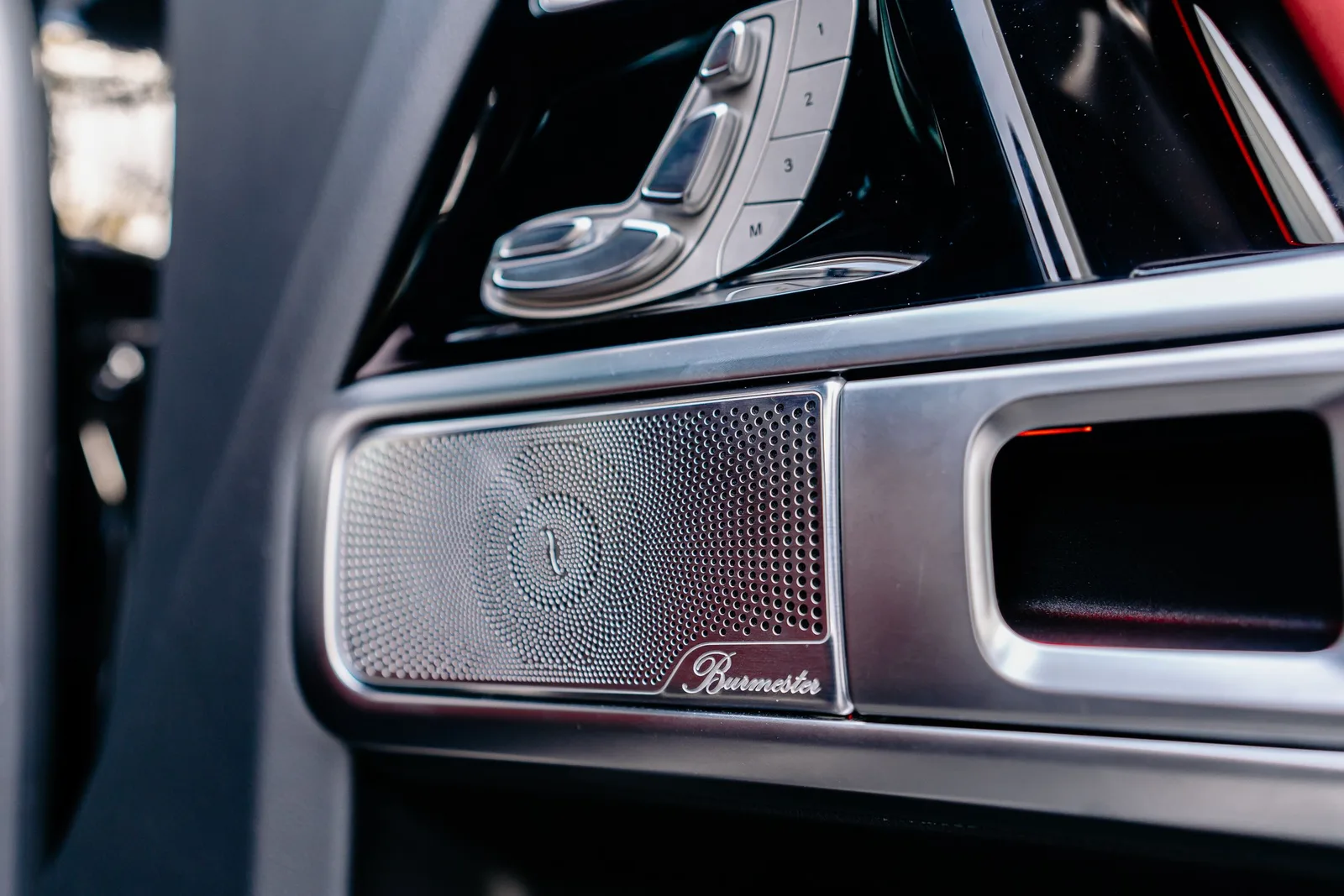
A speaker in a car door, not the one in an M5. In the F10 M5, part of the V8's sound arrives through the audio system.
That sounds like fraud, and BMW fans held it against the brand. Look at it as an economist would. The speaker gives the sound to the only person who wants it and to nobody else. The external cost is zero. A valve does the opposite: it puts the noise on the street as soon as the revs rise. Anyone thinking only of the neighbours should find the speaker the cleaner solution.
Buyers' acceptance is often explained by saying nobody can measure what they are missing. That is wrong. It has been measured, and a fuse is enough. On a test drive there is simply nothing to compare it with. You hear one car with the speaker on, and it sounds like a V8.
Those who do compare sometimes notice. The author of that 2022 analysis found the seventh and ninth orders too prominent, tones nobody associates with a V8. On the M5 Competition they went away again. On newer models the share has come down to a few percent, according to SRF. In 2015 BMW said nearly all the sound in the M3 and M4 was genuine.
The information is sound, by the way: the system takes revs and load from the engine. The speaker does not lie about what the V8 is doing. It lies about where the noise comes from. That costs nobody anything except the owner, who can judge it in an afternoon. Pull the fuse, drive a lap and listen. Would you put it back?
Images: BMW M5 F10 (8694398487) by Alexandre Prévot from Nancy, France (CC BY-SA 2.0); 2019 Ford Mustang GT, rear right side, Coffee & Cars – Littleton 2026-10-03 by Xnatedawgx (CC BY-SA 4.0); Photo by Garvin St. Villier on Pexels. Images resized.

