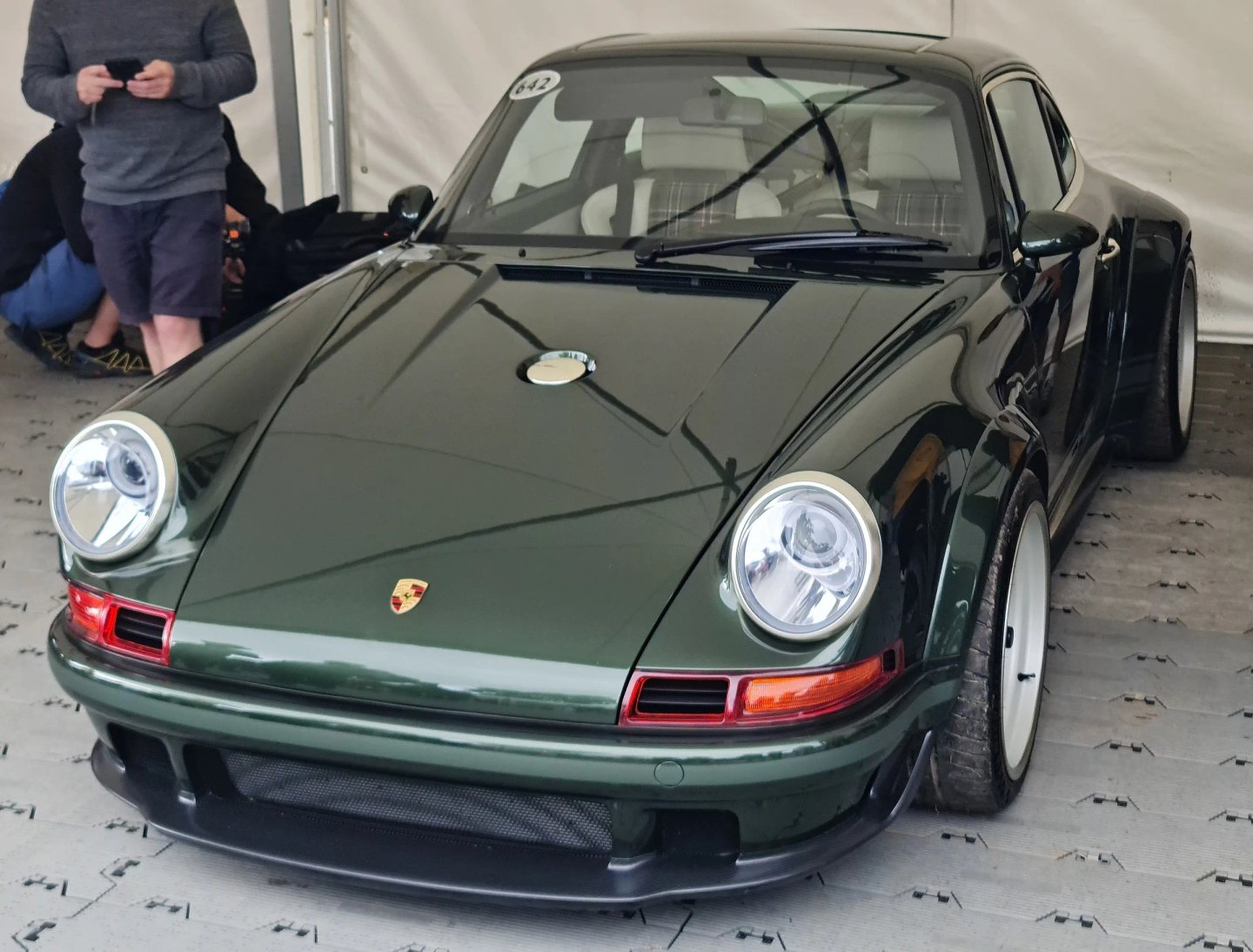
How many Porsche 964s can you take apart before it counts as vandalism? For the Classic, Singer Vehicle Design stops at about 450. That figure appears in auction catalogues, along with the note that the company no longer takes orders for this specification.
Vandalism and tribute are the two words that always come up. Neither helps much. A restoration tries to bring back what the car was. A restomod brings back what people remember of it, using current engineering. Whether that is a good idea depends on two things you can look up: what the buyer pays and what gets lost.
What the price of a Singer says
On 25 October 2022 a Singer sold on Bring a Trailer for $1,205,000, the so-called Gratitude Commission. Prescott Kelly did the sums in Sports Car Market. The restoration had cost $690,000. He put the donor, an ordinary all-wheel-drive 964, at about $100,000, give or take $25,000. So around $790,000 in all.
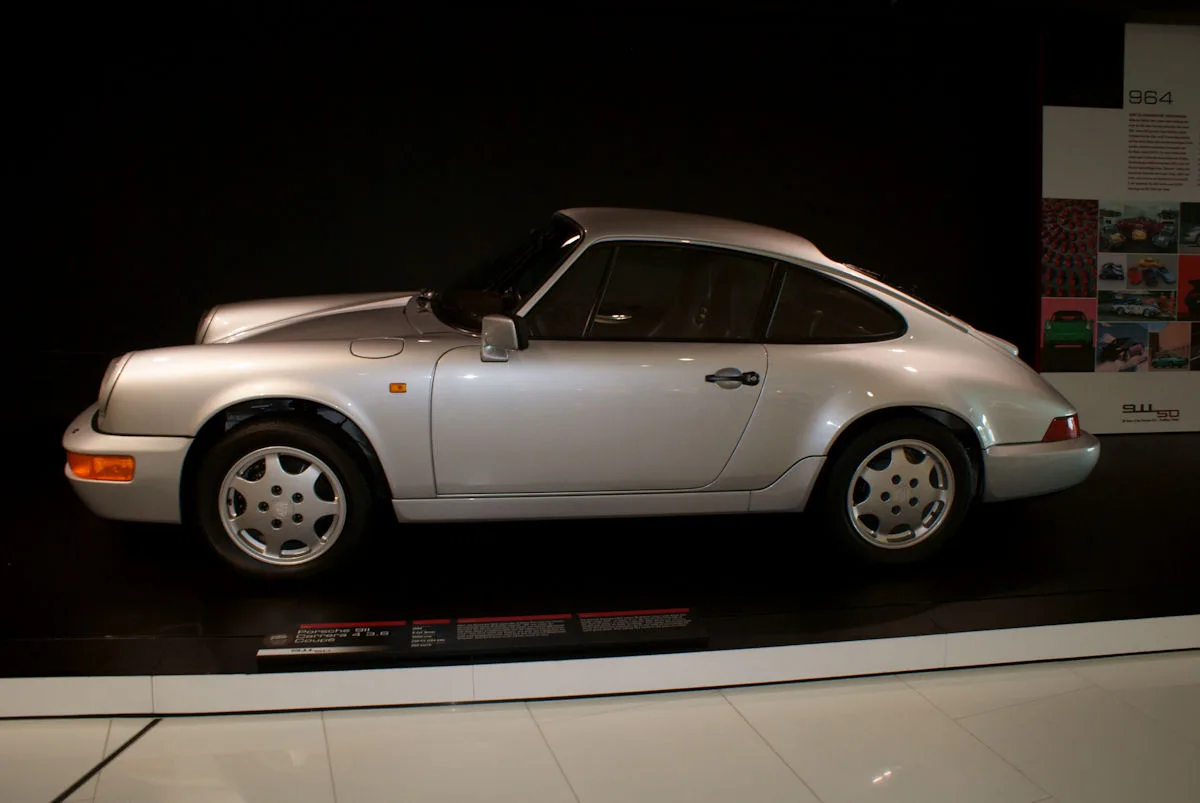
A 1989 964 Carrera 4 in the Porsche Museum. The 2022 Singer also started as an all-wheel-drive 964.
Look at the proportion. The client spent nearly seven times the value of the car on changing it. If the 964 were what people remember, that money would buy nothing. The classic world rarely says this aloud and a restomod's price list does: plenty of cars are better remembered than driven. There may be other motives, such as the shape or knowing the neighbour does not have one. But anyone after the shape alone can buy a good 911 from the 1970s and keep the change.
With the Jaguar E-Type the gap shows up in numbers. The reputation began in March 1961 with 150 mph. Motor recorded 149.1 in an open 3.8. But the test cars for Motor, Autocar and Autosport had been prepared by the works, with balanced engines and gas-flowed heads. The two well-known press cars also ran on Dunlop racing tyres. What an ordinary customer got was not in those tests. Eagle now starts with an original E-Type, fits a 4.7-litre straight six and quotes over 170 mph for the Spyder GT. The Low Drag GT cost £650,000, according to Silodrome. That is a lot of money for the car in the newspapers of 1961.
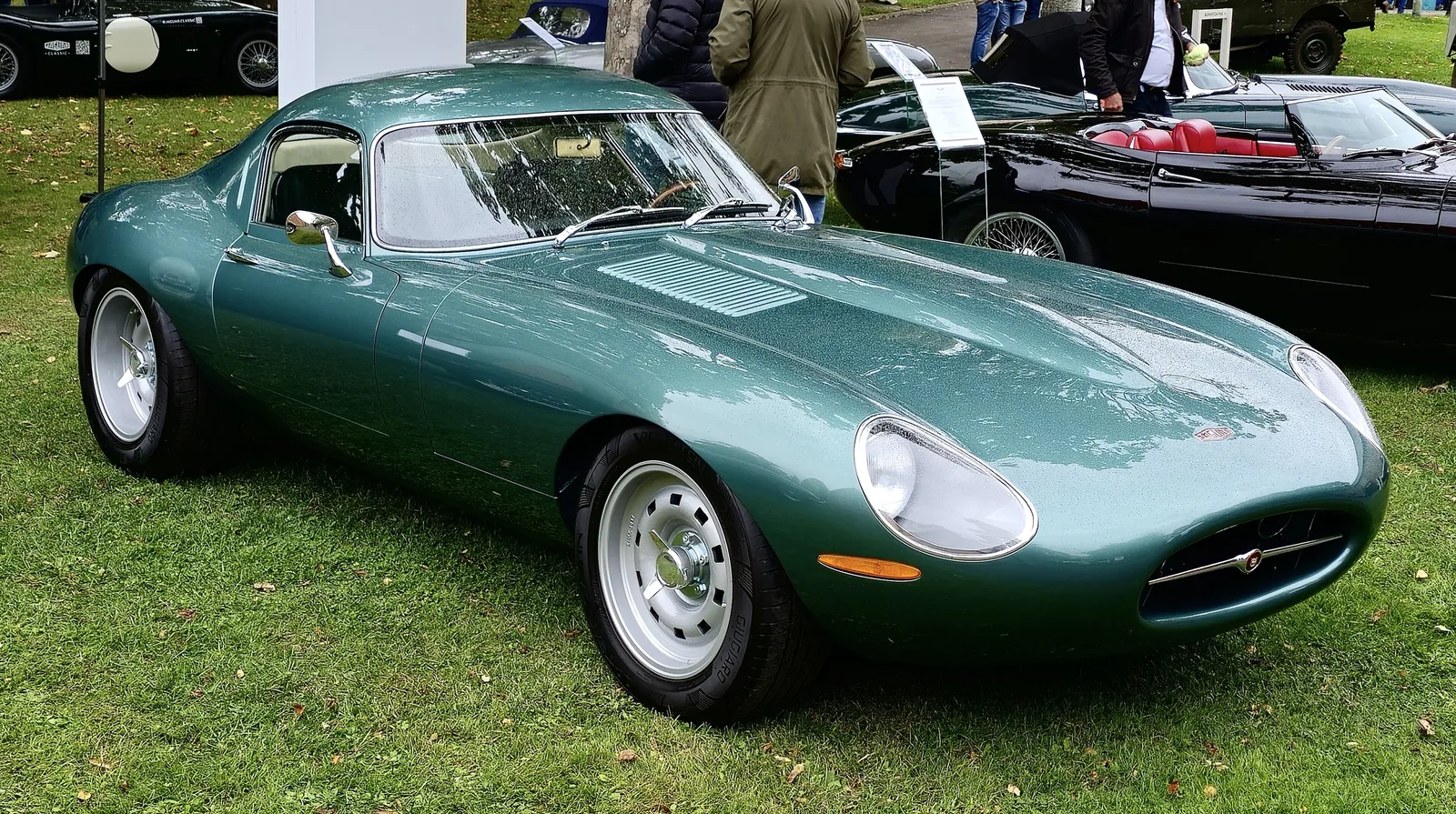
An Eagle Low Drag GT based on a 1962 E-Type, at Bicester in October 2024.
How many donors it takes
Now the objection. Every Singer was a 964. Singer strips it to the steel monocoque, strengthens that and replaces the steel panels with carbon fibre, in a shape that goes back to the 1980s G-series. What stands there is no longer a 964.
In numbers it is less than it sounds. Porsche built more than 62,000 964s, so 450 Singers come to about 0.7%. Kimera builds 37 EVO37s on the centre section of a Lancia Beta Montecarlo, of which about 7,800 were made: half a percent. Kimera also shows that the car you refer to and the car that pays for it need not be the same. The EVO37 refers to the Rally 037, of which about 220 were built for Group B. It touches none of them. The 037 itself sat on a Montecarlo too.
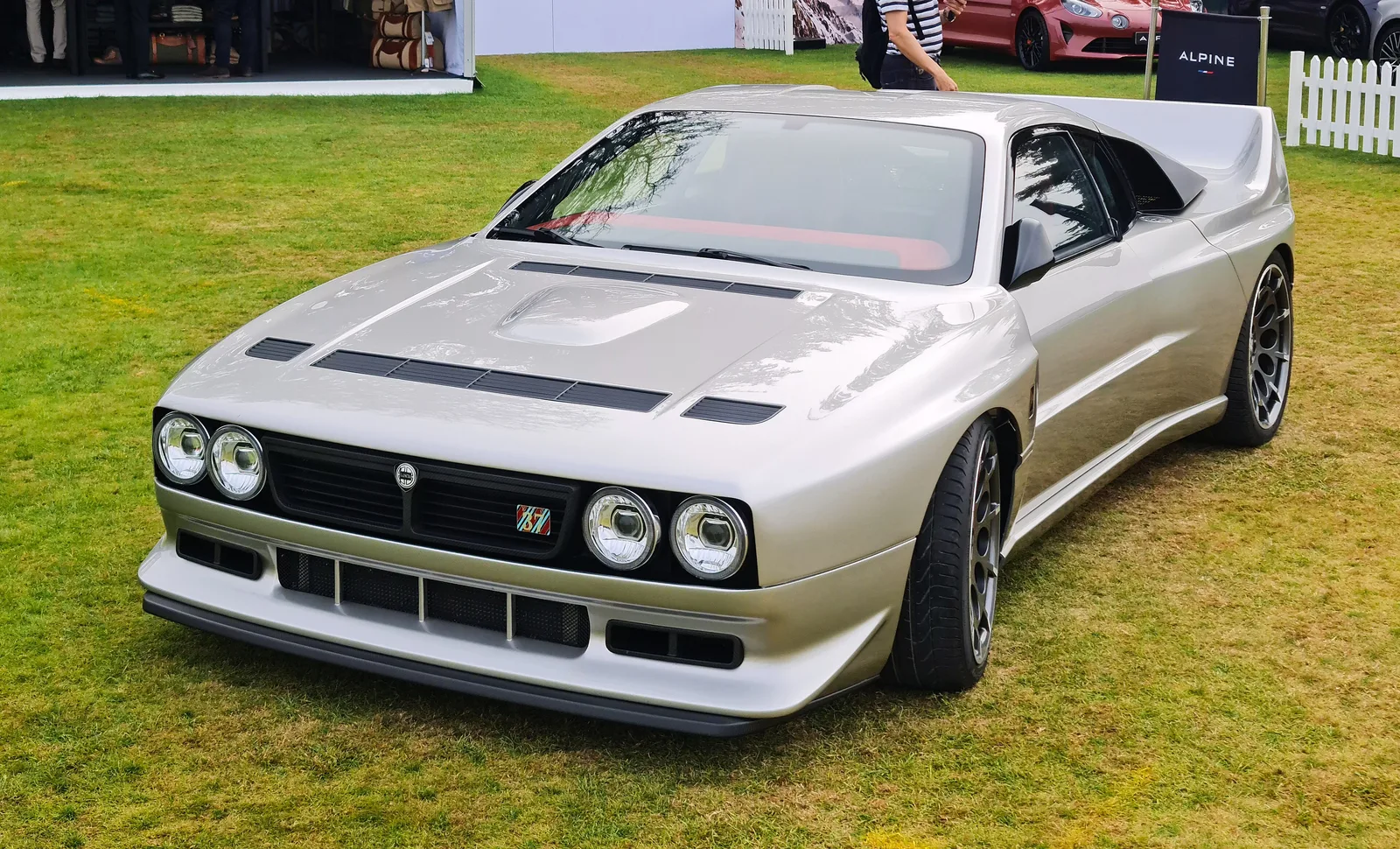
A Kimera EVO37 at Salon Privé in 2021. Under the carbon fibre is the centre section of a Lancia Montecarlo.
Where the objection does hold
Numbers do not tell everything. In 1974 the economists Kenneth Arrow and Anthony Fisher wrote about decisions that cannot be reversed, such as building on a piece of open country. Leave it alone and you can still build later, knowing more. Build and you cannot go back. That difference is worth something in itself. Investors know it as the value of an option.
An original 964 is such an option. It can be driven, restored or converted later. A Singer has used it up. With 62,000 cars the option is worth little per car, because plenty remain. But there is a hole in the sum. The donor is about 13% of the bill, so a 964 costing $25,000 more adds 3% to the total. A client has little financial reason to look for a poor car over a good one. For one Alfaholics GTA-R, according to Classic Driver, the donor was a 1966 Giulia Sprint Veloce. The damage lies less in the number than in which cars they are, and nobody can count that.
It is the owner's car, and they paid the market price. That price just does not include what a buyer thirty years from now would have given for an untouched 964, because that buyer is not bidding yet.
What the buyer risks
The 2022 Singer sold for about one and a half times what it had cost, at a time when a new Classic ran to $750,000 to $850,000, according to Kelly. So the buyer was mostly paying not to wait. Kelly added that for that money he might prefer a Ruf Yellowbird. A Kimera with 237 km, about €480,000 when new, went into a Broad Arrow sale at Zoute with an estimate of €950,000 to €1.15 million. Those are prices from a market with a waiting list. What they look like without one has not been tested.
There is one more thing that does not apply to an ordinary classic. A 964 that needs restoring in thirty years has a factory specification to go back to. A Singer has the specification of one commission, from a company that may no longer exist by then. If taste shifts or the builder goes, the owner cannot return to the original, because that was removed at the time. A restorer in 2060 would be looking at a car with no original to return to and no builder to ring.
Images: Porsche 911 reimagined by Singer VD by MrWalkr (CC BY-SA 4.0); Porsche 911 1989 Carrera 4 3.6 Coupè LSide PorscheM 9June2013 (14825918859) by Valder137 (CC BY 2.0); 1962 Jaguar E-Type Low Drag GT by Eagle BS O24 by MrWalkr (CC BY-SA 4.0); 2021 Kimera EVO37 SP21 by MrWalkr (CC BY-SA 4.0). Images resized.


