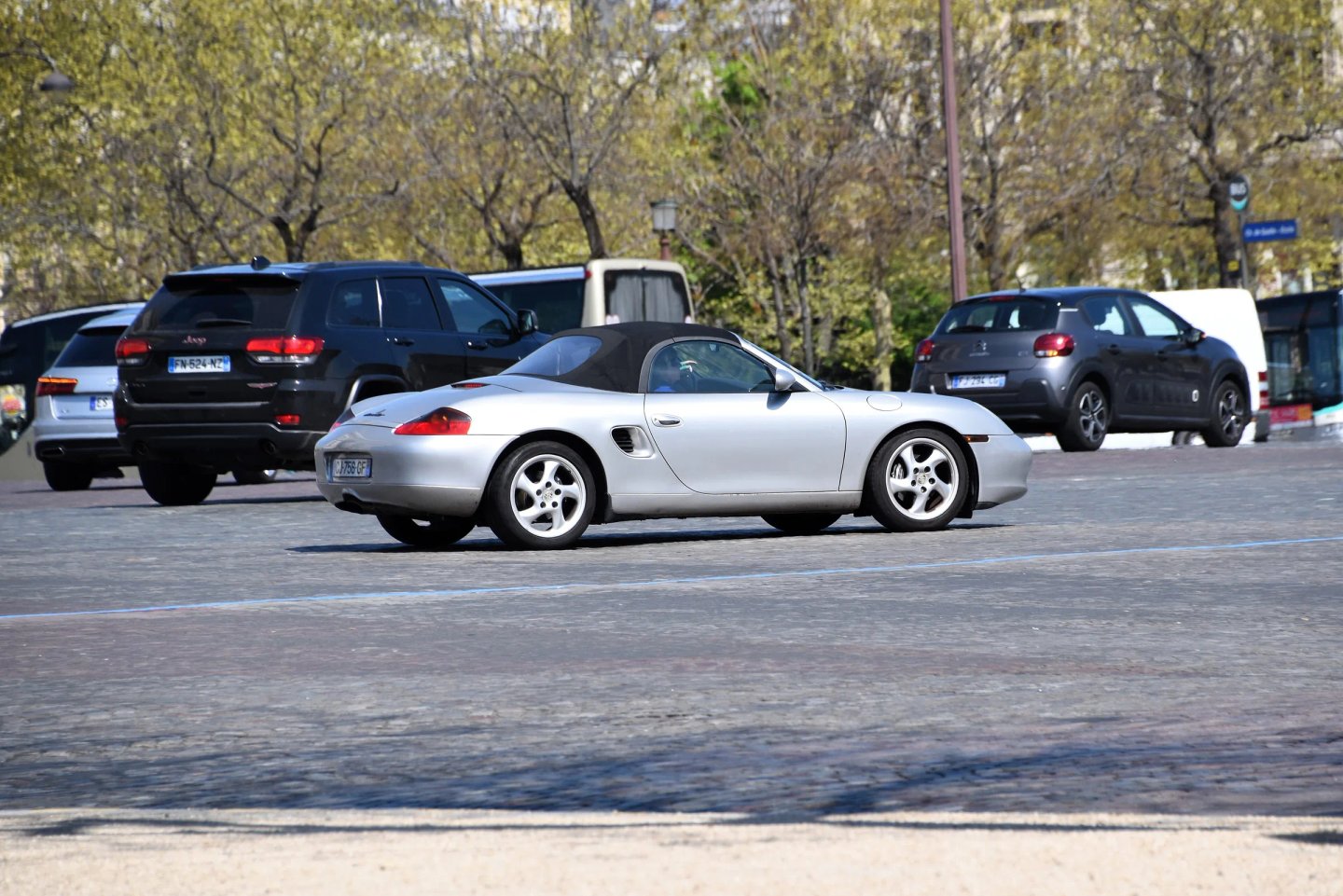
In January 1993 Porsche showed a concept car at the Detroit motor show, an open two-seater with its engine in the middle. The company showing it sold about 14,000 cars that year, against 50,000 in 1986. In 1991 it had been heading for a $150 million loss, the worst year in its history.
In the financial year to July 1997 Porsche sold more than 32,000 cars and made $50 million in profit on $2.2 billion of sales. The production version of that concept, the 986 Boxster, had just gone on sale. It was the best-selling Porsche until the Cayenne in 2003, and 164,874 were built.
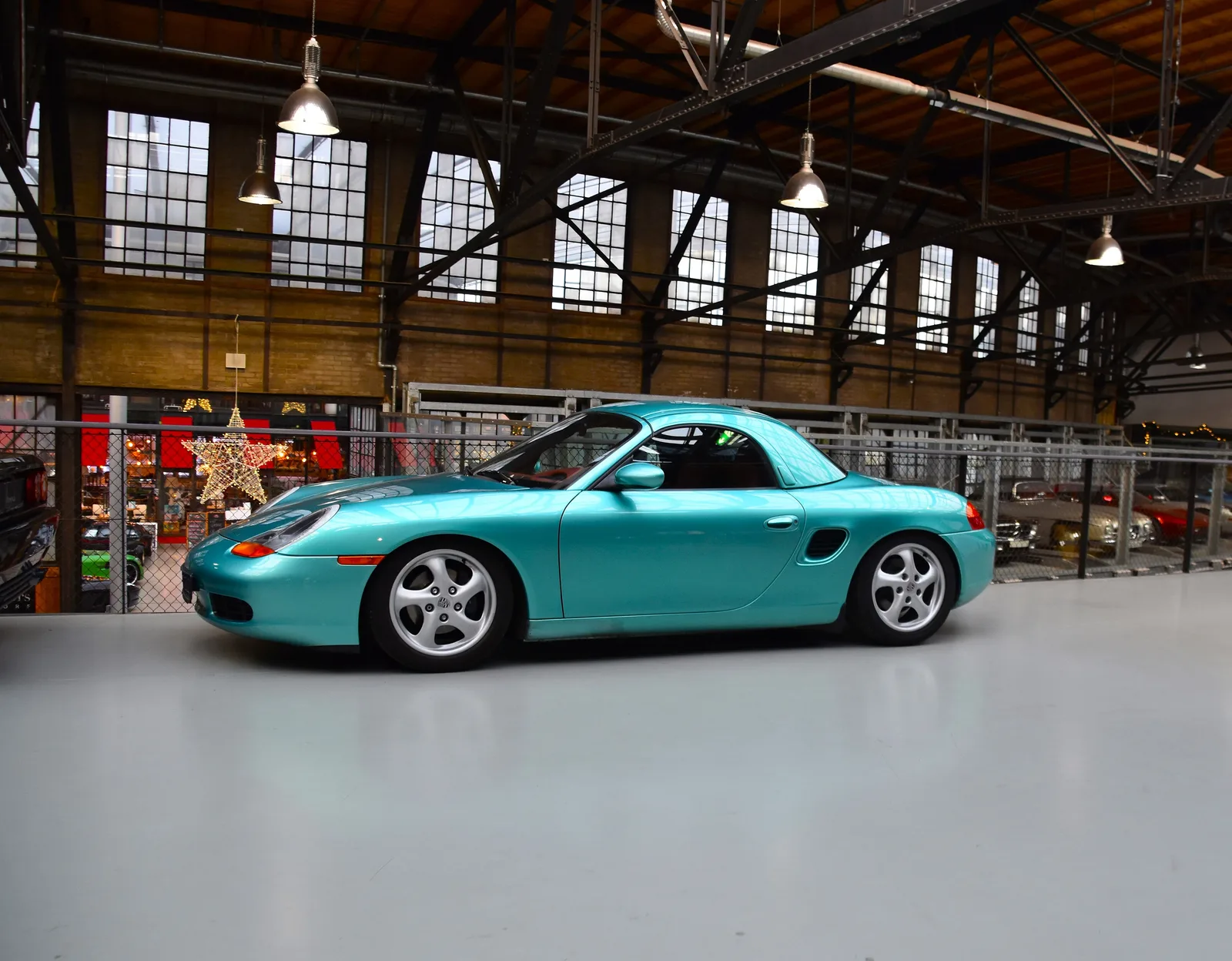
A 1998 Porsche Boxster in Düsseldorf, with the 204 hp 2.5-litre engine.
The German magazine Auto Motor und Sport calls it Porsche's rescue anchor. The same magazine gave the price of a 204 hp Boxster in condition 2, from Classic Analytics: about €19,300 in 2015 and €19,100 at its August 2025 update. Ten years flat, and with inflation a fall. In America the Classic.com benchmark for a 1998 Boxster stood at $13,547 in December 2025. A 993 Carrera Cabriolet of the same year sold for $73,000 on 30 August 2025. That compares a sold car with a benchmark and a cabriolet with a base model, so the ratio of more than five times is rough.
Important is not the same as scarce
The economist Fred Hirsch gave this a name in 1976. A positional good gets its value from the position it gives you, and you cannot share a position with everybody. A collector car is largely that kind of good. What it means in the history of its brand is something else: that is a fact about the past, and 164,874 owners can all have it at once. It comes free with the car. Nobody has to outbid anyone for it.
Then the rescue itself. According to IndustryWeek, Porsche developed the Boxster in 37 months alongside the new 911, with the same engine and the same basis for body parts and chassis, on a common line. The 996 got the same headlamps. The Boxster started at 76,500 marks and the 996 at about 135,000. When demand outran the Zuffenhausen factory, Porsche had some built by Valmet in Finland.
Every item on that list helped the company survive. Every item is also what a collector is not looking for: parts shared with another Porsche, a low price, high volume, some of the output from Finland. So buyers are not ignoring the Boxster's story. The story is the reason for the price.
The Boxster was not the whole rescue either. Wendelin Wiedeking brought in Japanese consultants led by Chihiro Nakao, and the time to build a 911 went from 120 hours to 60. Without that factory the Boxster would have achieved little.
The numbers do not explain all of it
The simple explanation is that there are too many. The 993 reached 68,881, so the Boxster is 2.4 times as common worldwide. But a 993 is no rarity either, and in the Netherlands the difference is smaller. On 3 November 2026 the register of the Dutch vehicle authority held 1,960 Boxsters first registered between 1996 and 2004, and about 1,500 911s from 1994 to mid 1998. The difference in numbers here is 1.3 times, the difference in price more than five times.
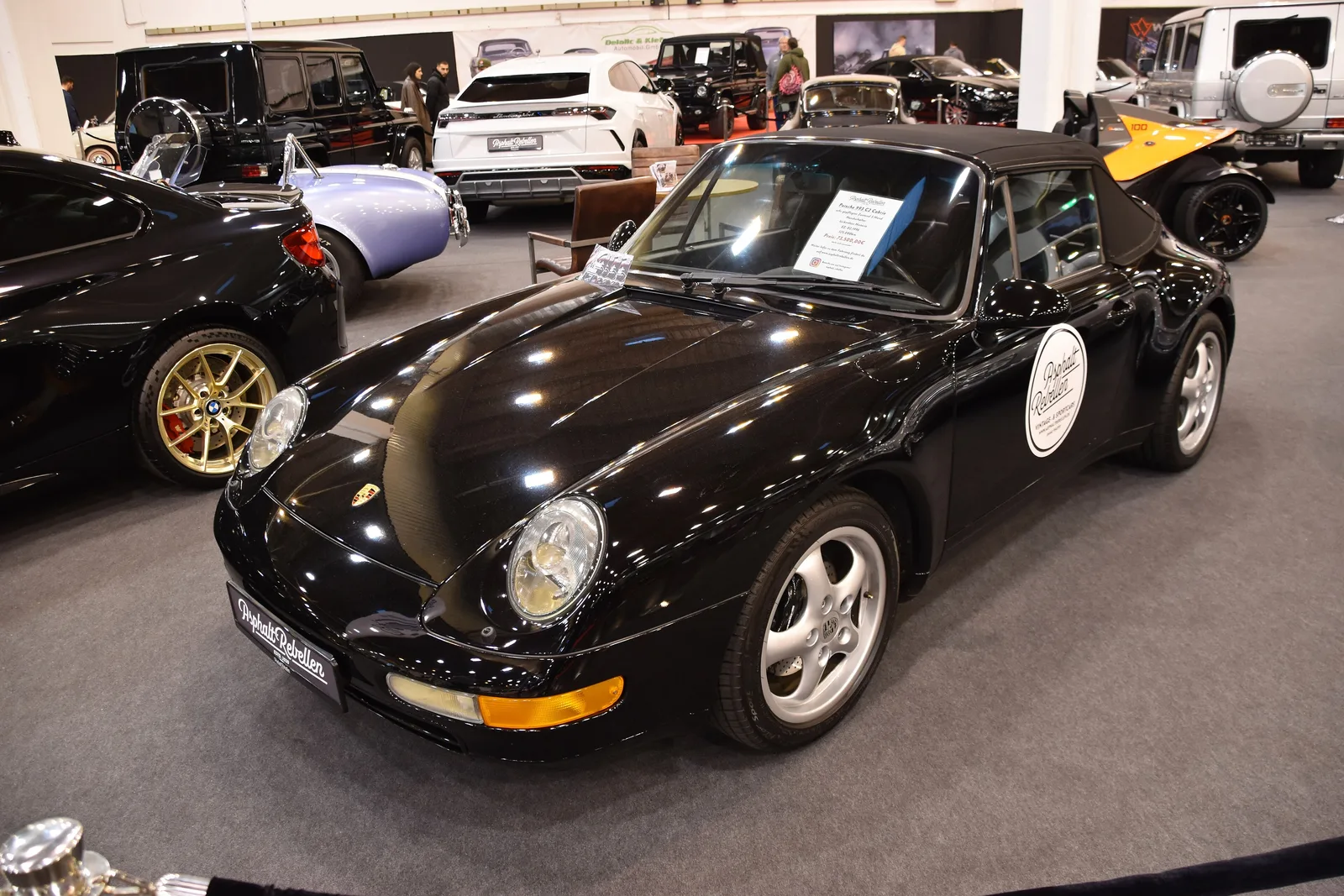
A 993 generation 911 Carrera Cabriolet, built in 1996, at a show.
The rest is rank. Porsche itself put the 911 above the Boxster, in price and in power. That has not changed since 1996. New, a 996 cost less than twice a Boxster, while a 993 today is more than five times, even if that is a different 911. Scarcity only goes so far inside the Boxster line as well. Porsche built 1,953 examples of the 2004 550 Spyder. In 2021 Hagerty UK put one with 50,000 miles at £15,000 to £20,000, against up to £15,000 for an immaculate Boxster S. A car 84 times rarer brings in a few thousand pounds more.
That flat line has another side. Anyone who bought a condition 2 Boxster for €19,300 in 2015 could have driven it for ten years and sold it for €19,100, if the Classic Analytics figures hold and the condition was kept up. That costs servicing and tax, but almost nothing in lost value. As an investment that earns nothing, but ten years in a mid-engined Porsche then cost very little.
So is it undervalued? Hagerty UK put the 986 on its Bull Market list for 2022 and wrote that collectors were starting to move in on perfect early cars. The Classic Analytics series shows nothing of the sort for the ordinary car three years later, although one series says nothing about the best examples. Undervalued assumes a price it ought to be heading for. The story does not supply one, because everybody has known it for thirty years.
What can change the price
What can change is the number. A cheap car disappears faster, because a repair soon approaches its value. In 2021 Hagerty UK gave £1,400 for an uprated IMS bearing and £1,200 for a new roof. Suppose an engine costs €12,000 on a €15,000 car. Many owners will not pay that, and the car gets broken for parts. In time the low price can create the scarcity it is waiting for. In the Netherlands you can check the pace. Of those 1,960 Boxsters, 1,594 had a valid roadworthiness certificate on 3 November 2026.
Images: Porsche Boxster (2003) (53050846379) by Charles from Port Chester, New York (CC BY 2.0); Porsche Boxster (1998) (52560758682) by Charles from Port Chester, New York (CC BY 2.0); Porsche 911 Carrera Cabriolet (993, 1996) (52573993772) by Charles from Port Chester, New York (CC BY 2.0). Images resized.


