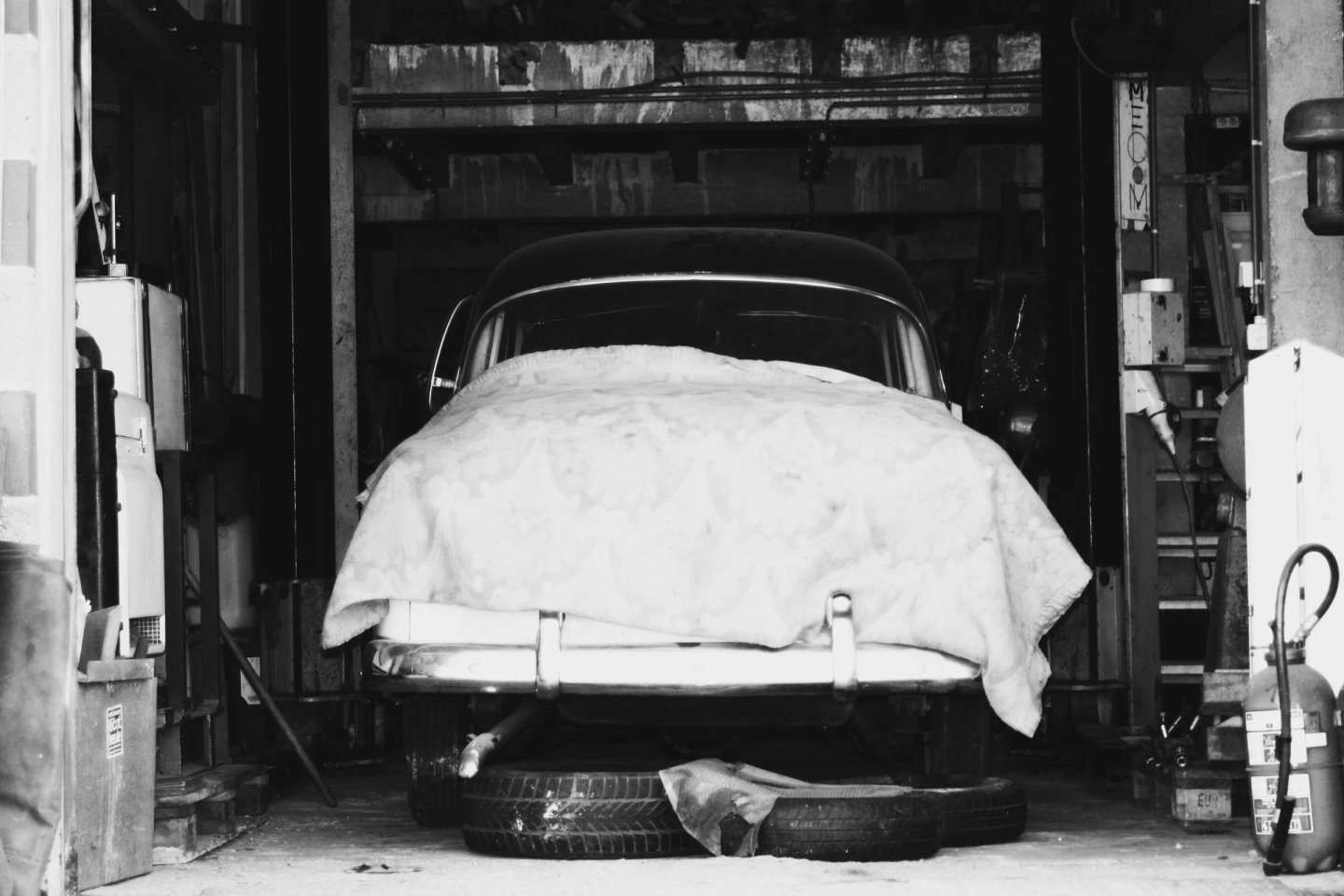
For €29.10, the RDW, the Dutch vehicle authority, will take a car older than 15 years off the road for a year. A younger passenger car costs €88.05. This is called schorsen, suspending the registration. Road tax stops automatically, and neither third-party insurance nor a valid APK (the Dutch MOT) is required any more. Log in on schorsen.rdw.nl, pay by iDEAL and that is it. Then a cover goes over the car and in April someone checks whether it starts.
The suspension deals with the paperwork. It does nothing for the car.
Damp, not cold
As long as the coolant is in order, cold does little to a stationary car. In a storage guide from Hagerty, one of the specialists names moisture as the great enemy of classic cars. Corrosion scientists have a term for it, time of wetness: the time metal spends under a film of moisture and so can rust. The standard ISO 9223 gives a rule of thumb: count the hours when relative humidity is above 80% and the temperature above zero. Researchers consider that crude, but it is enough to show where the Netherlands stands. The Dutch weather service KNMI gives De Bilt, in the middle of the country, an average winter humidity of 86.4% for 1991-2020, at an average 3.9 °C. An ordinary winter day counts.
Something can be done about it, because relative humidity depends on temperature. Air at 3.9 °C and 86.4% holds a fixed amount of water. Warm that air without adding water and the percentage falls quickly: 65% at 8 °C, 55% at 10.5 °C (our calculation, using the Magnus formula). That 55% is the figure James Mills of Hagerty uses for storage. So a room at around 11 °C gets there in principle with no machine at all. In practice a concrete floor, a wet car and a draughty door bring water back in. That is why Mills also mentions a dehumidifier that pulls 20 litres a day, for about £200 to £250.

A simple thermo-hygrometer, here reading 46% at 23.6 °C.
Dry storage, then, is not a measurement. Anyone renting a space can put one of these on the back seat and in a week will know more than the brochure says. The same goes for a cover at home. Plastic over a car that is still wet holds the water against the metal.
What runs on the calendar
The rest of the upkeep runs on the calendar as well. Ben Field of Vintage Tyres wants tyres replaced at ten years. Brake fluid draws water from the air: DOT 4 has a dry boiling point of 230 °C, and with 3.7% water it is down to 155 °C. A car doing 2,000 km a year reaches limits like these on the calendar, long before the odometer calls for a service.
Much winter damage can be prevented by dull jobs. John Mayhead of Hagerty does not want a disconnected battery running down but a self-monitoring charger. Field wants the highest recommended tyre pressure and the car rolled a little now and then, against flat spots. Barney Halse of Classic Heroes warns against wet brakes with the handbrake on. The pads leave a rust print on the disc, and that ends in vibration and new discs.
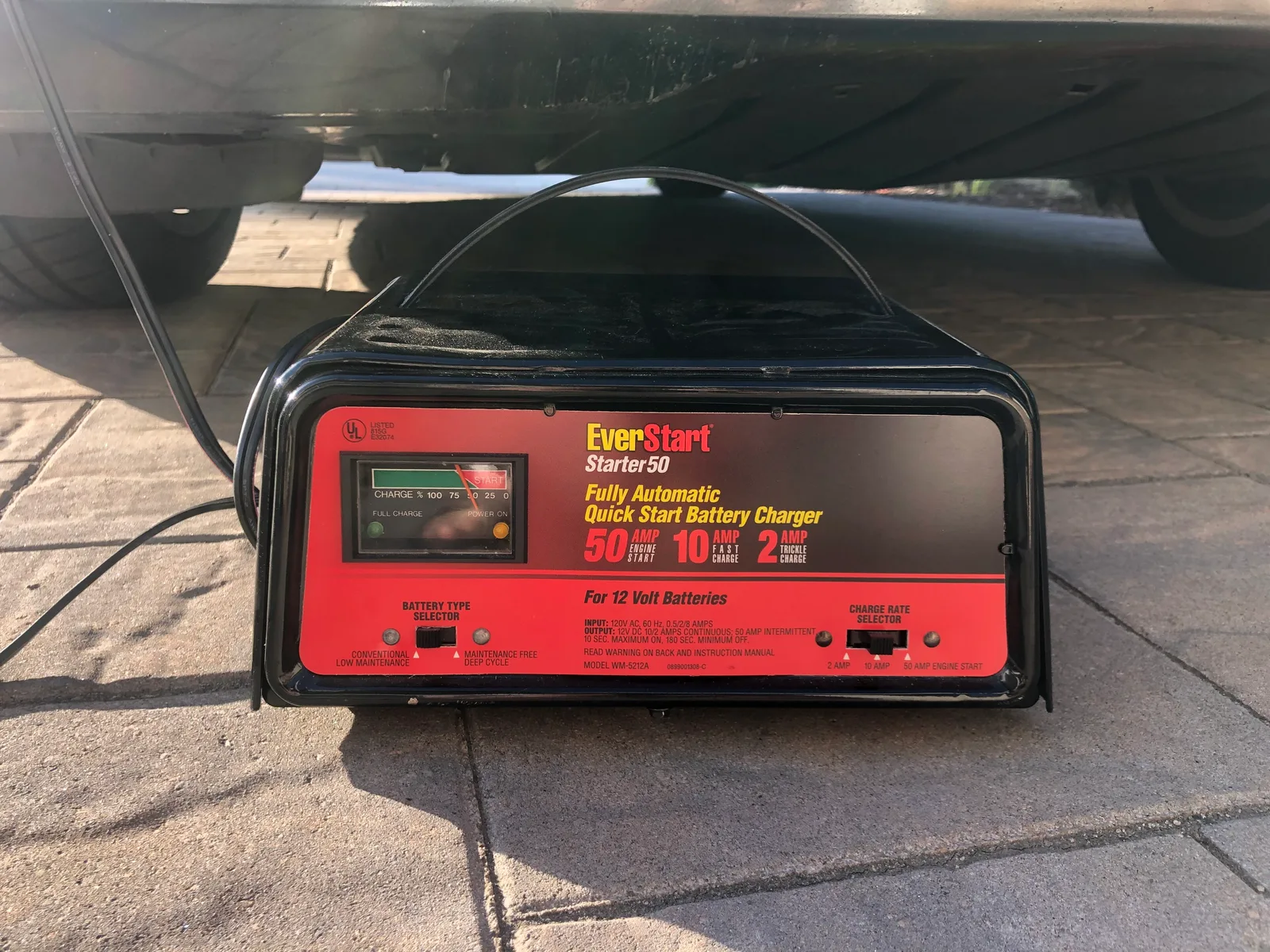
A battery charger with a 2 amp setting, next to the car on the drive.
On two things the specialists disagree, which is worth knowing before anyone presents their advice as law. The tank: Bill Nathan of Hexagon Classics wants a car stored with very little fuel, because petrol goes off and he has not found a stabiliser that works. In spring it gets 20 litres of fresh fuel. Other guides recommend a stabiliser. Ethanol takes up water, so anyone leaving fuel in the tank has reason to choose premium E5, such as the Dutch Super 98, over E10. Starting: Guy Lachlan of Classic Oils wants the engine run now and then and warmed right through. A Hagerty adviser in the US says a properly stored car need not be started at all. A short start without warming through fits neither.
Two honest winters
That brings the suspension back, because it forces a choice. According to the RDW, a suspended car may not be driven on a public road and may not stand on one. So not outside your house. The exceptions are narrow. There is the shortest route to an APK appointment, with third-party cover on that day. A vehicle of 15 years or older may also go to an event, after registering with the tax authority. A run on a dry Sunday in February is not among them.
Say you pay €275 a quarter in road tax (an assumption) and the car stands for five months. That is €458. A suspension costs €29.10 or €88.05, which leaves €429 or €370. For that sum you sell the right to drive that winter. There is no suspension shorter than a year: you pick a year, stop early and get nothing back. Stop within a month and the tax is charged after all.
That leaves two defensible winters. In the first the car is suspended and properly conserved: in dry, charger on, tyres up, humidity measured, brake fluid in date. A service follows in spring, above all if it is going up for sale afterwards. The legal insurance duty lapses, but the RDW refers you to your insurer about the policy. Anyone who cancels everything also has no cover against fire and theft. Once the suspension ends, APK, insurance and tax must be in order at once or a fine follows.
In the second winter the car stays registered, insured and taxed. It goes out once a month on a dry day, for long enough to bring the oil up to temperature. That costs the €458.
The expensive winter is the third: suspend it for the €400, do nothing else and find out in April that the battery is flat and the pads have stuck to the discs.
One more detail from the RDW page that is easy to miss. The suspension starts at once, and a future date is not possible. After payment two e-mails follow, a confirmation and one with the end date. The car is only suspended after the second. Until then the policy has to stay in force.
Images: Photo by Bart Sintobin on Pexels; 2023 Czujnik temperatury i wilgotności Xiaomi (2) by Jacek Halicki (CC BY-SA 4.0); Car Battery Charger 1 2021-05-27 by F ASTILY (CC BY-SA 4.0). Images resized.

