
"reportedly the Penman coachwork was in disrepair"
Seven words from the catalogue entry for a 1930 Bentley 4½ Litre, chassis PB3549, which RM Sotheby's sold at Monterey in 2022 for $698,000. The car was first bodied by A.C. Penman of Dumfries, according to the catalogue the only known W.O. Bentley by that firm. In 1972 it passed to a new owner, who had another body built in the style of Vanden Plas. That is the body on it now.
So the reason a unique body disappeared rests on one adverb. Someone said so, and the sentence does not say who. In the same sentence the new owner is named as the source for the mechanical state of the car, and at the coachwork the attribution stops. That is not carelessness. It is a sentence that stays true even if the body could have been saved in 1972.
This is the best way to read an auction catalogue. The text was written by someone who knows what can happen when a sentence is wrong, and the adverbs mark the places where the house will not stand behind it.
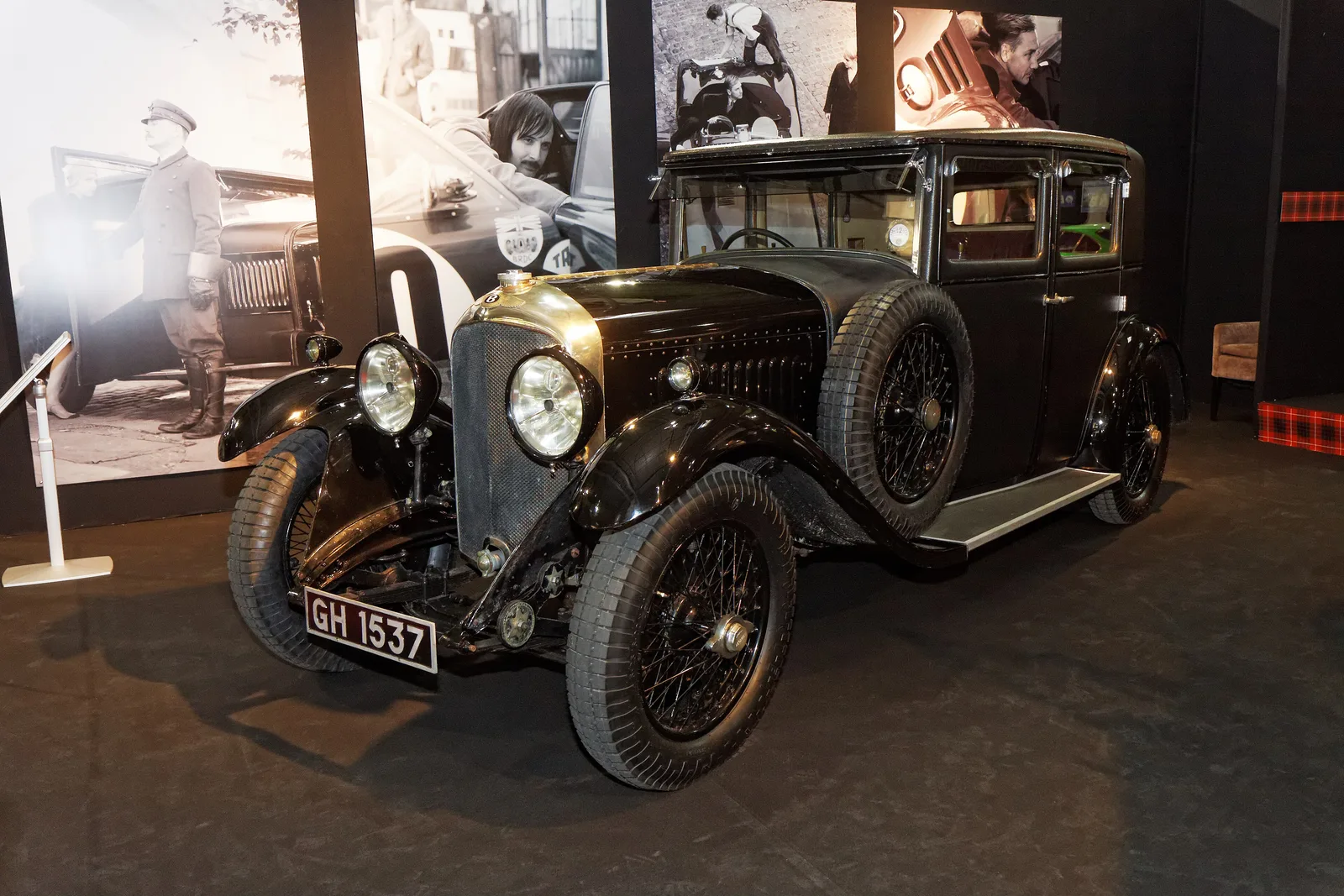
A 1930 4½ Litre that still has its original Freestone & Webb saloon body.
The bold part and the rest
Bonhams says it outright. Its general notice to bidders, here the one for the Monaco sale of 24 April 2026, makes only the part of the entry printed in bold a term of the sale contract. The rest is Bonhams' opinion, given on behalf of the seller. Bonhams acts for the seller and has no duty to check anything. The long passage about first owners and racing history falls under the rest.
RM Sotheby's words it differently and arrives at the same place. Under the conditions for its British Classics online sale, descriptions come from the consignor and third parties. RM need not verify them and gives no warranty on provenance or mileage. Sales are as is, where is, with no cooling-off period apart from the 14 days the law gives a consumer in the EU or UK buying from a business. RM's liability is capped at an amount equal to the buyer's premium. That sale ran under RM Auctions Netherlands B.V. and Dutch law, so this is a European matter as well. Terms differ from sale to sale, so read the ones for the sale in question.
Even the bold part promises less than it seems to. In 2007 the English specialist Stanley Mann sold a car as a 1930 Bentley Speed Six for £425,000. The engine dated from 1927 and had been uprated, the body was new and the chassis had been repaired with a lot of new steel. The buyer went to court. In 2012 the Court of Appeal held that the description did not require an original engine or a continuous documentary history. A chassis with its original number was enough, and a 1990 Volvo need not contain a 1990 engine, the court wrote. Anyone who wants history must stipulate for it. What Mann had said orally went back for a re-trial. This was a dealer sale under English law rather than an auction, but it shows how little a model name promises.
What the art world agreed on
Art auctions have a glossary for this. With old masters, the painter's full name stands for a work the house gives to the painter. Attributed to means probably by them, at least in part. Studio of comes from their workshop, by another hand. Circle of is someone around them, manner of is in their style and later, after is a copy. The houses print the list. A buyer knows what each step means and, as Artnet points out, that their protection shrinks with each one.
The Bonhams and RM terms we read contain no definition of reportedly or believed. The words are used anyway, so the reader has to build the ladder themselves. Here is ours, from firm to soft.
- A named source. A 4½ Litre offered by RM in 2014 had a report by the Bentley specialist Clare Hay on file. A 1963 Ferrari 250 GTE, sold by RM in 2023 for €545,000, has matching numbers according to factory data. You can ask to see things like that.
- Believed. Somebody thinks so. That same Ferrari is believed to be one of two surviving Le Mans safety cars from the 1960s. The entry does not say who believes it.
- Reportedly. Somebody said so. The writer does not say who and does not vouch for it.

A 1962 Ferrari 250 GTE. The car at RM was a 1963 Series III, chassis 4155.
In the style of does not belong on that ladder. It sounds like a hedge, and it is the clearest sentence in the catalogue: this body is not by Vanden Plas. PB3549 made $698,000 on those terms, and a 4½ Litre at Amelia Island in 2016 made $852,500.
The little word by gives less to hold on to. A 4½ Litre by Vanden Plas was estimated at €530,000 to €690,000 at Villa Erba in 2013 and did not sell. Its highlights claimed original coachwork, while the running text described extensive restoration in 1966 and a replaced chassis frame. Another 4½ Litre by Vanden Plas, with its first and only body, was estimated at $1.8 million to $2.2 million in 2014 and did not sell either. The same three words in the heading, about a factor of three in the estimate. The difference is in the running text.
What this does to a bid
Whatever falls outside the contract, you pay for and do not own. A bid on a car with a famous first owner contains money for that owner, while the seller may not be held to it at all.
So each adverb is a question to put before the sale: who says this, and where is it written? A document can be requested. At Octane, buyers can ask questions publicly during the auction. An answer is still no guarantee, but it is on the page. Whatever really matters to you goes in the sale agreement, which is what the Court of Appeal meant by stipulating. If no answer comes, take what that sentence is worth off your maximum.
After the hammer that is no longer possible. The buyer of PB3549 cannot find out whether the Penman body could have been saved in 1972, because it no longer exists. The sentence in the catalogue stays true.
Images: Bentley 4½ Litre - Right side - 20090924 by Sémhur (CC BY-SA 4.0); Paris - Retromobile 2013 - Bentley 4½ Litre sport saloon - 1930 - 103 by Thesupermat (CC BY-SA 3.0); 1962 Ferrari 250 GTE by Writegeist (CC BY 3.0). Images resized.


