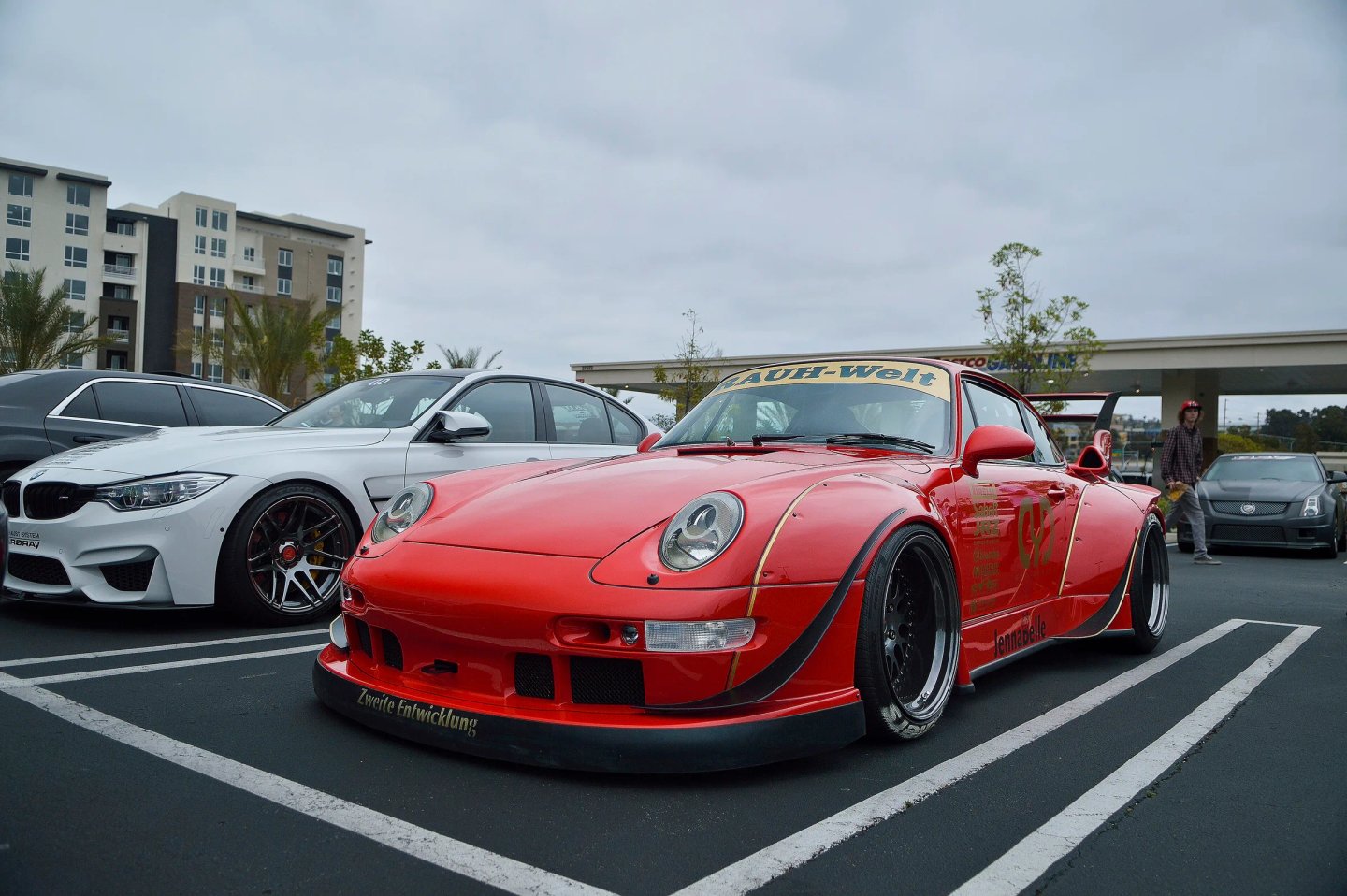
The tools are a roll of tape and a small air saw. Akira Nakai, the man behind Rauh-Welt Begriff, holds a fibreglass wing against a Porsche 993, tapes off the cutting line and saws just below it by hand, with no template. Motor1 watched one of these builds in 2024. The owner's body shop had put in 360 hours over 38 days and the car had just been repainted. Nakai allows about two days per car.
A cut like that is the clearest form of what every modification is: a bet. The stake is what you pay plus what the standard car was worth. The outcome depends on someone you do not know: the next owner and what they will like in ten years.
Most of these bets lose
Paul Cowland wrote at Hagerty UK in May 2025 that a well-modified classic costs, in his estimate, around half of a standard one. That is one expert's judgement and not a measurement, but look at what it says. The work did not come free with the car, it made the car cheaper.
That discount is no accident. A modification narrows the pool of buyers. A standard 964 suits anyone who wants a 964. A 964 with your wheels, your exhaust and your choice of interior suits whoever wants exactly that, and everyone else mainly sees what they will have to undo first. Someone buying well-modified cars gets another person's work for nothing, with a discount on top. Cowland recommends them for that reason.
The few that became a market of their own
The exceptions are large. At Gooding on Amelia Island in March 2025, a 1989 RUF CTR with just over 1,000 miles made $6,055,000. A month later another CTR made $4,680,000 at Broad Arrow. In 2018 one made $1,022,500 at RM Sotheby's. They built 29.
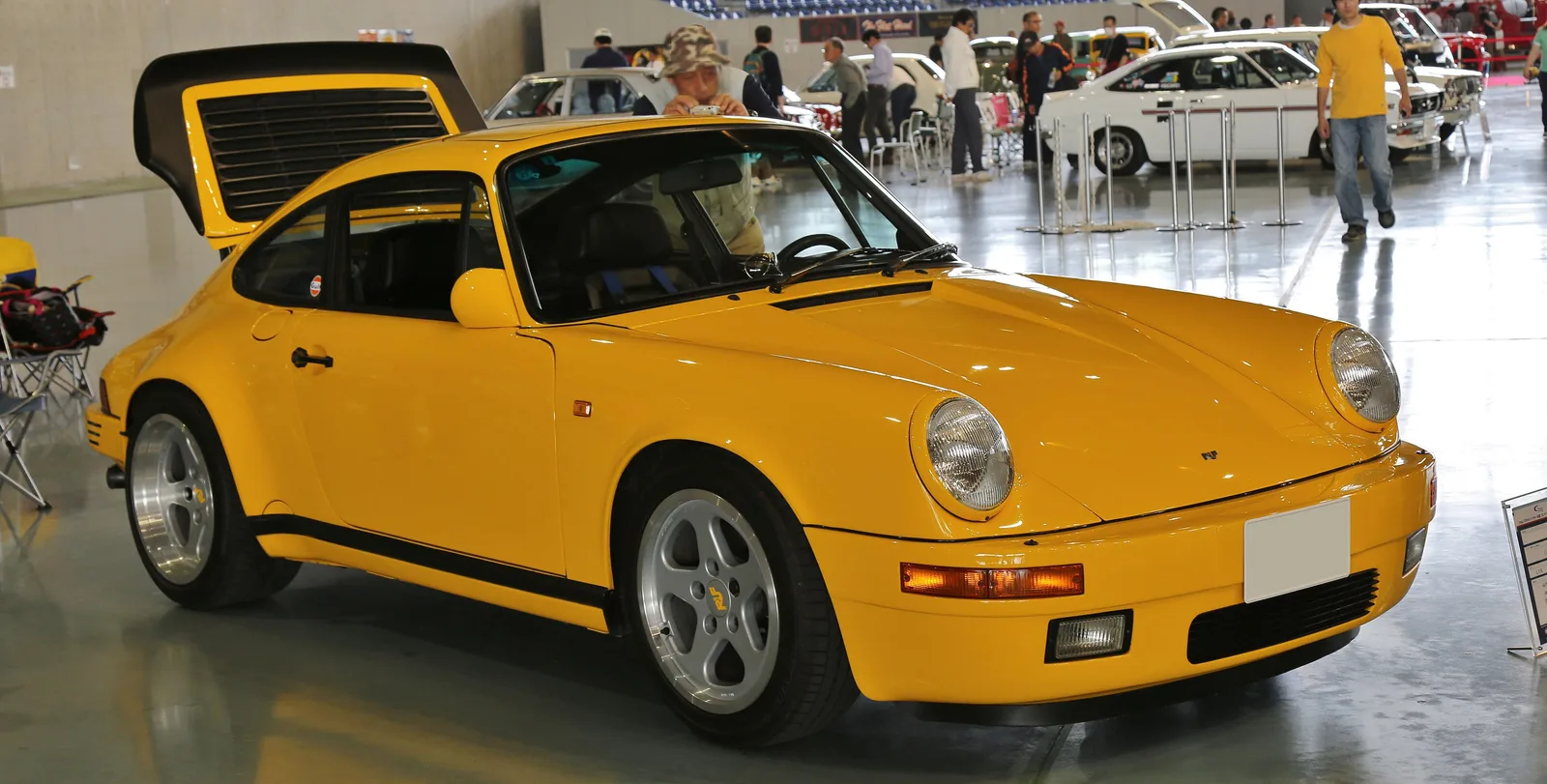
A 1989 RUF CTR, the type known as the Yellowbird.
That same month Gooding also offered a Mercedes 300E to which AMG gave a six-litre V8 in the late 1980s, a conversion costing nearly 100,000 marks. It made $753,000. That was far below the $1.25 million to $1.75 million estimate, and far above what an ordinary 300E fetches.
RWB belongs in this group, with wider swings. A 964 with an RWB body made $115,000 on PCarMarket in April 2019. Another, built in Kashiwa in 2022 and with a manual gearbox, made $241,000 in April 2023. For comparison, a standard 964 Carrera 2 with 111,000 miles made $78,400 at Gooding in August 2022. Take that standard car as a donor, add a kit from $28,000 and you are at over $106,000, before wheels and paint. A rough sum, since the years and cars do not line up. The 2019 car was about there and the 2023 car well above it. There, the sawn metal was worth more than the whole metal.
But in August 2025 a 993 Tiptronic from Hong Kong, with eleven previous owners and Nakai's signature on the dashboard, went for £68,205. An RWB has no fixed price.
What do the winners have in common? A name that is not the owner's. Someone buying a CTR is not paying for the previous owner's taste, but for Alois Ruf's. His firm went from modifying Porsches to building its own cars, so a CTR is hardly a modification any more. Someone buying an RWB is buying Nakai's, and he sometimes literally signs the dashboard. On almost every other modification the only name on the work is the owner's, and the next buyer owes them nothing.
A name is no guarantee, though. The Gemballa Avalanche began as a 930 Turbo, had mechanical work by RUF and cost 390,000 marks new, nearly €200,000 before any inflation. About 15 are believed to have been built. RM Sotheby's offered one in London in 2017 with an estimate of €170,000 to €210,000. It did not sell.
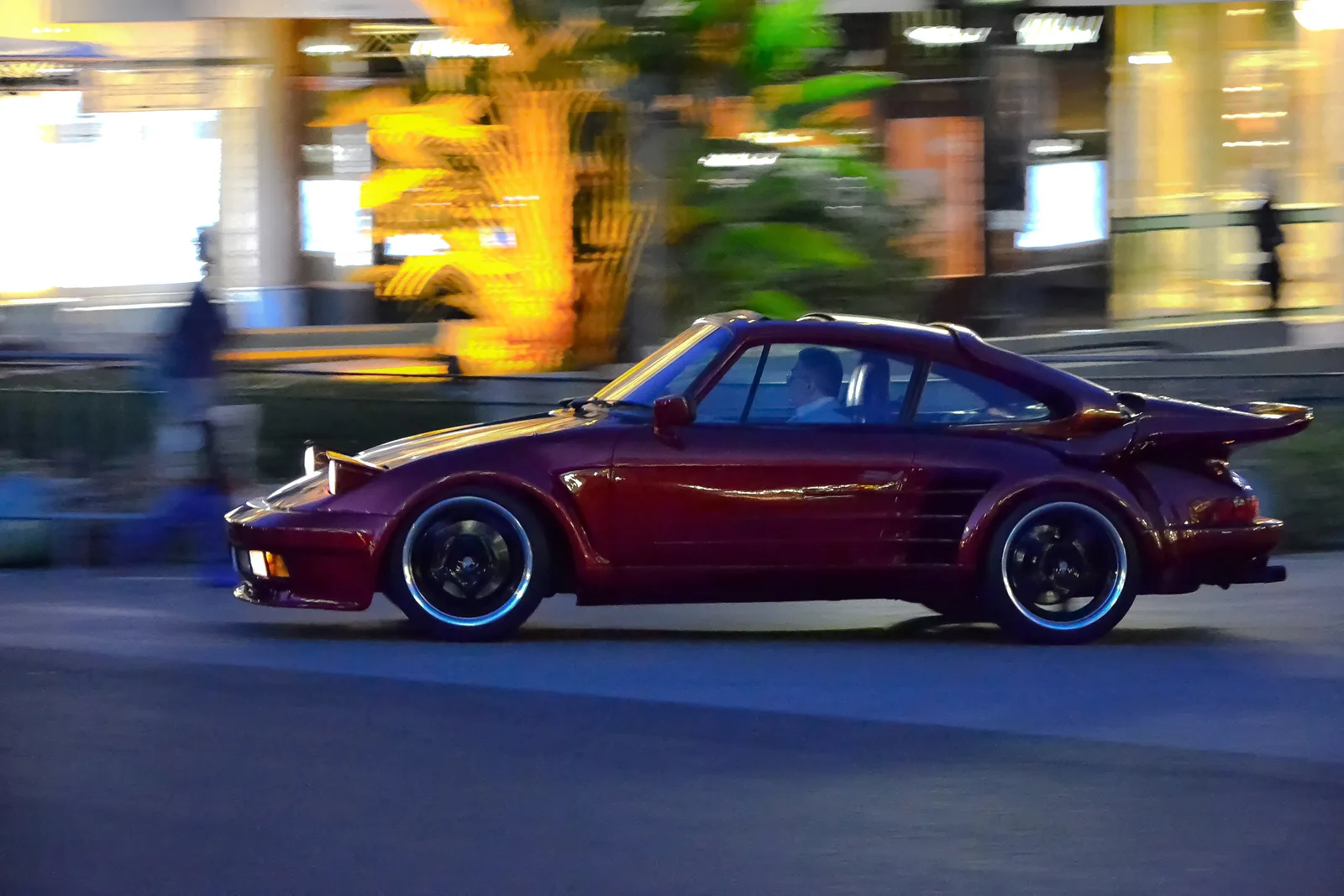
A Gemballa Avalanche based on a Porsche 930.
The rule that survives both outcomes
When the order was signed, nobody could know which of these a car would become. Finance has a framework for this. Avinash Dixit and Robert Pindyck wrote the standard work on it in 1994: anyone taking an irreversible decision under uncertainty gives up money and also the possibility of deciding differently later, and that possibility has value. It is called a real option.
A modification you can undo keeps that option open. Fit lighter wheels and put the originals in the loft. If taste turns against you, they go back on and you have lost the cost of the set. If it turns your way, the new ones stay. Both outcomes are survivable. Whoever saws has put everything on one outcome, and that goes for Nakai's customer as much as for the owner having their arches rolled by a local specialist. The fact that one bet won does not make it a good idea in hindsight. The Avalanche was the same idea.
Undoing is not free. The original wheels have to sit somewhere for twenty years and stay with the car. Labour costs money. And not everything goes back with a spanner: in the Netherlands, anyone making major changes to brakes, steering or drivetrain has to have them tested by the RDW, the vehicle authority, if need be at its Lelystad centre at an hourly rate. Then there is paperwork to reverse as well.
Enjoyment counts too. An exhaust that gives ten years of pleasure is allowed to cost money, as long as nobody mistakes it for an investment. There is one test that costs nothing, before the saw goes in or the exhaust comes off. Would you bid on this car if someone else had done this?
Images: Red RWB 993 by Farrell Small (CC BY 2.0); RUF CTR Yellowbird by TTTNIS (public domain); Porsche 930 Gemballa Avalanche (7159199311) by Alexandre Prévot from Nancy, France (CC BY-SA 2.0). Images resized.


