
$2,624.99. That was the asking price on eBay in June 2026, from a dealer in Missouri, for the bare carbon tub of a 2020 McLaren GT, windscreen and roof glass included. The seller reported damage at the front left and on one rear corner. The Drive, which wrote it up, could not say whether that damage was terminal.
That last point explains the price. This is the part the whole car hangs from. McLaren spent £127.7 million on the original MonoCell of the 12C. A damaged one went for less here than a single new aluminium front subframe for a 675LT ($3,500), because without testing nobody can say what it is still worth.
On an older car with a steel chassis the big risk is usually rust. Rust can be seen, prodded with a screwdriver and judged on a lift in an hour. Carbon fibre takes that risk away and puts another in its place. The question is how large the other one is, and whether the familiar warning is true that a kerb strike can write such a car off.
Damage you cannot see
Steel gives. It dents, it bends and it shows where it was hit. A jig can measure by how much. Carbon fibre is layers of fibre in resin. In an impact those layers can separate inside while the surface stays almost perfect.
Aviation has a name for this: barely visible impact damage, or BVID. Boeing describes it as small damage that a general visual inspection from 1.5 metres will not find, with a dent of 0.25 to 0.51 millimetres. According to a 2012 NASA report, such damage can cut compressive strength by up to 50%. So an aircraft structure has to carry its ultimate load with that damage in place, in case nobody finds it.
That refers to thin aircraft panels, and a car tub is built differently. McLaren does not publish what a 0.3-millimetre dent means for a 12C. The principle carries over all the same: with this material the size of the dent is a poor guide to the size of the damage.
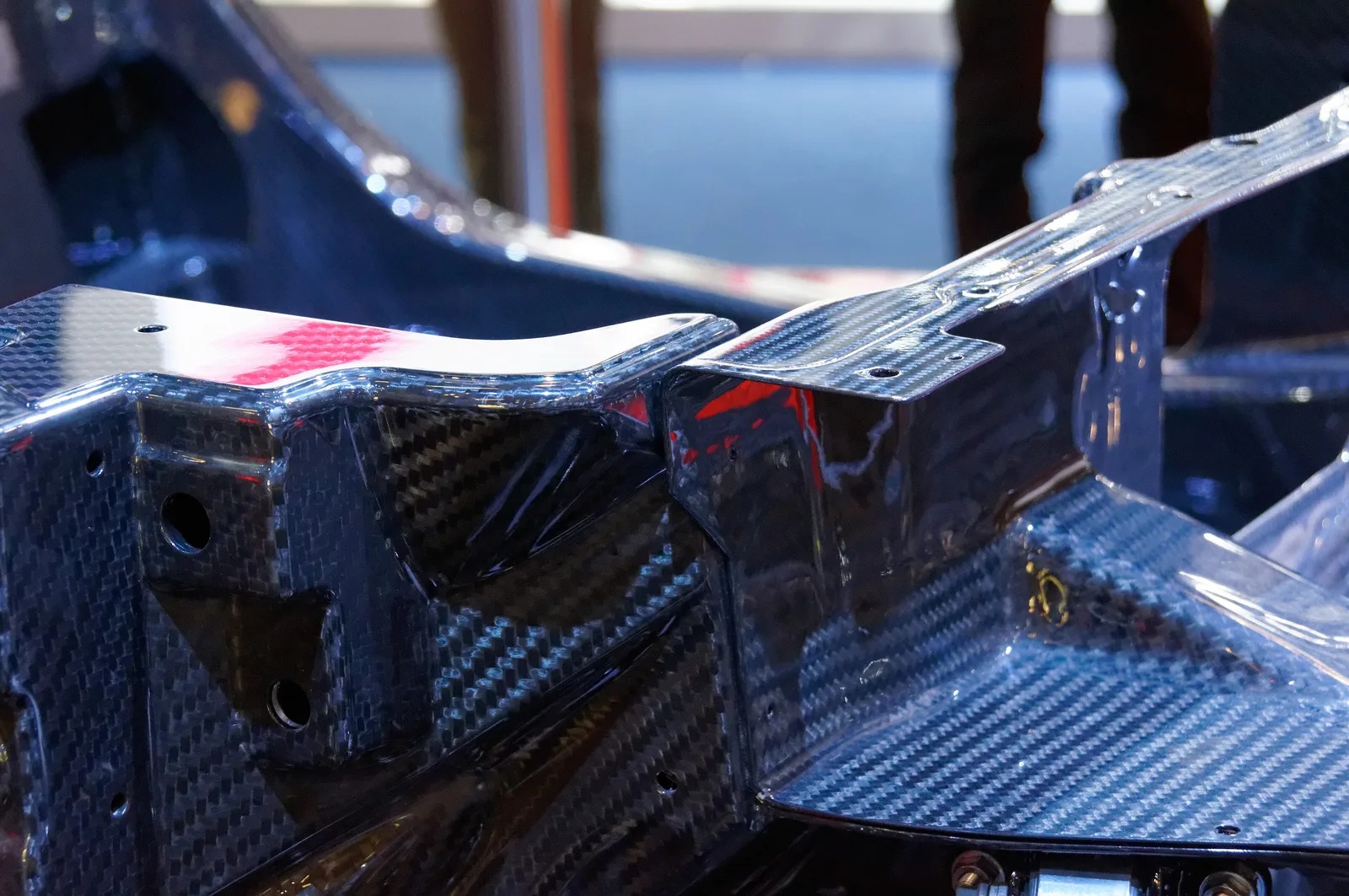
The bare carbon tub of an Alfa Romeo 4C. With this material, damage can sit between the layers.
What a kerb does
This is where the familiar warning needs adjusting. On a McLaren 12C, aluminium structures bolted to the tub front and rear form the crumple zones. Auto123 wrote in 2013 that this makes repair easier and cheaper than on a full carbon underbody. In crash tests, according to the trade magazine CompositesWorld, the tub stayed undamaged even after three hits, with all the damage in the metal around it. A kerb reaches the wheel, the wishbone and the subframe first. Then we are talking about that $3,500 bill.
That is not the bill the warning implies. We found no example of a 12C or 650S written off after a kerb strike alone. For the light knocks that happen often, this construction is if anything an advantage. The risk sits in the medium-sized hit that the aluminium passes on to the tub, and in whether anyone ever checked.
Who gets to say it is fine
Repair exists. CompositesWorld describes how simple damage at McLaren is fixed by trained mechanics, after a visual check and ultrasound where needed. Complicated work goes to the team that designed the tub. Sections that do not govern crash performance can be rebuilt, and if there is any doubt McLaren replaces the whole tub. Lamborghini works in a similar way. It began a repair service with Boeing in 2011 and sends out its own specialists, whom it calls the Flying Doctors. TÜV Italia certified the service in 2014.

The Aventador at the 2011 Geneva Motor Show, the year Lamborghini began its carbon repair work with Boeing.
So this is not a job for an ordinary body shop. The McLaren dealer Sytner says its approved body shop has technicians with structural training who can repair both carbon parts and aluminium subframes. The verdict lies with the maker or with someone the maker recognises. That makes the maker the referee of its own product, and when in doubt it has little reason to say yes.
A yellow 720S showed in 2025 how this looks from outside. The car, at 59,720 miles, went to an American salvage auction with a non-repairable status, which meant it could not be registered in California again. The photographs showed scratches on the splitter, a tear in an inner arch and a paint chip on a door. The auction house also mentioned damage underneath, without photographs. It said nothing about the tub. The writer at Carscoops thought it was an overreaction. Perhaps it was. Perhaps the insurer saw something the pictures do not show. A later buyer cannot judge that from outside.
One inspection
So on a used supercar with a carbon tub, the risk moves from rust to one inspection: ultrasound, by someone who knows where to measure, with a history to compare it against. A roadworthiness test does not do that. In the Netherlands the vehicle authority can flag a damaged car until it has been re-inspected, but only if the damage was reported. A hit at a circuit or a jack in the wrong place that never reached an insurer appears nowhere. We could not establish what such an inspection costs, or who does it outside the dealer network. A buyer needs to ask before bidding.
The biggest uncertainty is time. The 12C was built from February 2011 to April 2014, more than 3,400 of them. The oldest dates from 2011. Specialists know where a thirty-year-old steel Porsche rusts and how fast. What an unnoticed knock from 2014 does to a carbon tub that turns thirty in 2041, nobody knows. McLaren does not either, because that car does not exist yet.
Images: McLaren MP4-12C – Frontansicht (1), 30. August 2012, Düsseldorf by M 93 (CC BY-SA 3.0 de); " 13 - ITALIAN automotive engineering - Alfa Romeo 4C chassis - monocoque carbon fiber - aluminum platform (architecture) DxO 05 by youkeys (CC BY 2.0 it); Aventador 2011-03-04 Autosalon Genf 1226 by Norbert Aepli, Switzerland (CC BY 3.0). Images resized.


