$79.60. That is how much more an American buyer paid, on average, for a used convertible in a week 20 degrees Fahrenheit warmer than normal for that place and that time of year. The average transaction price was $22,222. The difference is 0.36%.
The figure comes from the study that seems, at first sight, to back the old garage advice about buying a soft top in winter. Meghan Busse, Devin Pope, Jaren Pope and Jorge Silva-Risso looked at more than 40 million car sales at about a fifth of all American new-car dealers, from 2001 to 2008. It was published in the Quarterly Journal of Economics in 2015. The numbers here are from the 2012 working paper.
What warm weather does change
The authors were testing for projection bias: the habit of assuming you will want later what you want now. Someone looking at a convertible on a warm day does the sums as if warm days were more common than they are.
They found it. A week 20 degrees Fahrenheit (11 degrees Celsius) warmer than normal lifts the convertible share of sales by 0.22 of a percentage point, from a base of 2.6%. That means 8.5% more convertibles. A clear sky, against full cloud, counts for as much as 16 degrees Fahrenheit. It works in November too, and only fades once it is already warmer than about 27 degrees Celsius.
By the authors' reckoning it would take a price difference of $567 to $1,133 on a $40,000 convertible to move demand that far. So the weather pulls like a decent discount, and the price hardly moves. They offer two possible reasons. A dealer can buy in more cars at a fixed price, so extra demand tends to become extra sales. And the buyer talked round by the weather may have been on the fence, and not keen to pay much.
The study stops there too. It covers American dealers from 2001 to 2008. A private seller of a Mercedes-Benz SL R107 has one car. If an extra bidder turns up at an auction in a warm week, all that bidder can do is push the price, because no second car is waiting. That could be worth more than $80. We have not found a measurement of it.
Nor can a seller plan much around it. An Octane auction usually goes live about a week after details and photos are handed over, then runs for seven days. The weather on the final day is two weeks away.
Season and weather are two different things
Busse and her colleagues took the season out on purpose. They compared a warm week with the same week in other years in the same place. The winter tip is about something else: January against June.
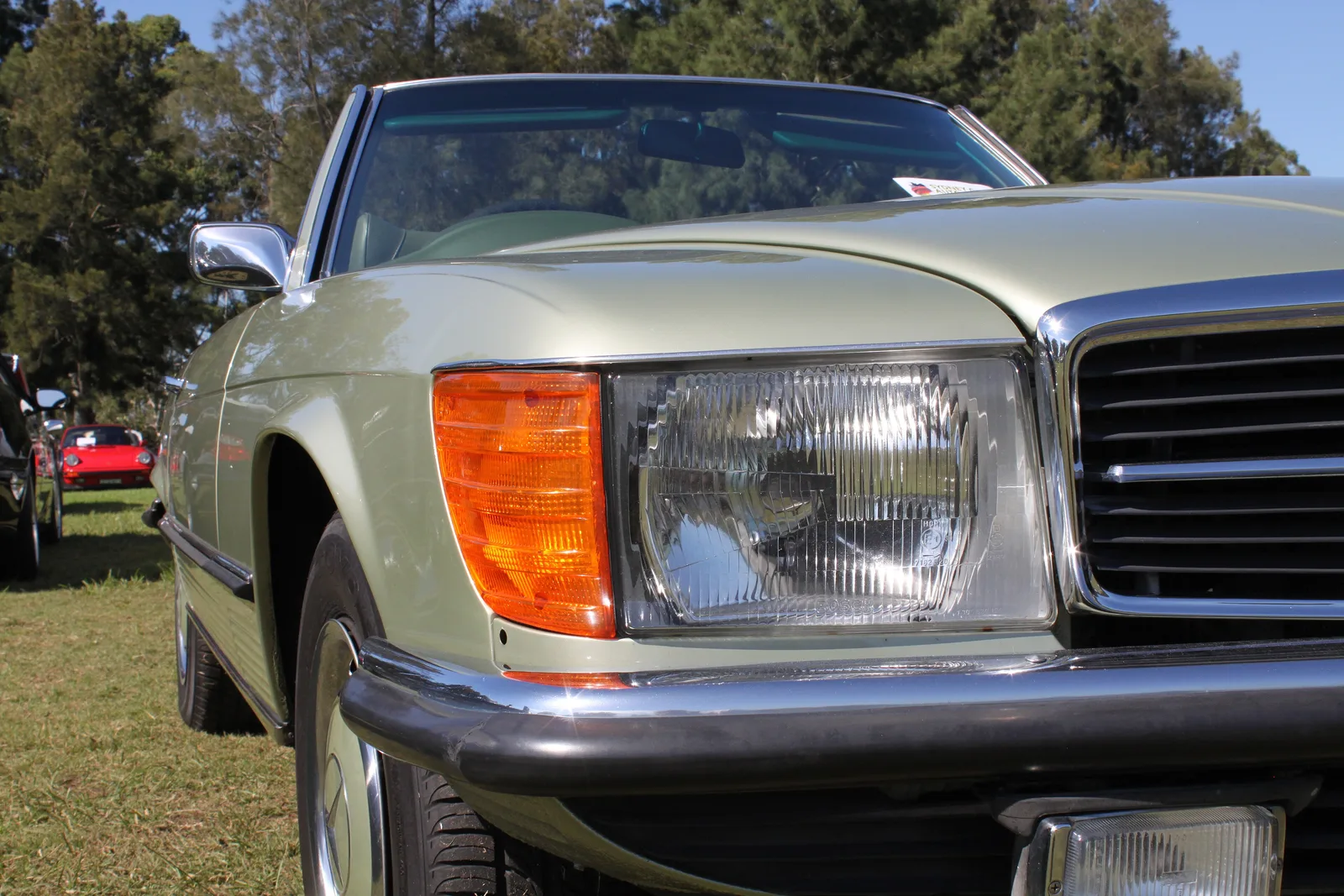
A 1975 Mercedes-Benz 450 SL (R107) at an Australian car day in 2015.
The evidence for that tip is thinner. BCA, the British trade auction group, reported in July 2015 that convertibles fetched an average of £9,828 in June, nearly £1,100 or 12.5% more than in January. That is the average of whatever sold in those months, not the same car measured twice. Germany's Auto Bild called the winter tip "Quatsch" in March 2020 and wrote that seasonal differences are barely measurable, without giving figures. Anything from about zero to 12.5% is still possible.
A seasonal discount would not be a mistake either. In seven of the eight years studied the convertible share peaked in April, and the authors find that sensible. The April buyer drives a whole summer straight away. The November buyer starts with a storage bill.
Run the sum. Say an R107 at €30,000, bought in November instead of April. The figures are assumptions. Five months of dry storage at €100 is €500. The money could have been elsewhere for those five months: at 3% that is €375. Together €875, or 2.9% of the price. On a 997-generation Porsche 911 Cabriolet at €60,000, storage costs the same and the interest €750. That makes €1,250, or 2.1%.
Below those percentages, buying in winter costs more than waiting. The weather contributes little: 0.36% on the R107 is €108, about one month of storage. The rest has to come from the season. If BCA's 12.5% holds for the same car, the winter purchase pays well, €3,750 against €875. If Auto Bild is right, the winter buyer ends up out of pocket. Anyone who wants to know should compare transaction prices for their own model in January and June. Asking prices say little about this.
Why the rain has a point after all
The study has one more finding, and it is about the buyer. The authors tracked vehicle identification numbers. A convertible bought in an abnormally warm week was more likely to reappear within two years as a trade-in or a resale: 0.34 of a point more likely per 20 degrees Fahrenheit, on a base of 7.3%. Only the two-year result is statistically significant, and the data cover just a fifth of dealers. The authors themselves call it suggestive.
Even so, this is the number a buyer can use. On price, a warm day costs perhaps €108. A car sold again after two years costs far more. The buyer pays transaction costs twice and two years of storage and insurance, and sells at a moment they did not choose.
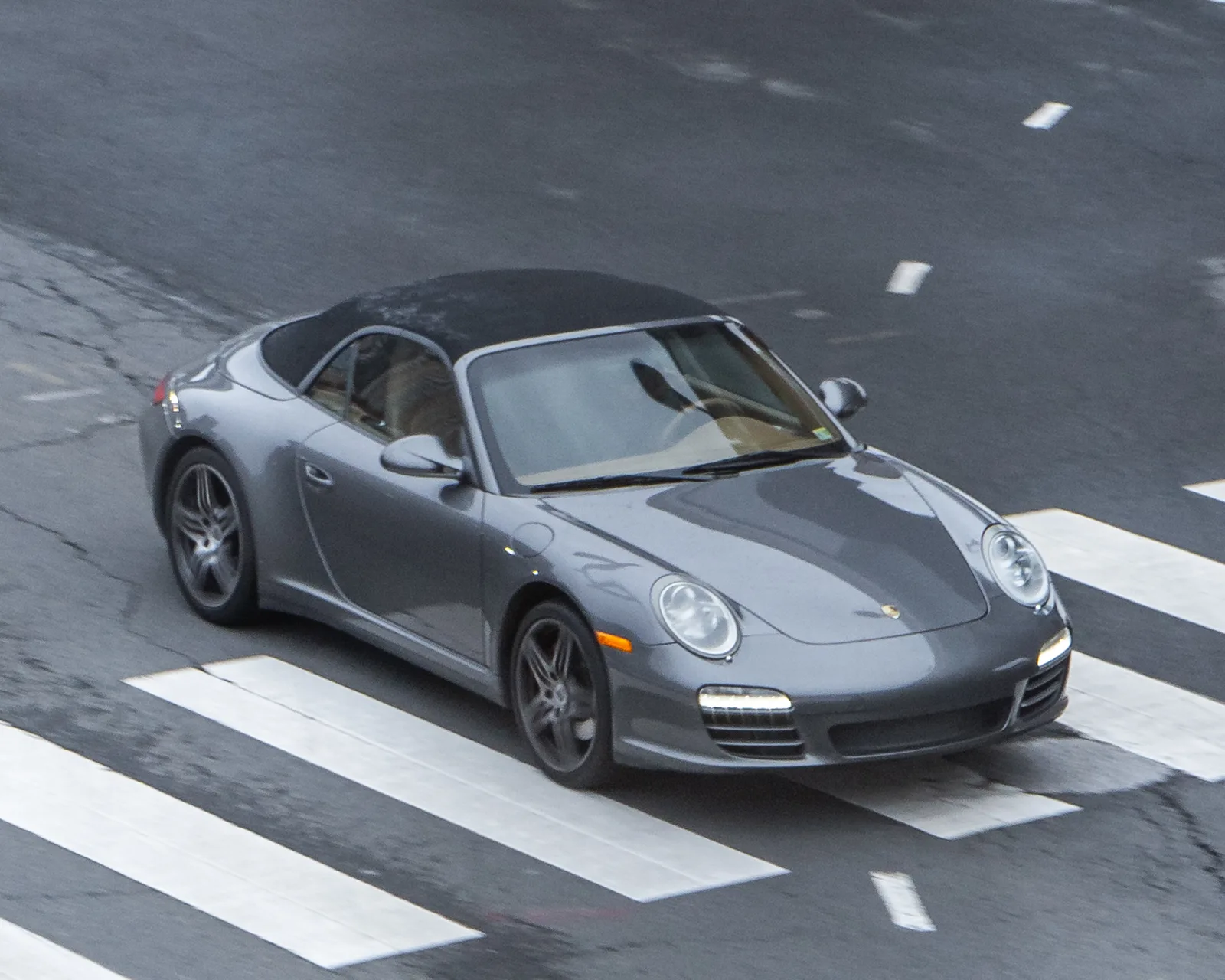
A Porsche 911 Cabriolet (997) in Washington DC, hood up on a grey day.
So the tip holds, for a different reason from the one you hear in the garage. Buy a convertible when it rains, because then you find out whether you want it without the sun's help. Nine degrees, hood up, misted windows, wind along the seams. Whatever is left of the plan by then did not come from the weather.
Rain also shows something the sun hides. On the Porsche Club of Great Britain forum, owners of 997s and Boxsters describe water under the mat in the footwell, with possible causes ranging from blocked drains and window seals to door membranes and, on a Boxster, a folded roof seal. At a viewing on a dry day in June, the most you might notice is a musty smell. On a wet day in February you lift the mat.
Images: Photo by Mikalai on Pexels; 1975 Mercedes-Benz 450 SL (R 107) roadster (16701779802) by Jeremy from Sydney, Australia (CC BY 2.0); Porsche 911 Carrera Cabriolet (997) Washington DC Metro Area, USA by OWS Photography (CC BY 4.0). Images resized.

