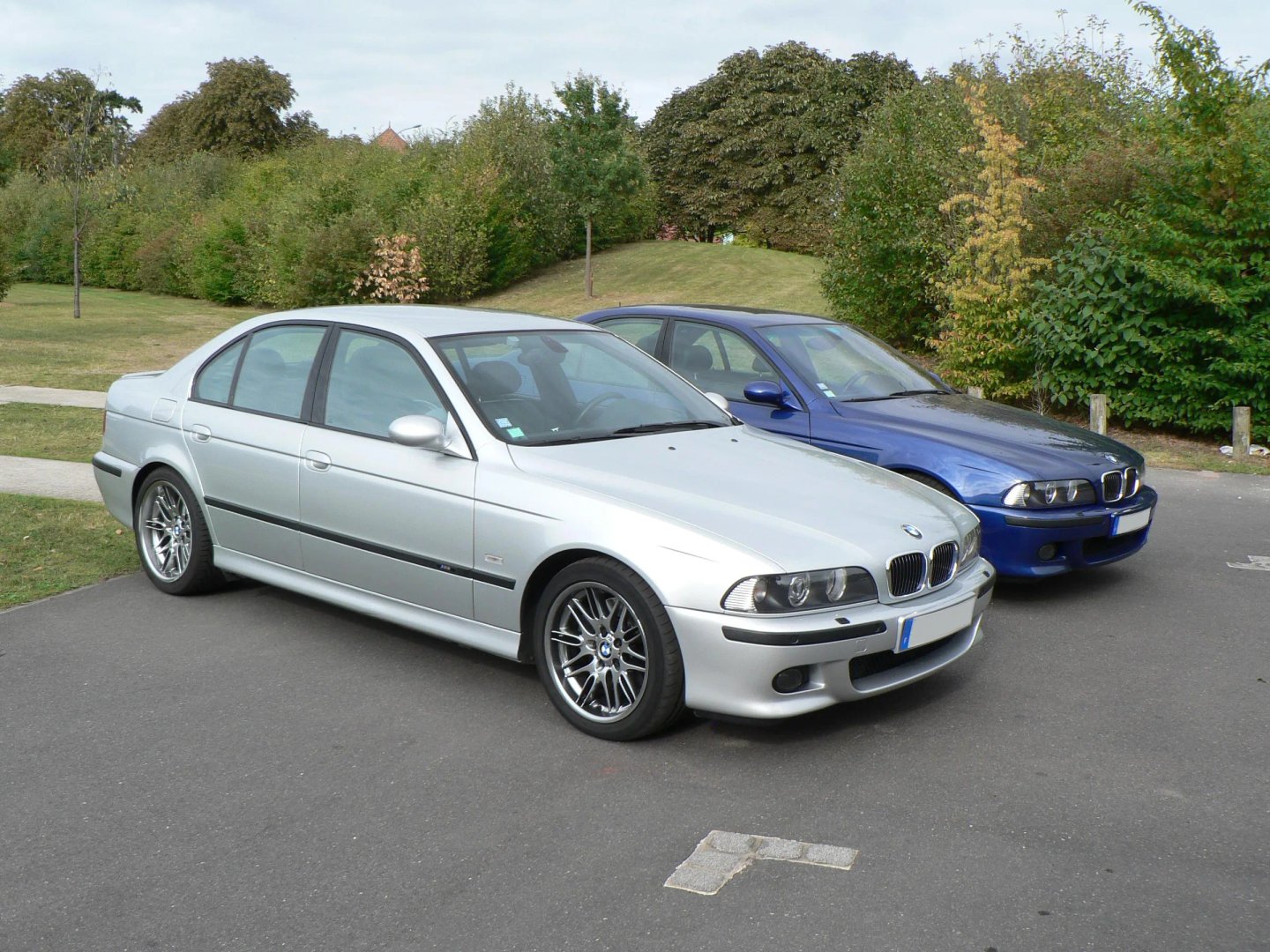
What a car costs goes down. What it costs to keep does not go down with it. A BMW E39 M5 listed at $69,400 in America in 2000. One of the known repairs on that car, taking the cylinder heads off to drill out the blocked passages of the secondary air injection, cost more than $2,000 according to a buyer guide from July 2014. Against the new price that is 3%. Against a $6,000 M5, which in 2014 was the price of a bad one, it is a third of the car.
That ratio decides who gets the car. A new E39 M5 went to someone who could spare $70,000. At the bottom of the curve almost anyone can buy one. The seller asks whether you have the purchase price, and nobody asks about the next bill.
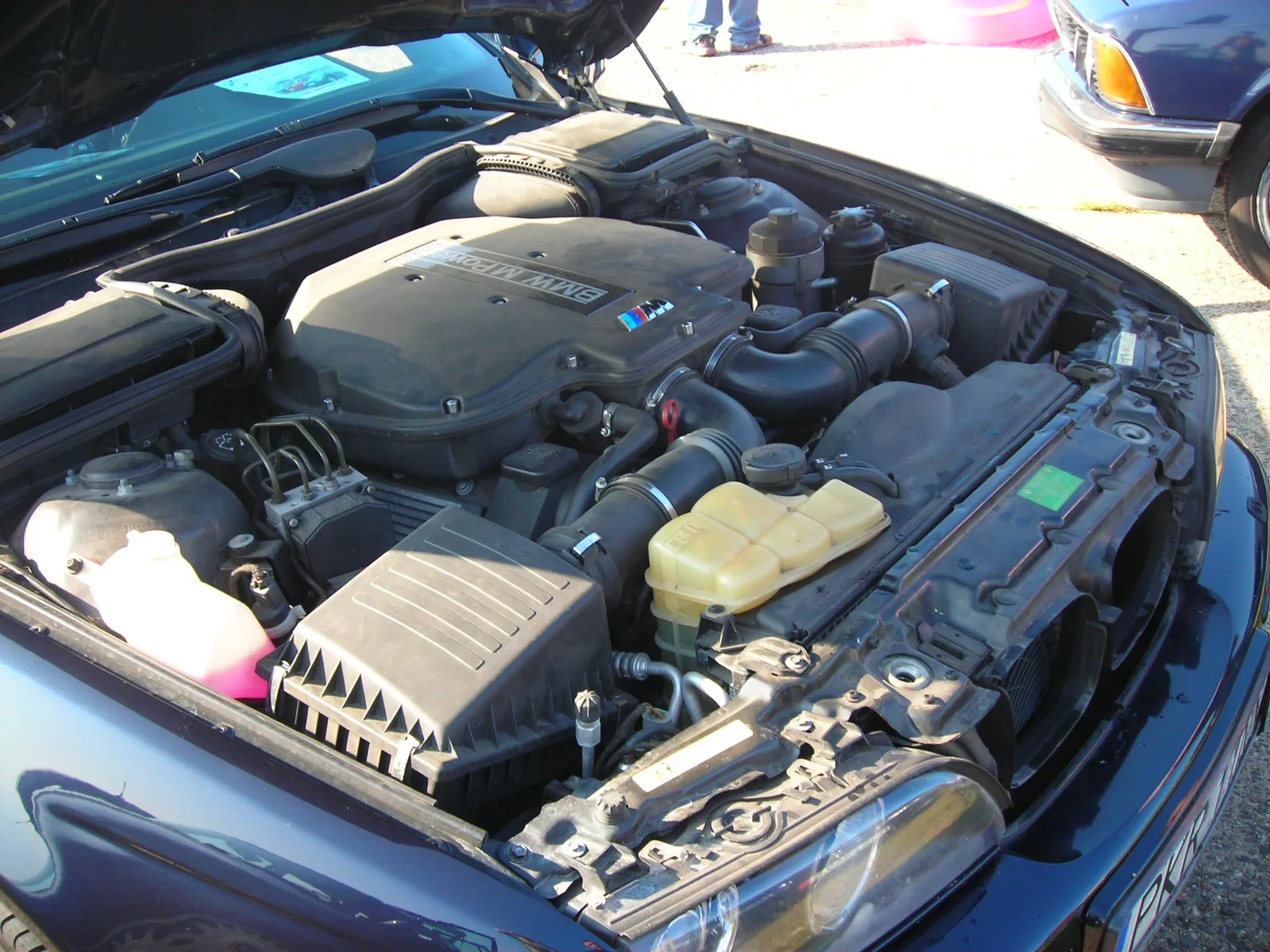
The S62 V8 of an E39 M5. A bill for this engine is the same size whatever the car is worth.
Say upkeep runs at €3,000 a year, which is an assumption. On a €30,000 car that is 10% of the value, and on a €7,000 car it is over 40%. The first owner pays without thinking about it. The second puts things off. What those postponed jobs add up to as a debt is a separate story. The point here is what they do to the next buyer: the car has become cheaper and worse, so it goes to someone with even less room. That repeats until somebody takes the car out of the sequence, or until it stops moving.
One model, four markets
The chart on which investors point to the bottom has one line per model. By 2014 the market had more than one. Jalopnik split the E39 M5 into four classes that year. From $4,500 to $9,000 were cars a flat tyre away from being written off, some with accident damage or salvage papers. From $9,000 to $15,500 sat most of the market, with what the writer called a larger number of owners and a questionable history. Above that, up to $25,500, the good cars. And from there to $30,000 and beyond, the few to which almost nothing had happened.
Seven years later a dealer in Ohio sold a 2003 car with 3,157 miles and no modifications for $199,990. Hagerty's guide put a top-condition car at $108,000 at the time. Sales since 2020 run from £2,590 to £134,539, with a median of £26,496.
Look at the bottom of that range. In 2014 the market started at $4,500, then about £2,650. Twelve years later, after everything that happened at the top, it still starts at around that figure. So the bottom was not a moment the whole model passed through. It was the average of two groups moving apart, and one of those groups never climbed out.
That is the flaw in the advice to buy at the bottom. On the chart it holds. Anyone who paid $30,000 for one of the best E39s in 2014 owned, by 2021, a car Hagerty put at $108,000, provided the condition held. But that buyer did not buy cheaply. They paid two to three times what most M5s cost then, and five times the floor. Whoever paid $6,000 bought the price of the bottom, and with it the owners the bottom had attracted.
The car that was never down there
The Mercedes SL R129 shows the same pattern more slowly. The price curve was still falling until 2014 according to the German valuers Classic Data, Auto Bild reported in June 2019. After that the car rose by more than 30%, good ones passed €20,000 and collector-condition cars rose faster than the middle. Marius Brune of Classic Data did not expect the climb to speed up, because there are too many SLs. That is probably right for the ordinary SL. There are fewer of the good ones.
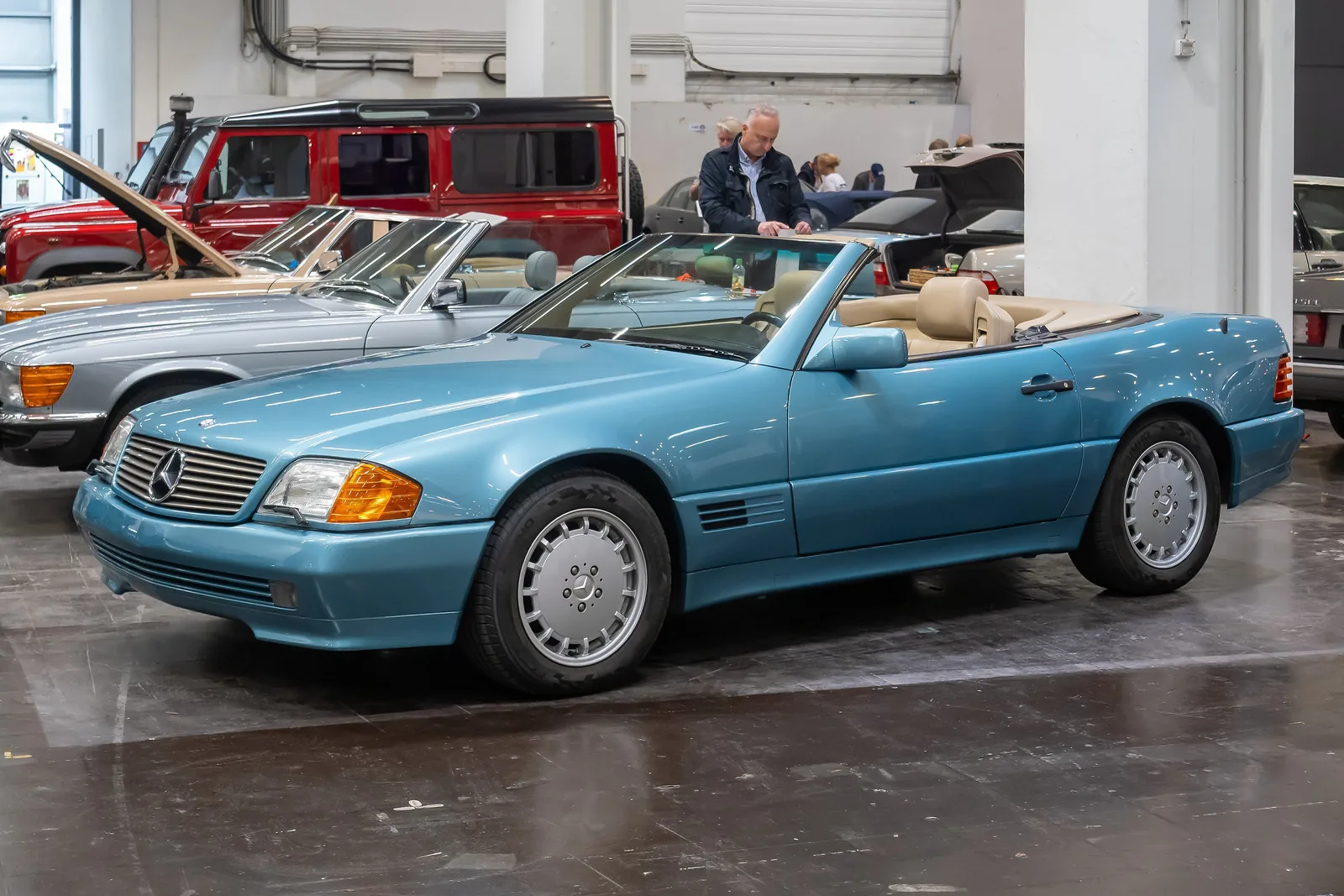
A 500 SL at Techno-Classica in Essen, 2025. Not the car in the story, but the same type and the same engine.
On Motor1, Maddox Kay describes buying a 1997 SL500 for about $8,000, which he says is also what a great Mazda Miata costs. It had 82,000 miles, original paint and a dry underside. What set it apart was its past. A friend of the seller bought the car in 2002 and kept it until his death in 2024, with regular dealer visits until 2020. The seller and his wife took it on from the estate, and she found the low seat awkward. With new tyres, a bonnet pad and rebuilt roof cylinders (the rebuild alone about $1,200 before fitting), Kay ended up nearer $13,000.
That car never saw the bottom from the inside. It spent twenty-two years with one owner and then reached someone who did not want to keep it. Kay had been through hundreds of listings before he found it and knew it would not last. So buying at the bottom can work. It works on cars with the price of the bottom and the history from before it, and few of those come along.
What is standing still in the Netherlands
The Dutch register shows something of what happens to the rest. On 3 November 2026 there are 209 E39 M5s on Dutch plates, not counting those flagged for export. Of those, 108 have a valid APK, the Dutch roadworthiness test. On 101 it has lapsed, on 59 more than three years ago. That makes 52% valid. For the ordinary BMW 5 Series of the same years it is 70%, for the R129 SL 69% and for the Porsche 911 of those years 81%.
A lapsed test is not a dead car. Some sit dry in a collection. The gap with the ordinary 5 Series can be explained, though. A 520i with an expensive fault goes to the breaker and drops out of the count. An M5 with the same bill is worth too much to scrap and costs too much to fix, so it stays registered, with a test date from 2015 or 2019.
The shortage of good E39s was made in the years when they cost little and nobody was looking, by owners who did nothing wrong except buy a car they could only just afford. That has a consequence for anyone looking at the next one. Of the E60 M5, built from 2005 to 2010, 265 are on Dutch plates and 155 have a valid test. The good examples of twenty years from now are being made today, by someone spending money on a car whose price does not yet pay it back. If the market ever pays for that difference, the money goes to whoever is selling at the time. That need not be the owner who settled the bills.
Images: BMW M5 E39 twins by Neef - 2 (CC BY-SA 3.0); M5 engine pl by Beemwej (CC BY-SA 3.0); Mercedes-Benz 500 SL, Techno-Classica 2025, Essen (P1045878) by Matti Blume (CC BY-SA 4.0). Images resized.


