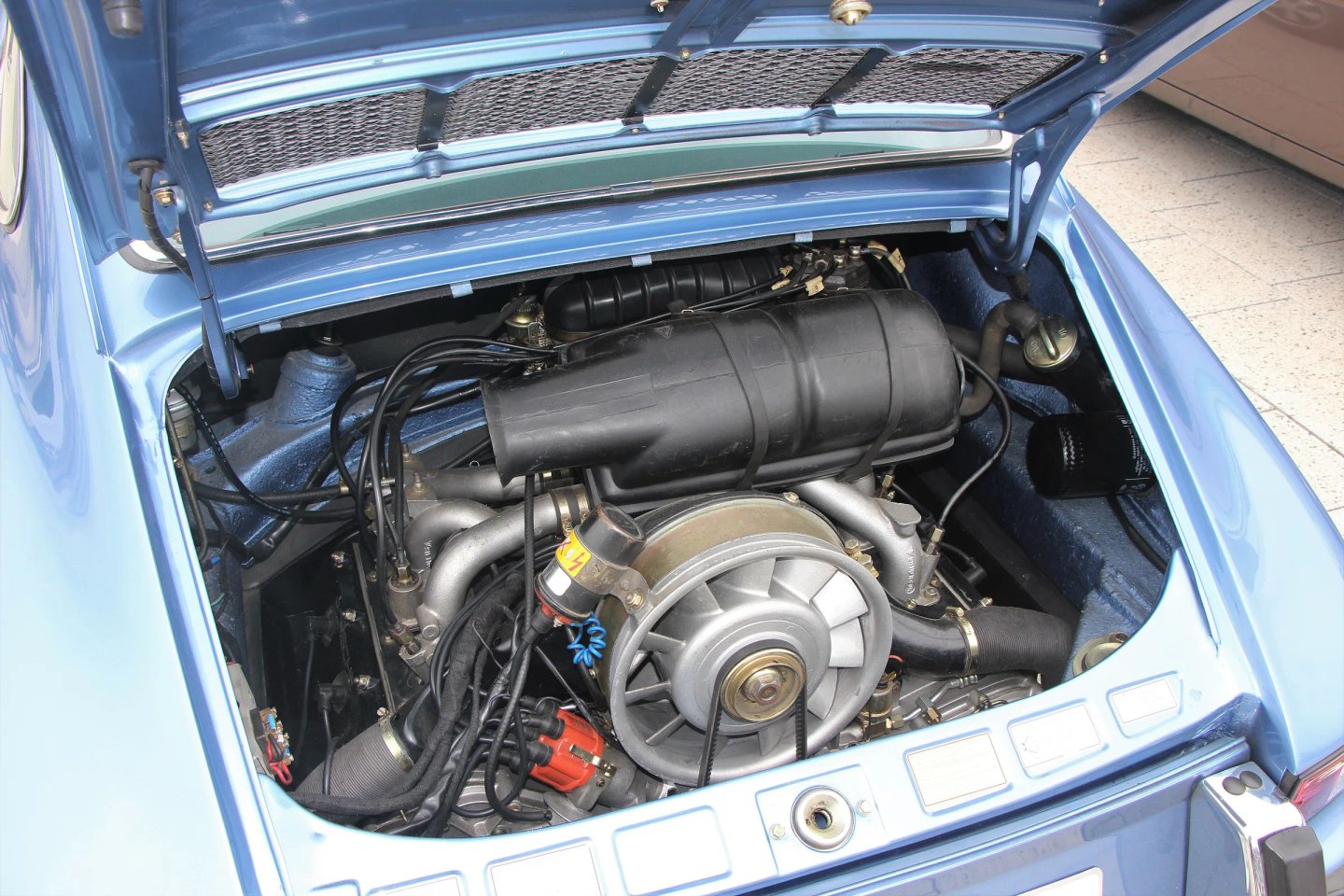
Nobody drawing a sports car from scratch puts its heaviest part behind the rear axle. Porsche knew that in 1948. The first car to carry the name, the 356 Nr. 1 Roadster, had its Volkswagen-derived four-cylinder ahead of the rear axle. The production cars had it behind, like the Beetle. The usual account is that this cut costs and made room for two more seats. When the 911 arrived in 1963 with an entirely new six-cylinder, the engine stayed where it was.
Paul David described this kind of history in 1985 in a famous short paper on the typewriter keyboard, Clio and the Economics of QWERTY. A design chosen for an accidental reason can survive long after the reason has gone. Economists call it path dependence. David named three causes. The parts of a system are fitted to one another. What is widely used gets cheaper as a result. Switching grows more expensive with time. With QWERTY it was typists and typewriters. With the 911 it was mechanics, racing knowledge and customers.
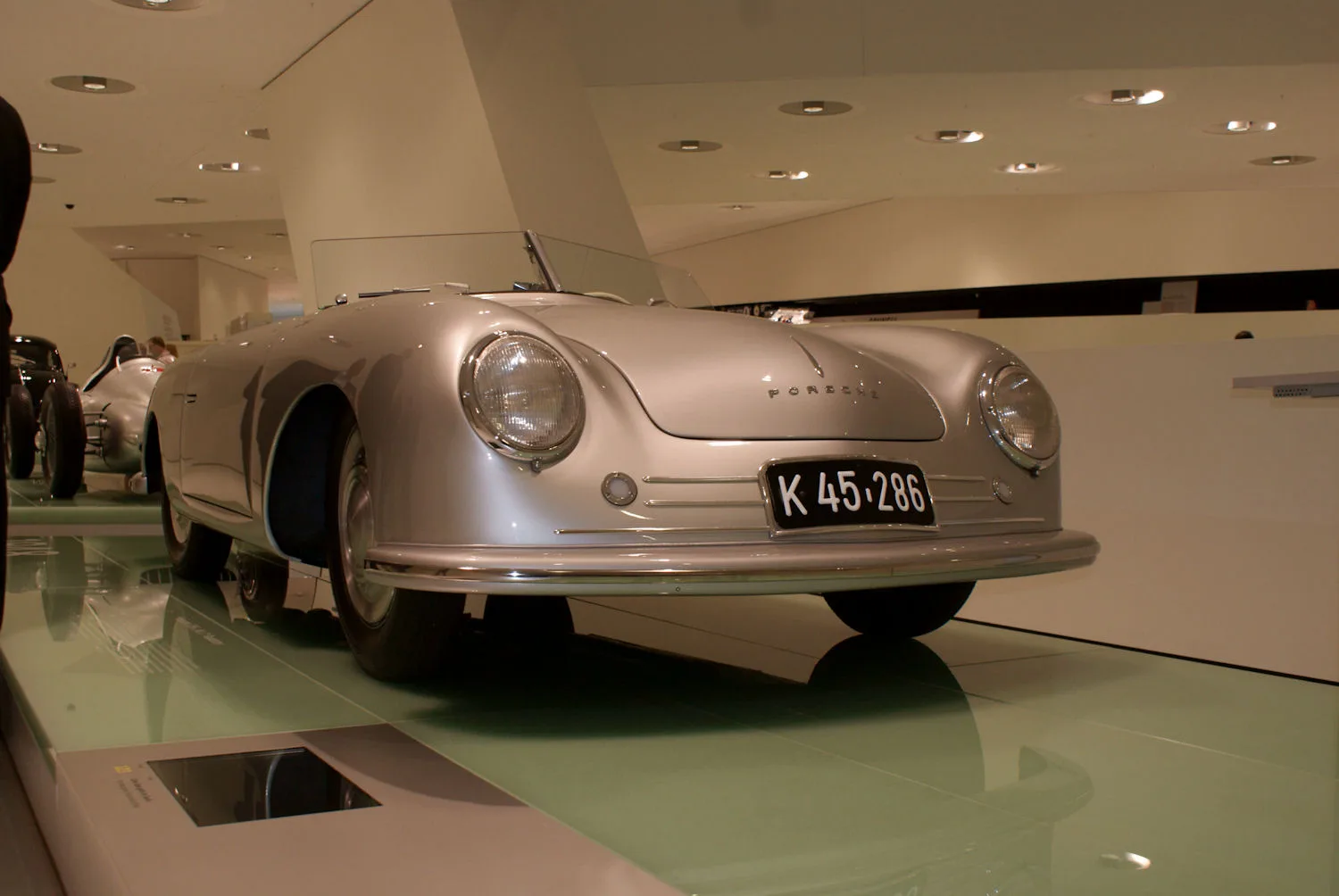
The 1948 356 Nr. 1 Roadster in the Porsche Museum. On this car the engine still sits ahead of the rear axle.
What the location cost
The bill came quickly. A car with its weight at the back lets go more readily. Early 911s found to handle badly are said to have received two 11 kg cast-iron blocks in the front bumper, officially a "bumper reinforcement". For the 1969 model year the wheelbase grew by 57 mm through moving the rear wheels back. Wider tyres came too. The 991 of 2011 added another 100 mm.
Those are answers to a problem another engine position does not have. Each generation got its own corrections, and after each one there was more that a new car would have to do over. That is David's third cause at work: what holds you is less the first choice than what you put into it afterwards.
The moment Porsche could have left
By the late 1970s the management wanted out. Under Ernst Fuhrmann, development of the 911 was wound down in favour of the 928, with a V8 at the front and the gearbox at the back. The Porsche magazine Excellence calls that a minority view. Fuhrmann was removed in 1980, and Peter Schutz started on 1 January 1981, after what Porsche histories record as the first year of losses.
The familiar story has Schutz in the office of engineering chief Helmuth Bott, looking at a chart with lines for the 924, the 928 and the 911. The 911's line stopped at the end of 1981. Schutz took a marker and ran the line off the edge of the chart and across the wall. Then he told Bott to make it happen. It comes mostly from Schutz himself and others call it folklore. Whether the 928 was ever really meant to replace the 911 is still argued over. The outcome is not in doubt. The 3.2 Carrera came in 1984 and the 928 became a side branch of 61,056 cars in eighteen years. The 911 reached its millionth in May 2017. Porsche sold 28,000 cars worldwide in 1980-81 and 53,000 in 1986. Not all of that was the marker: the growth was mostly in the United States, and by 1987 production had dropped back to 48,520.
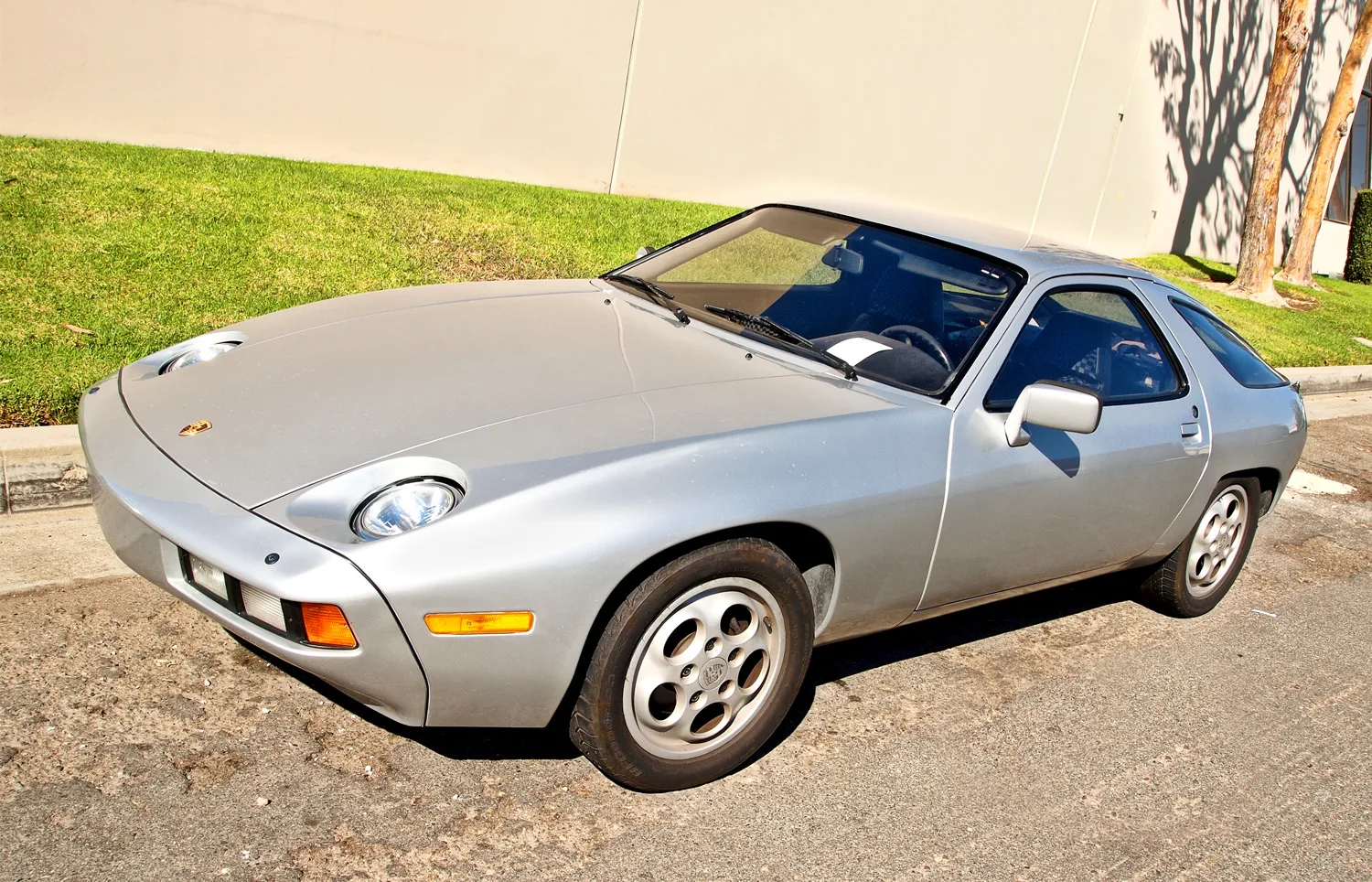
A US-specification 1978 Porsche 928. The V8 is at the front and the gearbox at the back.
David's causes explain this better than the marker. The knowledge was at Weissach: in 1979, while the 911's line was running out on that chart, a 935 based on the 911 Turbo won Le Mans outright. The factory and the specialists were built around the flat-six, and the customers came back for it. The 928 still had to build all that, with its own buyers who did not exist yet. Fixing a fault you already knew was cheaper than walking away from it.
Is it even a fault?
This is the weak spot, for QWERTY and for the 911. Stan Liebowitz and Stephen Margolis argued in 1990, in The Fable of the Keys, that the evidence for a better keyboard rested largely on a 1944 Navy study run by August Dvorak himself. A later government study found no advantage. If QWERTY is no worse, the most famous case of path dependence has nothing in it to regret. The 911 has a similar defence: weight over the driven wheels also gives grip when pulling away.
Porsche ran something like the same test in 2017. The 911 RSR for Le Mans had its engine moved ahead of the rear axle. The change in weight distribution, according to Porsche's motorsport chief, was 2 to 3%. The gain lay mainly in room for a far larger diffuser, and the engineers declined to call it mid-engined. After 54 years of adjustment the weight problem had grown small, at least on a racing car on racing tyres. On the road the engine stayed where it was.
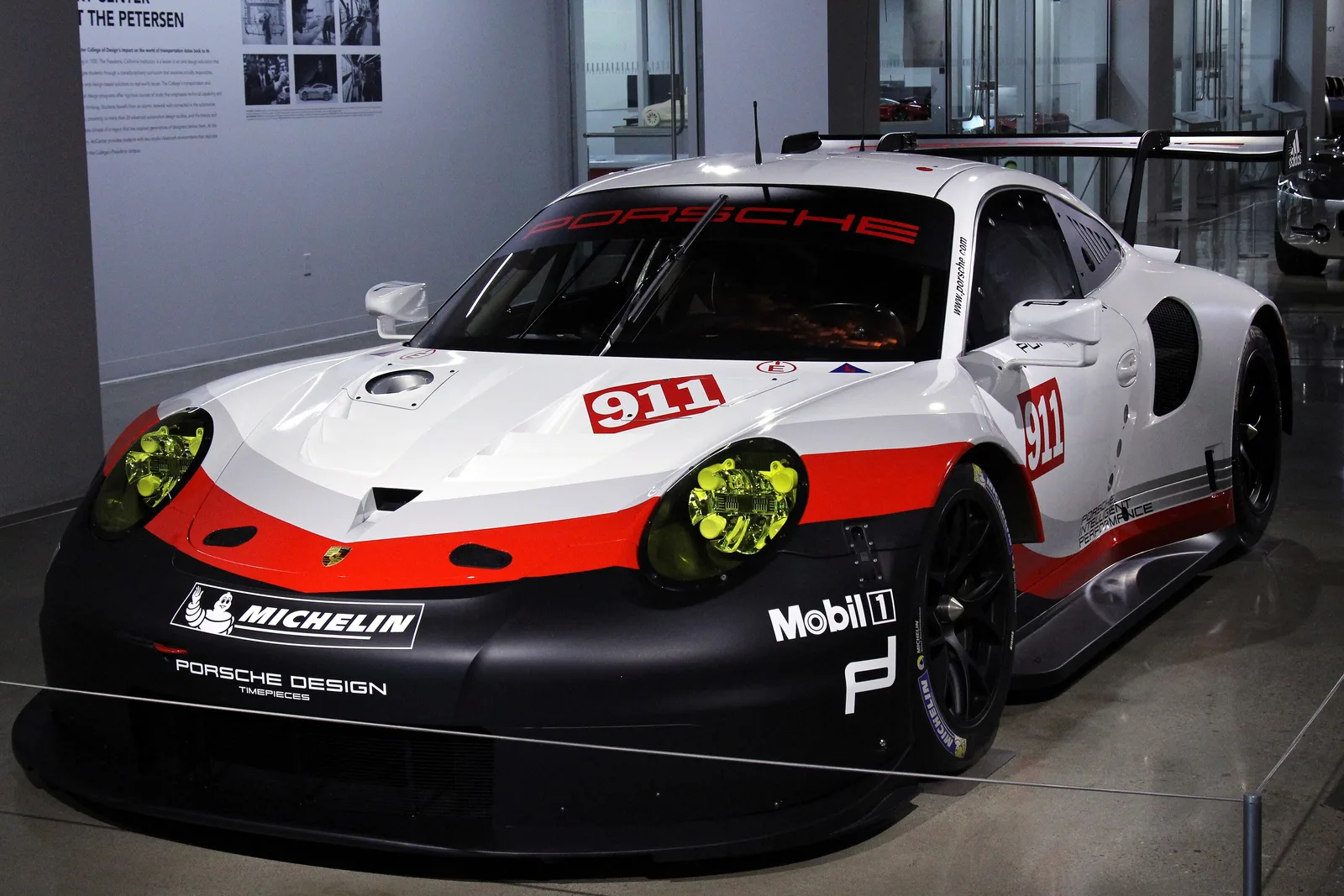
The 2017 911 RSR in the Petersen Automotive Museum, the 911 with its engine ahead of the rear axle.
Porsche was still working around that spot in 2024. The 911 Carrera GTS T-Hybrid received a 1.9 kWh battery, which Porsche put under the front bonnet, by its own account for the sake of weight distribution. In the 1960s it was cast iron, now it is lithium, at the front and for the same reason.
The consequence is on the price list. Porsche has long known the right place: in the 718 Cayman the engine sat ahead of the rear axle. In Belgium, a market without Dutch BPM tax on top, that car cost from €67,312 in 2024 and a 911 Carrera from €135,660. The 911 is larger and more powerful, so engine position does not explain the whole gap. But the spot that took sixty years of adjustment does not hold the price down either. The fault has become the specification. Fixing it would not improve the 911. It would turn it into a car Porsche has already built, for half the money.
Images: 2022 Porsche-911-1971 engine RetroClassics by Wikisympathisant (CC BY-SA 4.0); Porsche 356 Nr.1 1948 Roadster RSideFront PorscheM 9June2013 (14825988138) by Valder137 (CC BY 2.0); 1978 Silver Porsche 928 by Decampos (CC BY-SA 4.0); 2017 Porsche 911-RSR (30851252443) by Prayitno / Thank you for (12 millions +) view from Los Angeles, USA (CC BY 2.0). Images resized.


